


Adjustment to a "New Normal:" Coping Flexibility and Mental Health Issues During the COVID-19 Pandemic
- PMID: 33815166
- PMCID: PMC8017149
- DOI: 10.3389/fpsyt.2021.626197
Adjustment to a "New Normal:" Coping Flexibility and Mental Health Issues During the COVID-19 Pandemic
Abstract
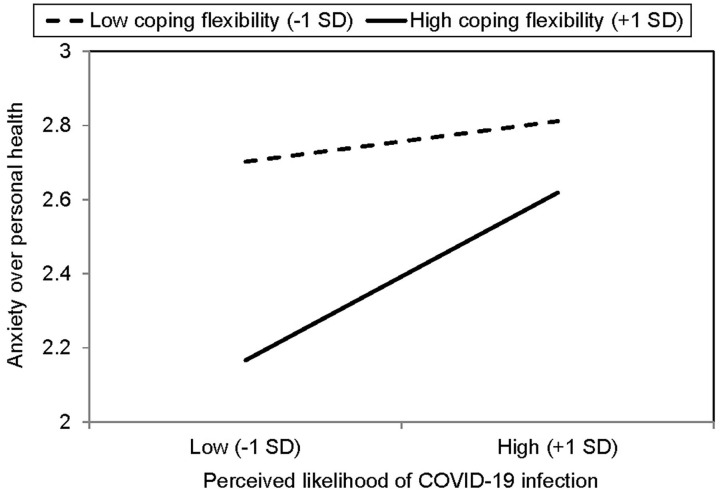
The Coronavirus Disease 2019 (COVID-19) pandemic is an unprecedented health crisis in terms of the scope of its impact on well-being. The sudden need to navigate this "new normal" has compromised the mental health of many people. Coping flexibility, defined as the astute deployment of coping strategies to meet specific situational demands, is proposed as an adaptive quality during this period of upheaval. The present study investigated the associations between coping flexibility and two common mental health problems: COVID-19 anxiety and depression. The respondents were 481 Hong Kong adults (41% men; mean age = 45.09) who took part in a population-based telephone survey conducted from April to May 2020. Self-report data were assessed with the Coping Flexibility Interview Schedule, COVID-19-Related Perception and Anxiety Scale, and Center for Epidemiological Studies Depression Scale. Slightly more than half (52%) of the sample met the criteria for probable depression. Four types of COVID-19 anxiety were identified: anxiety over personal health, others' reactions, societal health, and economic problems. The results consistently revealed coping flexibility to be inversely associated with depression and all four types of COVID-19 anxiety. More importantly, there was a significant interaction between perceived likelihood of COVID-19 infection and coping flexibility on COVID-19 anxiety over personal health. These findings shed light on the beneficial role of coping flexibility in adjusting to the "new normal" amid the COVID-19 pandemic.
Keywords: Chinese; adaptation; coping; coronavirus disease; epidemic; psychological well-being; resilience; stress.
Copyright © 2021 Cheng, Wang and Ebrahimi.
Conflict of interest statement
The authors declare that the research was conducted in the absence of any commercial or financial relationships that could be construed as a potential conflict of interest.
Figures
References
-
- World Health Organization . Timeline: WHO's COVID-19 Response. (2020). Available online at: https://www.who.int/emergencies/diseases/novel-coronavirus-2019/interact... (accessed October 8, 2020).
-
- Baker SR, Bloom N, Davis SJ, Kost K, Sammon M, Viratyosin T. The unprecedented stock market reaction to COVID-19. Rev Asset Pricing Studies. (2020) raaa008. 10.3386/w26945 - DOI
LinkOut - more resources
Full Text Sources
Other Literature Sources
Miscellaneous
