


Case Reports
doi: 10.1016/j.radcr.2021.03.032.
Epub 2021 Mar 27.
Bilateral adrenal hemorrhage in a man with severe COVID-19 pneumonia
Affiliations
- PMID: 33815638
- PMCID: PMC7998055
- DOI: 10.1016/j.radcr.2021.03.032
Item in Clipboard
Case Reports
Bilateral adrenal hemorrhage in a man with severe COVID-19 pneumonia
Radiol Case Rep.
2021 Jun.
Abstract
This case report demonstrates bilateral adrenal hemorrhage in a fifty-year old man with severe COVID-19 pneumonia. We discuss how adrenal hemorrhage can be one of the possible complications of COVID-19. The case also shows how adrenal hemorrhage can be diagnosed incidentally in a scan performed for a different reason given the difficulty of clinical diagnosis and the non-specific clinical presentation.
Keywords: Adrenal hemorrhage; COVID-19; Cardiopulmonary; Diagnostic radiology; Genitourinary.
© 2021 The Authors.
Figures

Axial CT scan image demonstrating multifocal areas of peripheral ground glass consolidation in keeping with classic/probable COVID-19 infection.
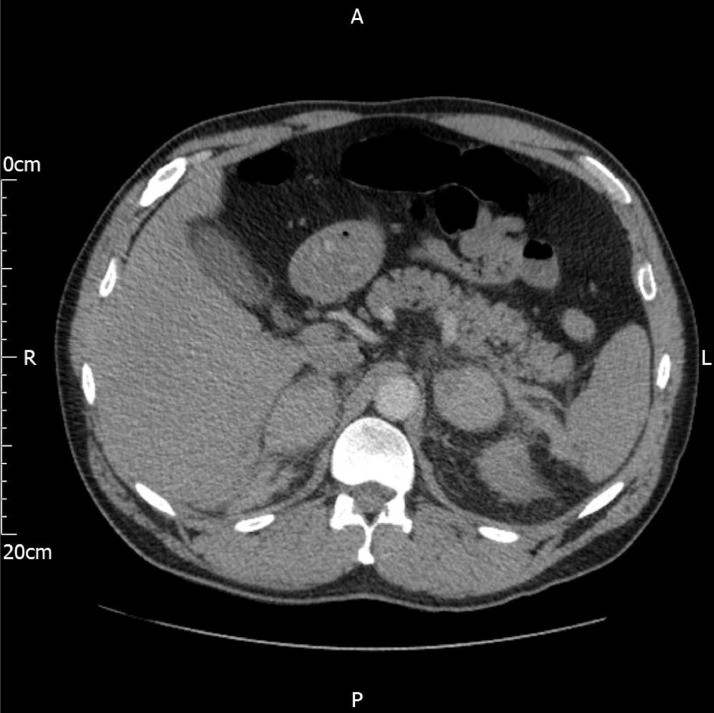
Axial CT image from CT Pulmonary Angiogram (CTPA). Hyperdense ovoid suprarenal lesions incidentally detected on the last slice of the CTPA stack with surrounding high attenuating collections and fat stranding. These features suggested the bilateral adrenal hematomas and subsequent abdominal imaging was recommended.

Multiphase coronal CT images from a CT Abdomen and Pelvis study. The scan phases include A) Non-contrast, B) Arterial phase, and C) Portal-Venous phase. Bilateral hyperdense ovoid suprarenal lesions with loss of the normal adrenal gland contour (small white arrow). Small left perirenal collection and fat stranding suggest associated retroperitoneal hemorrhage (thick white arrow). No enhancement of the lesions following contrast administration and no contrast extravasation on delayed phase images to suggest active bleeding. These features are classic of adrenal hematomas. Of note, contrast is also seen within the pelvicalyceal systems which is from the previous CTPA scan.
References
-
- Gorbalenya Alexander E., Baker Susan C., Baric Ralph S., de Groot Raoul J, Drosten Christian, Anastasia A. The species severe acute respiratory syndrome-related coronavirus: classifying 2019-nCoV and naming it SARS-CoV-2. Nat Microbiol. 2020;5:536–544. doi: 10.1038/s41564-020-0695-z. - DOI - PMC - PubMed
-
- Karki B.R., Sedhai Y.R., Bokhari S.R.A. Waterhouse-Friderichsen syndrome. - PubMed
-
- Adem P.V., Montgomery C.P., Husain A.N., Koogler T.K., Arangelovich V., Humilier M. Staphylococcus aureus sepsis and the Waterhouse-Friderichsen syndrome in children. N Engl J Med. 2005;353(12):1245–1251. - PubMed
Publication types
LinkOut - more resources
Full Text Sources
Other Literature Sources
