


A Simple Physical Therapy Algorithm Is Successful in Decreasing Skilled Nursing Facility Length of Stay and Increasing Cost Savings After Hip Fracture With No Increase in Adverse Events
- PMID: 33815865
- PMCID: PMC7995299
- DOI: 10.1177/2151459321998615
A Simple Physical Therapy Algorithm Is Successful in Decreasing Skilled Nursing Facility Length of Stay and Increasing Cost Savings After Hip Fracture With No Increase in Adverse Events
Abstract
Introduction: Shorter length of stays (LOS) at a Skilled Nursing Facility (SNF) after hip fracture surgery would be expected to lead to costs savings for the healthcare system. Evidence also suggests that shorter SNF stays also leads to improved 30-day outcomes, thus compounding this value proposition. Our Integrated Fragility Hip Fracture Program created a simple algorithm at discharge to provide each post-operative hip fracture patient with an expected SNF LOS. We studied whether this intervention produced a shorter SNF LOS and other observable short-term outcomes.
Methods: We retrospectively reviewed all original Medicare hip fracture patients treated with operative fixation who were admitted to our hospital in 2015, 2017 and 2018. We selected patients who were discharged to a single SNF following hospitalization, and excluded patients with incomplete records. The algorithm for the expected LOS recommendation was based on the degree of assistance the patient needed for ambulation: 7 days ("0-person assist"), 14 days ("1-person assist"), or 21 days ("2-person assist"). We compare the SNF LOS of our hip fracture patient population between those discharged to a program participant, those SNF that agreed to this algorithm, and those discharged to a non-program participant SNF.
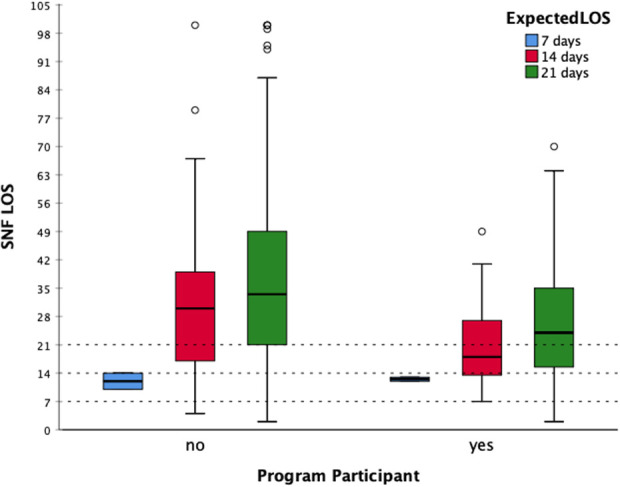
Results: We identified 246 patients meeting our selection criteria. 69 were discharged to a program participant SNF. Patients discharged to a participant SNF had similar baseline demographics and ASA distributions to those discharged to a non-participant provider. There was a statistically significant difference in length of stay between the groups, with program participant patients spending an average of 23 days at the SNF while the control group spent an average of 31 days. (p < 0.001). Program participant discharges were also associated with additional cost savings. There was no significant difference in ED visits within 90 days of discharge.
Discussion: SNF LOS for geriatric hip fractures can be decreased with implementation of a simple physical therapy driven algorithm based on the patient's ambulatory independence at hospital discharge. Conclusion: This is a simple, yet completely unique program that seems to have increased the value of healthcare provided.
Keywords: economics of medicine; fragility fractures; geriatric nursing; physical medicine and rehabilitation; trauma surgery.
© The Author(s) 2021.
Conflict of interest statement
Declaration of Conflicting Interests: The author(s) declared no potential conflicts of interest with respect to the research, authorship, and/or publication of this article.
Figures
References
-
- Johnell O, Kanis JA. An estimate of the worldwide prevalence and disability associated with osteoporotic fractures. Osteoporos Int. 2006;17(12): 1726–1733. - PubMed
-
- Braithwaite RS, Col NF, Wong JB. Estimating hip fracture morbidity, mortality and costs. J Am Geriatr Soc. 2003;51(3):364–370. - PubMed
-
- Magaziner J, Fredman L, Hawkes W, et al. Changes in functional status attributable to hip fracture: a comparison of hip fracture patients to community-dwelling aged. Am J Epidemiol. 2003;157(11):1023–1031. - PubMed
Grants and funding
LinkOut - more resources
Full Text Sources
Other Literature Sources
