Review
. 2021 Mar 16:11:650098.
doi: 10.3389/fonc.2021.650098. eCollection 2021.

Peritoneal Metastases From Colorectal Cancer: Defining and Addressing the Challenges

Affiliations
Review

Peritoneal Metastases From Colorectal Cancer: Defining and Addressing the Challenges

Onno Kranenburg et al. Front Oncol. .

Abstract

The presence of peritoneal metastases (PM) in patients with colorectal cancer (CRC) is associated with an extremely poor prognosis. The diagnosis of PM is challenging, resulting in an underestimation of their true incidence. While surgery can be curative in a small percentage of patients, effective treatment for non-operable PM is lacking, and clinical and pre-clinical studies are relatively sparse. Here we have defined the major clinical challenges in the areas of risk assessment, detection, and treatment. Recent developments in the field include the application of organoid technology, which has generated highly relevant pre-clinical PM models, the application of diffusion-weighted MRI, which has greatly improved PM detection, and the design of small clinical proof-of-concept studies, which allows the efficient testing of new treatment strategies. Together, these developments set the stage for starting to address the clinical challenges. To help structure these efforts, a translational research framework is presented, in which clinical trial design is based on the insight gained from direct tissue analyses and pre-clinical (organoid) models derived from CRC patients with PM. This feed-forward approach, in which a thorough understanding of the disease drives innovation in its clinical management, has the potential to improve outcome in the years to come.

Keywords: CMS4; colorectal; imaging; organoid; peritoneal.


Conflict of interest statement

The authors declare that the research was conducted in the absence of any commercial or financial relationships that could be construed as a potential conflict of interest.

Figures
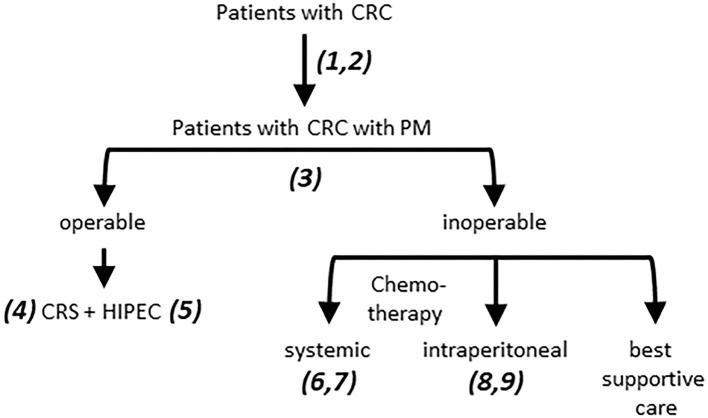
Figure 1
Figure 1
Challenges in the treatment of PM from CRC. 1. Patients with PM are underdiagnosed due to poor performance of routine imaging procedures. 2. Risk assessment of metachronous PM development is insufficient. This requires a comprehensive analysis of clinical parameters and (epi)genetic features of tumors and patients, informing the development of (composite) biomarkers. 3. 40–60% of the patients currently selected for CRS HIPEC experience rapid disease recurrence and are over-treated. The rate of under-treatment (patients who would have benefitted but were not selected) is unknown. Improved patient selection requires better imaging modalities for robust PCI assessment, combined with clinical and (epi-)genetic features, as in 2. 4. Incomplete resection leaves tumor residue which may initiate intra-abdominal recurrence. Novel intra-operative imaging strategies are needed to guide CRS. 5. The currently used monotherapies in HIPEC are unlikely to be effective. Novel more effective treatment strategies need to be developed. 6. Patients with PM benefit least from modern chemotherapy regimens. The factors determining PM resistance to systemic therapy need to be identified. 7. Some patients with PM do benefit from long-term chemotherapy. Biomarkers predicting such benefit are urgently needed. 8. The currently used monotherapies in i.p. chemotherapy are unlikely to be effective. Novel more effective treatment strategies need to be developed. 9. Response assessment to i.p. chemotherapy is challenging due to underperformance of CT. Improvement requires development of better imaging modalities. CRC, colorectal cancer; PM, Peritoneal metastases; CRS, cytoreductive surgery; HIPEC, hyperthermic (heated) intraperitoneal chemotherapy.
Figure 2
Figure 2
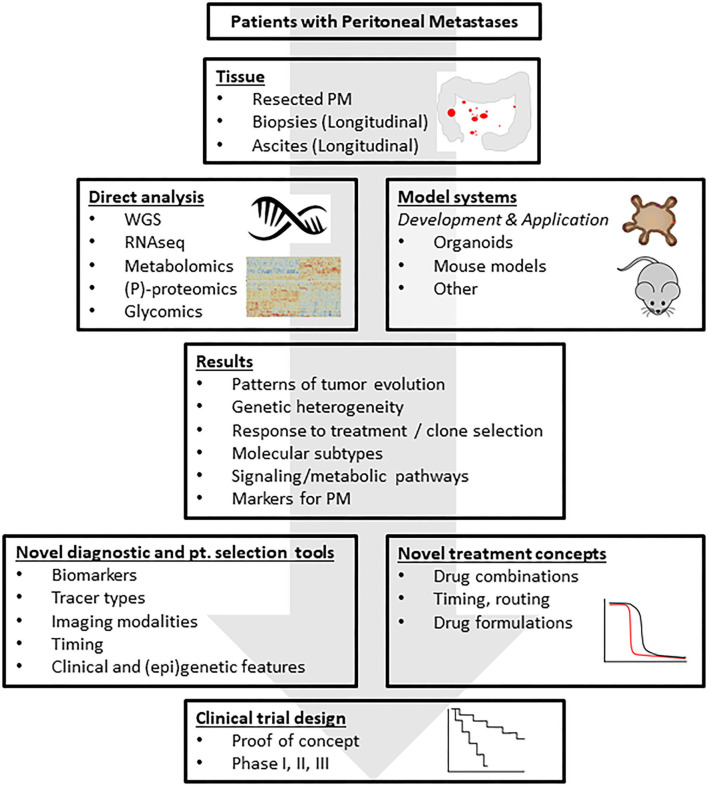
A research framework addressing the challenges. The standardized collection of tissue and body fluids derived from patients with peritoneal metastases from CRC generates biobanks of frozen and fixed tissues for downstream molecular analysis. Moreover, organoid technology allows the co-establishment of “living biobanks” in which individual cancer patients are represented by their tumor-derived organoids. These organoids may be used in transplantation studies generating spontaneous metastasis models in mice. The molecular tissue analyses will generate novel leads for the detection and treatment of PM, for understanding resistance mechanisms, tumor cell plasticity and intra- and inter-lesion (epi-)genetic heterogeneity. Insight into the biology of PM will lead to the formulation of novel treatment concepts that can subsequently be tested in the generated novel PM model systems. These efforts should yield a series of pre-clinically validated novel treatment strategies, possibly limited to specific, identifiable patient subgroups. These strategies can then be tested in small proof-of-concept studies to generate biological proof for the validity of the treatment concept in cancer patients, and subsequently in regular phase 1–3 clinical trials. Analysis of the tissues from such trials may subsequently identify potential resistance mechanisms and help design pre-clinical studies that are aimed at further improving the strategy. This translational feed-forward approach has the potential to impact clinical outcome in the years to come. PM, peritoneal metastases; WGS, whole genome sequencing; RNAseq, RNA sequencing; (P)-proteomics, (phospho-)proteomics.

References

    1. Franko J, Shi Q, Meyers JP, Maughan TS, Adams RA, Seymour MT, et al. . Research in cancers of the digestive system: prognosis of patients with peritoneal metastatic colorectal cancer given systemic therapy: an analysis of individual patient data from prospective randomised trials from the analysis and research in cancers of the digestive system (ARCAD) database. Lancet Oncol. (2016) 17:1709–19. 10.1016/S144444470-2045(16)30500-9 - DOI - PubMed
    1. Franko J. Therapeutic efficacy of systemic therapy for colorectal peritoneal carcinomatosis: surgeon's perspective. Pleura Peritoneum. (2018) 3:20180102. 10.1515/pp-2018-0102 - DOI - PMC - PubMed
    1. Koh JL, Yan TD, Glenn D, Morris DL. Evaluation of preoperative computed tomography in estimating peritoneal cancer index in colorectal peritoneal carcinomatosis. Ann Surg Oncol. (2009) 16:327–33. 10.1245/s10434-008-0234-2 - DOI - PubMed
    1. Rivard JD, Temple WJ, McConnell YJ, Sultan H, Mack LA. Preoperative computed tomography does not predict resectability in peritoneal carcinomatosis. Am J Surg. (2014) 207:760–4. 10.1016/j.amjsurg.2013.12.024 - DOI - PubMed
    1. Hugen N, van de Velde CJ, de Wilt JH, Nagtegaal ID. Metastatic pattern in colorectal cancer is strongly influenced by histological subtype. Ann Oncol. (2014) 25:651–7. 10.1093/annonc/mdt591 - DOI - PMC - PubMed

LinkOut - more resources