


Disease Onset in Huntington's Disease: When Is the Conversion?
- PMID: 33816663
- PMCID: PMC8015887
- DOI: 10.1002/mdc3.13148
Disease Onset in Huntington's Disease: When Is the Conversion?
Abstract
Background: Determination of disease onset in Huntington's disease is made by clinical experience. The diagnostic confidence level is an assessment regarding the certainty about the clinical diagnosis based on motor signs. A level of 4 means the rater has ≥99% confidence motor abnormalities are unequivocal signs of disease. However, it does not state which motor abnormalities are signs of disease and how many must be present.
Objective: Our aim is to explore how accurate the diagnostic confidence level is in estimating disease onset using the Enroll-HD data set. For clinical disease onset we use a cut-off total motor score >5 of the Unified Huntington's Disease Rating Scale. This score is used in the TRACK-HD study, with ≤5 indicating no substantial motor signs in premanifests.
Methods: At baseline premanifest participants who converted to manifest (converters) and non-converters were compared for clinical symptoms and diagnostic confidence level. Clinical symptoms and diagnostic confidence levels were longitudinally displayed in converters.
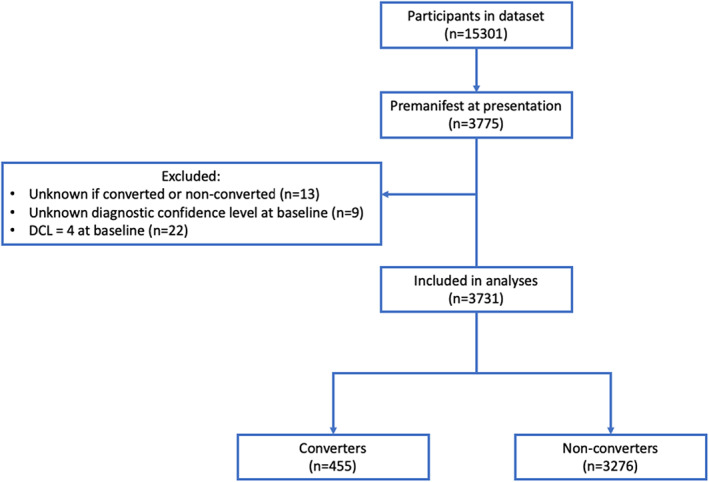
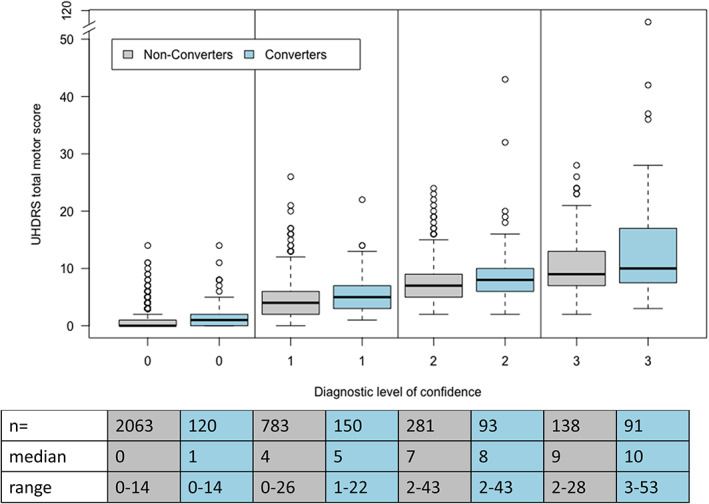
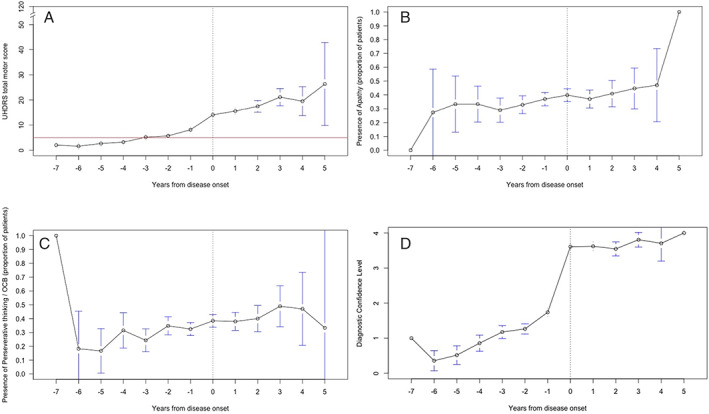
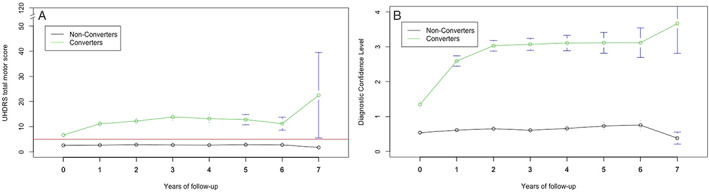
Results: Of 3731 eligible participants, 455 were converters and 3276 non-converters. Baseline diagnostic confidence levels were significantly higher in converters compared to non-converters (P < 0.001). 232 (51%) converters displayed a baseline motor score >5 (mean = 6.7). Converters had significantly more baseline clinical symptoms, and higher disease burden compared to non-converters (P < 0.001). Diagnostic confidence level before disease onset ranged between 1 and 3 in converters.
Conclusions: According to this data the diagnostic confidence level is not an accurate instrument to determine phenoconversion. With trials evaluating disease modifying therapies it is important to develop more reliable diagnostic criteria.
Keywords: Huntington's disease; diagnostic confidence interval; disease onset; unified Huntington's disease rating scale.
© 2021 The Authors. Movement Disorders Clinical Practice published by Wiley Periodicals LLC. on behalf of International Parkinson and Movement Disorder Society.
Conflict of interest statement
No specific funding was received for this research. The authors declare that there is no conflict of interest.
Figures
References
-
- The Huntington's Disease Collaborative Research Group . A novel gene containing a trinucleotide repeat that is expanded and unstable on Huntington's disease chromosomes. Cell 1993;72(6):971–983. - PubMed
-
- Bruyn GW. Huntington's chorea. Historical, clinical and laboratory synopsis. In: Vinken PJ, Bruyn GW, eds. Handbook of Clinical Neurology. Amsterdam: Elsevier; 1968.
-
- Huntington Study Group . Unified Huntington's Disease Rating Scale: reliability and consistency. Mov Disord 1996;11(2):136–142. - PubMed
-
- de Boo G, Tibben A, Hermans J, Maat A, Roos RA. Subtle involuntary movements are not reliable indicators of incipient Huntington's disease. Mov Disord 1998;13(1):96–99. - PubMed
LinkOut - more resources
Full Text Sources
Other Literature Sources
