Review
. 2021 Feb 15;9(1):101-120.
eCollection 2021.

Targeting treatment options for castration-resistant prostate cancer

Affiliations
Review

Targeting treatment options for castration-resistant prostate cancer

Dannah R Miller et al. Am J Clin Exp Urol. .

Abstract

Prostate cancer (PCa) is the most commonly diagnosed solid tumor and the second leading cause of cancer-related deaths in U.S. men in 2020. Androgen-deprivation therapy (ADT) is the standard of care for metastatic PCa. Unfortunately, PCa relapse often occurs one to two years after initiation of ADT, resulting in the development of castration-resistant PCa (CRPCa), a lethal disease. While several anticancer agents such as docetaxel, abiraterone acetate, and enzalutamide are currently utilized to extend a patient's life after development of CRPCa, patients will eventually succumb to the disease. Hence, while targeting androgen signaling and utilization of docetaxel remain the most crucial agents for many of these combinations, many studies are attempting to exploit other vulnerabilities of PCa cells, such as inhibition of key survival proteins, anti-angiogenesis agents, and immunotherapies. This review will focus on discussing recent advances on targeting therapy. Several novel small molecules will also be discussed.

Keywords: Prostate cancer; androgen deprivation therapy; castration-resistant prostate cancer; combination treatment; targeting therapy.


Conflict of interest statement

None.

Figures
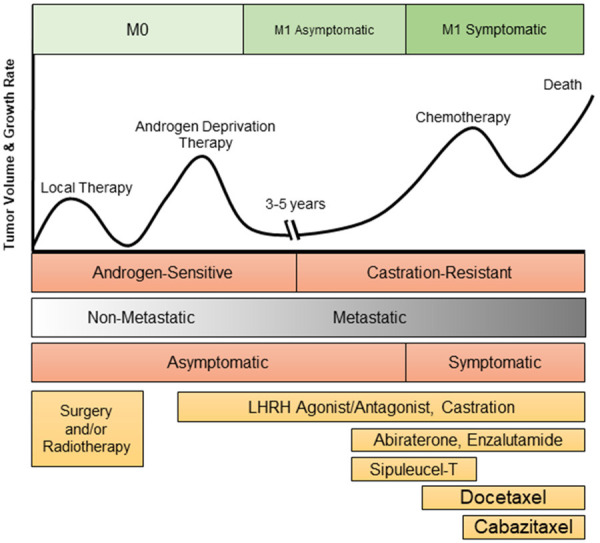
Figure 1
Figure 1
PCa Disease Progression and Current Treatment Options. PCa originates within the prostate and will often be detected before it invades into other areas of the body. Localized PCa is treated via surgery and/or radiotherapy. When the PCa is metastatic, the standard-of-care treatment is ADT. Three to five years after treatment with ADT, the PCa is likely to relapse, thus the development of CRPC. CRPC is initially treated with antiandrogens such as enzalutamide or abiraterone or immunotherapy Sipuleucel-T. Upon further progression of the disease, docetaxel and cabaitaxel may be utilized, in addition to abiraterone and enzalutamide if the patient has not previously been treatment with these agents. Unfortunately, these anti-cancer treatments utilized for CRPC will only prolong a patient’s life by several months before they succumb to the disease [120].
Figure 2
Figure 2
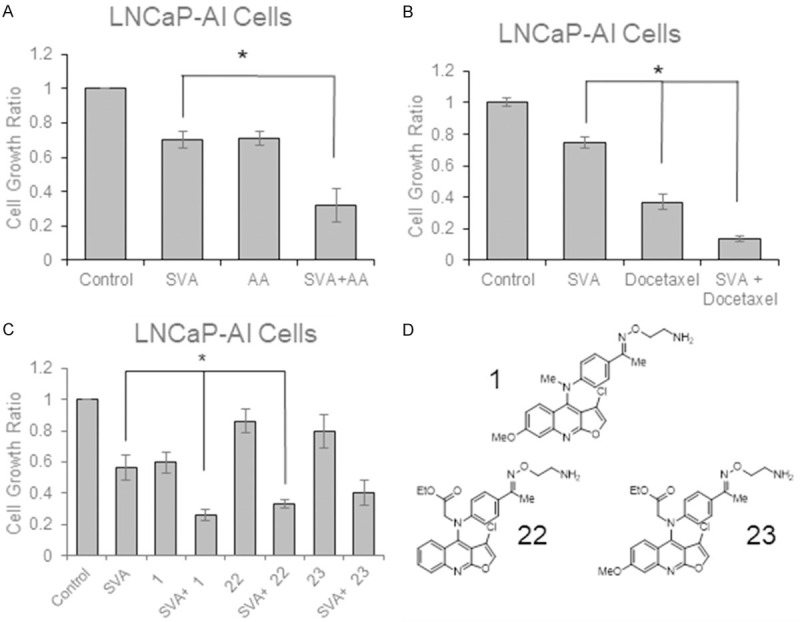
Combination treatments with Simvastatin Derivative SVA. A. LNCaP-AI cells were plated for 3 days in regular medium before being adjusted to steroid-reduced conditions for 2 days. Cells were then treated with 2.5 μM SVA and/or 5 μM abiraterone acetate for 3 days in steroid-reduced conditions. Cell number was determined with trypan blue exclusion dye assay. Results presented are mean ± SE. n=3. *P<0.05 (Unpublished data). B. LNCaP-AI cells were plated for 3 days in regular medium before being adjusted to steroid-reduced conditions for 2 days. Cells were then treated with 2.5 μM SVA and/or 1 nM docetaxel for 3 days in steroid-reduced conditions. Cell number was determined with trypan blue exclusion dye assay. Results presented are mean ± SE. n=3. *P<0.05 (Unpublished data) C. LNCaP-AI cells were plated for 3 days in regular medium before being adjusted to steroid-reduced conditions for 2 days. Cells were then treated with 5 μM SVA and/or 500 nM of the CIL-102 derivatives 1, 22, or 23 for 3 days in steroid-reduced conditions. Cell number was determined with trypan blue exclusion dye assay. Results presented are mean ± SE. n=3. *P<0.05 (Unpublished data). D. Chemical structures of CIL-102 derivatives 1, 22, and 23.
Figure 3
Figure 3
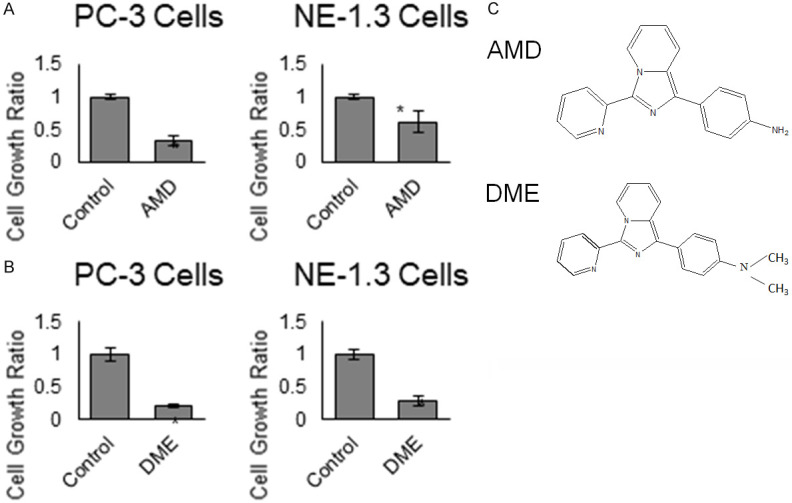
Novel Imidazopyridine derivatives on neuroendocrine-like prostate cancer cells. PC-3 and NE-1.3 cells were cultured in steroid-reduced conditions and treated with 10 µM of each compound (A) AMD and (B) DME for 3 days. Both treated and control cells were harvested and cell numbers were determined by trypan blue dye exclusion assay. Results presented are mean ± SE. n=3, *P<0.05. (C) Chemical structures of AMD and DME. (Unpublished data).

References

    1. Siegel RL, Miller KD, Jemal A. Cancer statistics, 2020. CA Cancer J Clin. 2020;70:7–30. - PubMed
    1. Mohler JL, Armstrong AJ, Bahnson RR, D’Amico AV, Davis BJ, Eastham JA, Enke CA, Farrington TA, Higano CS, Horwitz EM, Hurwitz M, Kane CJ, Kawachi MH, Kuettel M, Lee RJ, Meeks JJ, Penson DF, Plimack ER, Pow-Sang JM, Raben D, Richey S, Roach M 3rd, Rosenfeld S, Schaeffer E, Skolarus TA, Small EJ, Sonpavde G, Srinivas S, Strope SA, Tward J, Shead DA, Freedman-Cass DA. Prostate cancer, version 1.2016. J Natl Compr Canc Netw. 2016;14:19–30. - PubMed
    1. Huggins C, Clark PJ. Quantitative Studies of Prostatic Secretion: Ii. The effect of castration and of estrogen injection on the normal and on the hyperplastic prostate glands of dogs. J Exp Med. 1940;72:747–762. - PMC - PubMed
    1. Liu J, Geller J, Albert J, Kirshner M. Acute effects of testicular and adrenal cortical blockade on protein synthesis and dihydrotestosterone content of human prostate tissue. J Clin Endocrinol Metab. 1985;61:129–133. - PubMed
    1. Taplin ME, Bubley GJ, Shuster TD, Frantz ME, Spooner AE, Ogata GK, Keer HN, Balk SP. Mutation of the androgen-receptor gene in metastatic androgen-independent prostate cancer. N Engl J Med. 1995;332:1393–1398. - PubMed

LinkOut - more resources