


Synthetic dataset generation for object-to-model deep learning in industrial applications
- PMID: 33816875
- PMCID: PMC7924434
- DOI: 10.7717/peerj-cs.222
Synthetic dataset generation for object-to-model deep learning in industrial applications
Abstract
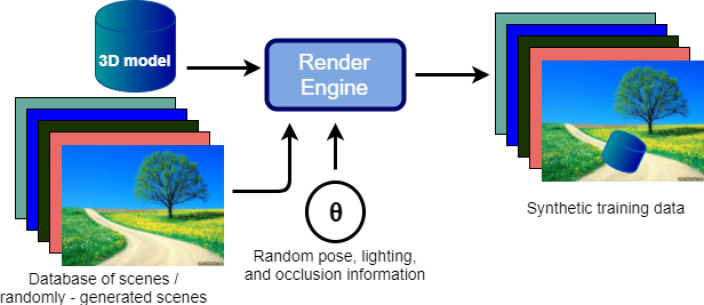
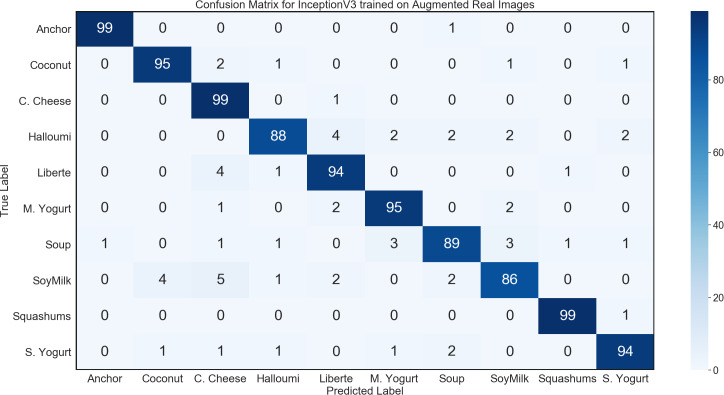
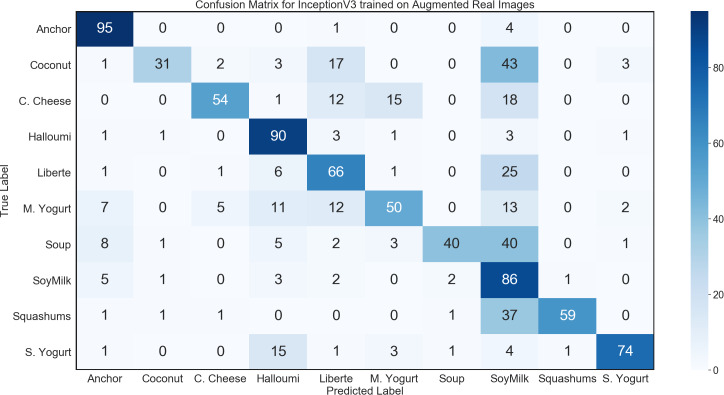
The availability of large image data sets has been a crucial factor in the success of deep learning-based classification and detection methods. Yet, while data sets for everyday objects are widely available, data for specific industrial use-cases (e.g., identifying packaged products in a warehouse) remains scarce. In such cases, the data sets have to be created from scratch, placing a crucial bottleneck on the deployment of deep learning techniques in industrial applications. We present work carried out in collaboration with a leading UK online supermarket, with the aim of creating a computer vision system capable of detecting and identifying unique supermarket products in a warehouse setting. To this end, we demonstrate a framework for using data synthesis to create an end-to-end deep learning pipeline, beginning with real-world objects and culminating in a trained model. Our method is based on the generation of a synthetic dataset from 3D models obtained by applying photogrammetry techniques to real-world objects. Using 100K synthetic images for 10 classes, an InceptionV3 convolutional neural network was trained, which achieved accuracy of 96% on a separately acquired test set of real supermarket product images. The image generation process supports automatic pixel annotation. This eliminates the prohibitively expensive manual annotation typically required for detection tasks. Based on this readily available data, a one-stage RetinaNet detector was trained on the synthetic, annotated images to produce a detector that can accurately localize and classify the specimen products in real-time.
Keywords: 3D Modelling; Computer science applications; Convolutional neural network; Deep learning with limited data; Industrial computer vision; Photogrammetry; Synthetic data.
© 2019 Wong et al.
Conflict of interest statement
The authors declare that they have no competing interests.
Figures







References
-
- Agisoft LLC Agisoft photoscan. 2018. http://www.agisoft.com/ http://www.agisoft.com/
-
- Bergstra J, Bardenet R, Bengio Y, Kégl B. Algorithms for hyper-parameter optimization. Proceedings of the 24th International Conference on Neural Information Processing Systems, NIPS’11; Red Hook: Curran Associates Inc.; 2011. pp. 2546–2554.
-
- Bergstra J, Bengio Y. Random search for hyper-parameter optimization. Journal of Machine Learning Research. 2012;13:281–305.
-
- Chollet F. Keras. 2015. https://github.com/fchollet/keras https://github.com/fchollet/keras
-
- Deng J, Dong W, Socher R, Li L-J, Li K, Fei-Fei L. ImageNet: a large-scale hierarchical image database. CVPR 2009; Miami beach Florida. 2009.
LinkOut - more resources
Full Text Sources
Other Literature Sources