


Oral frailty and neurodegeneration in Alzheimer's disease
- PMID: 33818486
- PMCID: PMC8354109
- DOI: 10.4103/1673-5374.310672
Oral frailty and neurodegeneration in Alzheimer's disease
Abstract
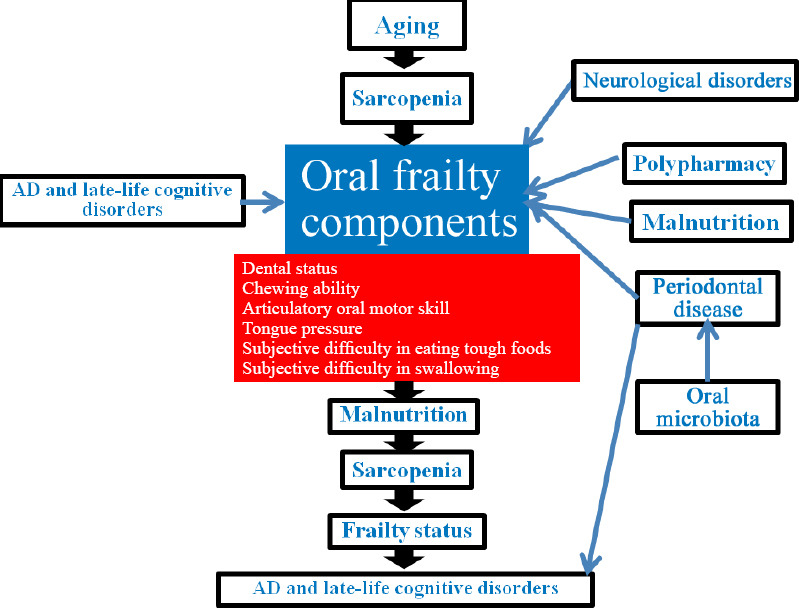
Frailty is a critical intermediate status of the aging process with a multidimensional and multisystem nature and at higher risk for adverse health-related outcomes, including falls, disability, hospitalizations, institutionalization, mortality, dementia, and Alzheimer's disease. Among different frailty phenotypes, oral frailty has been recently suggested as a novel construct defined as a decrease in oral function with a coexisting decline in cognitive and physical functions. We briefly reviewed existing evidence on operational definitions of oral frailty, assessment and screening tools, and possible relationships among oral frailty, oral microbiota, and Alzheimer's disease neurodegeneration. Several underlying mechanism may explain the oral health-frailty links including undernutrition, sarcopenia linked to both poor nutrition and frailty, psychosocial factors, and the chronic inflammation typical of oral disease. Oral microbiota may influence Alzheimer's disease risk through circulatory or neural access to the brain and the interplay with periodontal disease, often causing tooth loss also linked to an increased Alzheimer's disease risk. On this bases, COR388, a bacterial protease inhibitor targeting Porphyromonas gingivalis implicated in periodontal disease, is now being tested in a double-blind, placebo-controlled Phase II/III study in mild-to-moderate Alzheimer's disease. Therefore, oral status may be an important contributor to general health, including Alzheimer's disease and late-life cognitive disorders, suggesting the central role of preventive strategies targeting the novel oral frailty phenotype and including maintenance and improvement of oral function and nutritional status to reduce the burden of both oral dysfunction and frailty.
Keywords: biomarkers; cognitive frailty; dementia; diet; mild cognitive impairment; nutritional frailty; oral health; oral microbiota; periodontal disease; tooth loss.
Conflict of interest statement
None
Figures
References
-
- Arastu-Kapur S, Nguyen M, Raha D, Ermini F, Haditsch U, Araujo J, De Lannoy IAM, Ryder MI, Dominy SS, Lynch C, Holsinger LJ. Treatment of porphyromonas gulae infection and downstream pathology in the aged dog by lysine-gingipain inhibitor COR388. Pharmacol Res Perspect. 2020;8:e00562. - PMC - PubMed
-
- Bassim C, Mayhew AJ, Ma J, Kanters D, Verschoor CP, Griffith LE, Raina P. Oral health, diet, and frailty at baseline of the Canadian longitudinal study on aging. J Am Geriatr Soc. 2020;68:959–966. - PubMed
-
- Bush LA, Horenkamp, Morley JE, Spiro A., 3rd D-E-N-T-A-L: a rapid self-administered screening instrument to promote referrals for further evaluation in older adults. J Am Geriatr Soc. 1996;44:979–981. - PubMed
-
- Choi JH, Kang JH, Koh SB, Kim NH, Kho HS. Development of an oral and maxillofacial frailty index: a preliminary study. J Oral Rehabil. 2020;47:187–195. - PubMed
Publication types
LinkOut - more resources
Full Text Sources
Other Literature Sources
