


Prolonged Emergency Department Length of Stay for US Pediatric Mental Health Visits (2005-2015)
- PMID: 33820850
- PMCID: PMC8086002
- DOI: 10.1542/peds.2020-030692
Prolonged Emergency Department Length of Stay for US Pediatric Mental Health Visits (2005-2015)
Abstract
Background and objectives: Children seeking care in the emergency department (ED) for mental health conditions are at risk for prolonged length of stay (LOS). A more contemporary description of trends and visit characteristics associated with prolonged ED LOS at the national level is lacking in the literature. Our objectives were to (1) compare LOS trends for pediatric mental health versus non-mental health ED visits and (2) explore patient-level characteristics associated with prolonged LOS for mental health ED visits.
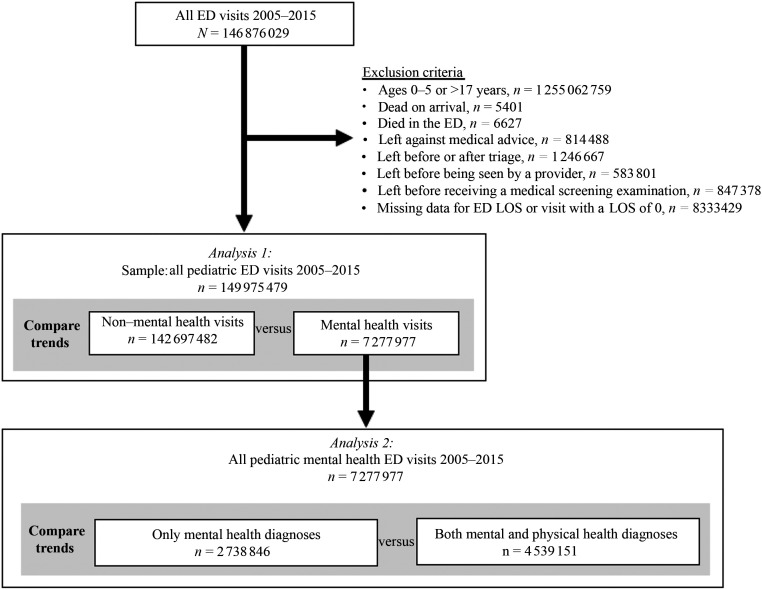
Methods: We conducted an observational analysis of ED visits among children 6 to 17 years of age using the National Hospital Ambulatory Medical Care Survey (2005-2015). We assessed trends in rates of prolonged LOS and the association between prolonged LOS and demographic and clinical characteristics (race and ethnicity, payer type, and presence of a concurrent physical health diagnosis) using descriptive statistics and survey-weighted logistic regression.
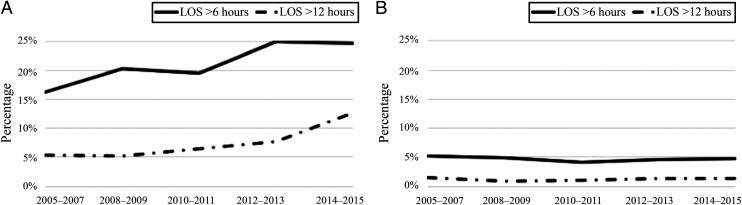
Results: From 2005 to 2015, rates of prolonged LOS for pediatric mental health ED visits increased over time from 16.3% to 24.6% (LOS >6 hours) and 5.3% to 12.7% (LOS >12 hours), in contrast to non-mental health visits for which LOS remained stable. For mental health visits, Hispanic ethnicity was associated with an almost threefold odds of LOS >12 hours (odds ratio 2.74; 95% confidence interval 1.69-4.44); there was no difference in LOS by payer type.
Conclusions: The substantial rise in prolonged LOS for mental health ED visits and disparity for Hispanic children suggest worsening and inequitable access to definitive pediatric mental health care. Policy makers and health systems should work to provide equitable and timely access to pediatric mental health care.
Copyright © 2021 by the American Academy of Pediatrics.
Conflict of interest statement
POTENTIAL CONFLICT OF INTEREST: The authors have indicated they have no potential conflicts of interest to disclose.
Figures
Comment in
-
Equity in Emergency Mental Health Care.Pediatrics. 2021 May;147(5):e2020049843. doi: 10.1542/peds.2020-049843. Epub 2021 Apr 5. Pediatrics. 2021. PMID: 33820848 Free PMC article. No abstract available.
References
-
- Alakeson V, Pande N, Ludwig M. A plan to reduce emergency room ‘boarding’ of psychiatric patients. Health Aff (Millwood). 2010;29(9):1637–1642 - PubMed
-
- Cama S, Malowney M, Smith AJB, et al. . Availability of outpatient mental health care by pediatricians and child psychiatrists in five U.S. Cities. Int J Health Serv. 2017;47(4):621–635 - PubMed
-
- Torio CM, Encinosa W, Berdahl T, McCormick MC, Simpson LA. Annual report on health care for children and youth in the United States: national estimates of cost, utilization and expenditures for children with mental health conditions. Acad Pediatr. 2015;15(1):19–35 - PubMed
Publication types
MeSH terms
Grants and funding
LinkOut - more resources
Full Text Sources
Other Literature Sources
Medical
