


Homeschooling during the SARS-CoV-2 pandemic: the role of students' trait self-regulation and task attributes of daily learning tasks for students' daily self-regulation
- PMID: 33821144
- PMCID: PMC8014902
- DOI: 10.1007/s11618-021-01011-w
Homeschooling during the SARS-CoV-2 pandemic: the role of students' trait self-regulation and task attributes of daily learning tasks for students' daily self-regulation
Abstract
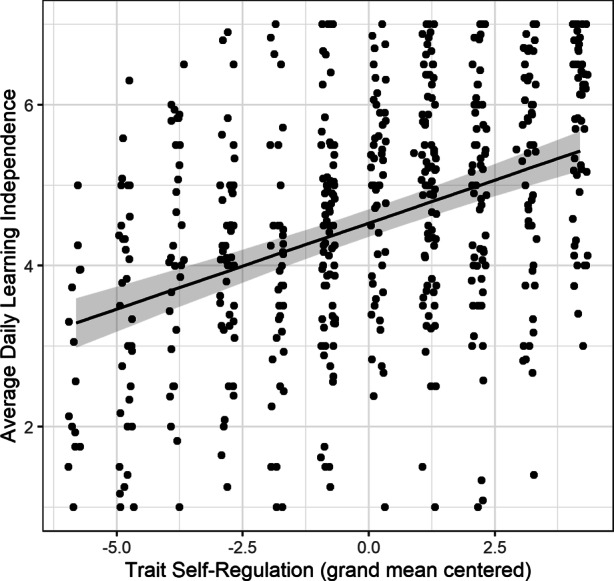
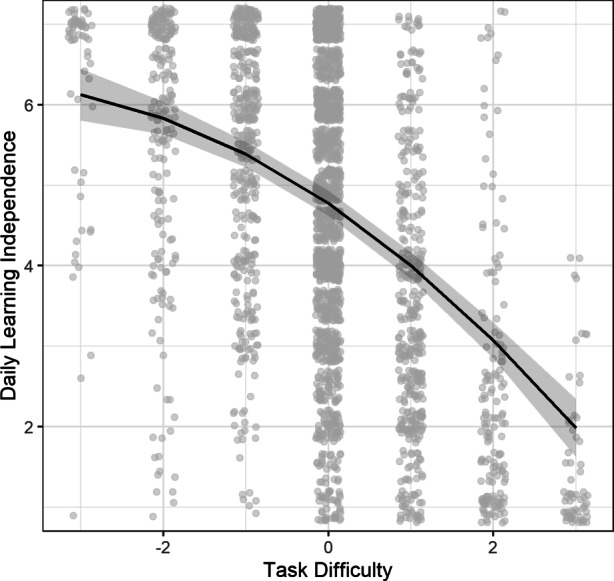
As a means to counter the SARS-CoV‑2 pandemic, schools were closed throughout Germany between mid-March and end of April 2020. Schooling was translocated to the students' homes where students were supposed to work on learning tasks provided by their teachers. Students' self-regulation and attributes of the learning tasks may be assumed to have played important roles when adapting to this novel schooling situation. They may be predicted to have influenced students' daily self-regulation and hence the independence with which they worked on learning tasks. The present work investigated the role of students' trait self-regulation as well as task difficulty and task enjoyment for students' daily independence from their parents in learning during the homeschooling period. Data on children's trait self-regulation were obtained through a baseline questionnaire filled in by the parents of 535 children (M age = 9.69, SD age = 2.80). Parents additionally reported about the daily task difficulty, task enjoyment, and students' learning independence through 21 consecutive daily online questionnaires. The results showed students' trait self-regulation to be positively associated with their daily learning independence. Additionally, students' daily learning independence was shown to be negatively associated with task difficulty and positively with task enjoyment. The findings are discussed with regard to students' daily self-regulation during the homeschooling period. Finally, implications for teaching practice during the pandemic-related school closures are derived.
Um die SARS-CoV-2-Pandemie einzudämmen, wurden zwischen Mitte März und Ende April 2020 deutschlandweit alle Schulen geschlossen. Während dieser Zeit wurden die Schüler*innen zu Hause beschult (‚Homeschooling‘) und arbeiteten an Lernaufgaben, die von ihren Lehrkräften bereitgestellt wurden. Bei der Anpassung an diese neuartige Beschulungssituation könnten sowohl die Selbstregulation der Schüler*innen als auch die Eigenschaften der Lernaufgaben eine wichtige Rolle gespielt haben. Es ist anzunehmen, dass diese insbesondere die tagtägliche Selbstregulation der Schüler*innen beim Bearbeiten der Lernaufgaben und damit die Selbstständigkeit, mit der sie an den Lernaufgaben arbeiteten beeinflusst haben. Die vorliegende Arbeit untersuchte, welche Rolle die dispositionelle Selbstregulation von Schüler*innen, die Schwierigkeit der Lernaufgaben und die Freude an den Aufgaben für die tagtägliche Selbstständigkeit der Bearbeitung der Aufgaben während des Homeschoolings spielten. Die dispositionelle Selbstregulation der Schüler*innen wurde zunächst über einen Eingangsfragebogen erfasst, der von den Eltern von 535 Kindern ausgefüllt wurde (M Alter = 9,69; SD Alter = 2,80). Die Eltern berichteten anschließend an 21 aufeinander folgenden Tagen über die tägliche Aufgabenschwierigkeit, die Freude an den Aufgaben und die Selbstständigkeit, mit der ihre Kinder die Lernaufgaben bearbeiteten. Die Ergebnisse zeigten, dass die dispositionelle Selbstregulation der Schüler*innen positiv mit ihrer täglichen Selbstständigkeit beim Lernen assoziiert war. Darüber hinaus war die tägliche Selbstständigkeit der Schüler*innen beim Lernen negativ mit der Aufgabenschwierigkeit und positiv mit der Freude an den Aufgaben verbunden. Die Ergebnisse werden im Hinblick auf die tägliche Selbstregulation der Schüler*innen während der Beschulung zu Hause diskutiert. Abschließend werden Implikationen für die Lehrpraxis während der pandemiebedingten Schulschließungen abgeleitet.
Keywords: Ambulatory assessment; Homeschooling; SARS-CoV‑2 pandemic; Self-regulation; Task attributes.
© The Author(s) 2021.
Figures

References
-
- Allen J, Hamre B, Pianta R, Gregory A, Mikami A, Lun J. Observations of effective teacher-student interactions in secondary school classrooms: Predicting student achievement with the classroom assessment scoring system-secondary. School Psychology Review. 2013;42(1):76–98. doi: 10.1080/02796015.2013.12087492. - DOI - PMC - PubMed
-
- Baumeister RF, Vohs KD. Self-regulation, ego depletion, and motivation. Social and Personality Psychology Compass. 2007;1(1):115–128. doi: 10.1111/j.1751-9004.2007.00001.x. - DOI
-
- Baumeister RF, Heatherton TF, Tice DM. Losing control: How and why peiple fail at self-regulation. 1994.
-
- Blume F, Göllner R, Moeller K, Dresler T, Ehlis A-C, Gawrilow C. Do students learn better when seated close to the teacher? A virtual classroom study considering individual levels of inattention and hyperactivity-impulsivity. Learning and Instruction. 2019;61:138–147. doi: 10.1016/j.learninstruc.2018.10.004. - DOI
-
- Boekaerts M. Being concerned with well-being and with learning. Educational Psychologist. 1993;28(2):149–167. doi: 10.1207/s15326985ep2802_4. - DOI
LinkOut - more resources
Full Text Sources
Other Literature Sources
Miscellaneous