. 2022 Aug;22(4):672-689.
doi: 10.3758/s13415-021-00883-z. Epub 2021 Apr 5.

Associations between lifetime stress exposure and the error-related negativity (ERN) differ based on stressor characteristics and exposure timing in young adults

Affiliations

Associations between lifetime stress exposure and the error-related negativity (ERN) differ based on stressor characteristics and exposure timing in young adults

Iulia Banica et al. Cogn Affect Behav Neurosci. 2022 Aug.

Abstract

Life stress increases risk for multiple forms of psychopathology, in part by altering neural processes involved in performance monitoring. However, the ways in which these stress-cognition effects are influenced by the specific timing and types of life stressors experienced remains poorly understood. To address this gap, we examined how different social-psychological characteristics and developmental timing of stressors are related to the error-related negativity (ERN), a negative-going deflection in the event-related potential (ERP) waveform that is observed from 0 to 100 ms following error commission. A sample of 203 emerging adults performed an ERN-eliciting arrow flanker task and completed an interview-based measure of lifetime stress exposure. Adjusting for stress severity during other developmental periods, there was a small-to-medium effect of stress on performance monitoring, such that more severe total stress exposure, as well as more severe social-evaluative stress in particular, experienced during early adolescence significantly predicted an enhanced ERN. These results suggest that early adolescence may be a sensitive developmental period during which stress exposure may result in lasting adaptations to neural networks implicated in performance monitoring.

Keywords: Development; Error-related negativity; Life stress; Sensitive periods.


Conflict of interest statement

Declarations of interest None.

Figures

Fig. 1
Fig. 1
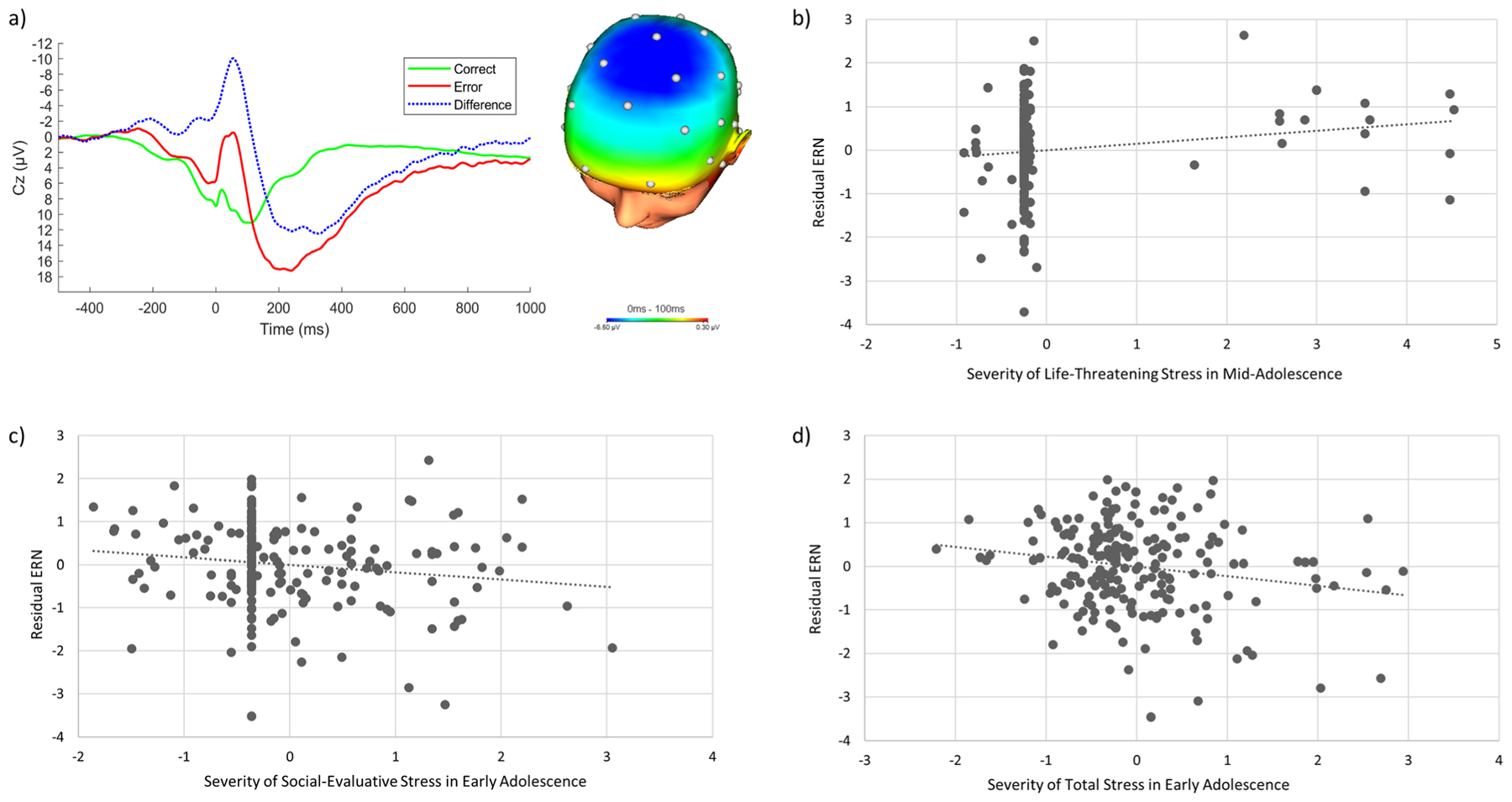
(a) Response-locked ERP average waveforms after erroneous and correct responses, and the difference (conditional ERN values minus conditional CRN values), at electrode site Cz, and a topographical map displaying the error minus correct neural response difference (in μV) for all participants (N = 203). (b) A partial regression plot depicting the association between life-threatening stress severity during mid-adolescence and the residual ERN, adjusting for gender and stress severity during other time periods. (c) Partial regression plot depicting the association between social-evaluative stress severity during early adolescence and the residual ERN, adjusting for gender and stress severity during other time periods. (d) Partial regression plot depicting the association between total stress severity during early adolescence and the residual ERN, adjusting for gender and stress severity during other time periods

References

    1. Andersen SL (2003). Trajectories of brain development: point of vulnerability or window of opportunity? Neuroscience & Biobehavioral Reviews, 27(1–2), 3–18. 10.1016/S0149-7634(03)00005-8 - DOI - PubMed
    1. Andersen SL, & Teicher MH (2008). Stress, sensitive periods and maturational events in adolescent depression. Trends in Neurosciences, 31(4), 183–191. 10.1016/j.tins.2008.01.004 - DOI - PubMed
    1. Andersen SL, Tomada A, Vincow ES, Valente E, Polcari A, & Teicher MH (2008). Preliminary evidence for sensitive periods in the effect of childhood sexual abuse on regional brain development. The Journal of Neuropsychiatry and Clinical Neurosciences, 20(3), 292–301. - PMC - PubMed
    1. Anokhin AP, & Golosheykin S (2015). Neural correlates of error monitoring in adolescents prospectively predict initiation of tobacco use. Developmental Cognitive Neuroscience, 16, 166–173. 10.1016/j.dcn.2015.08.001 - DOI - PMC - PubMed
    1. Bae JN, MacFall JR, Krishnan KRR, Payne ME, Steffens DC, & Taylor WD (2006). Dorsolateral prefrontal cortex and anterior cingulate cortex white matter alterations in late-life depression. Biological Psychiatry, 60(12), 1356–1363. 10.1016/j.biopsych.2006.03.052 - DOI - PubMed

Publication types

LinkOut - more resources