Trends in Geographic and Temporal Distribution of US Children With Multisystem Inflammatory Syndrome During the COVID-19 Pandemic
- PMID: 33821923
- PMCID: PMC8025123
- DOI: 10.1001/jamapediatrics.2021.0630
Trends in Geographic and Temporal Distribution of US Children With Multisystem Inflammatory Syndrome During the COVID-19 Pandemic
Abstract
Importance: Multiple inflammatory syndrome in children (MIS-C) occurs in association with the COVID-19 pandemic.
Objective: To describe the clinical characteristics and geographic and temporal distribution of the largest cohort of patients with MIS-C in the United States to date.
Design, setting, and participants: Cross-sectional analysis was conducted on clinical and laboratory data collected from patients with MIS-C. The analysis included patients with illness onset from March 2020 to January 2021 and met MIS-C case definition.
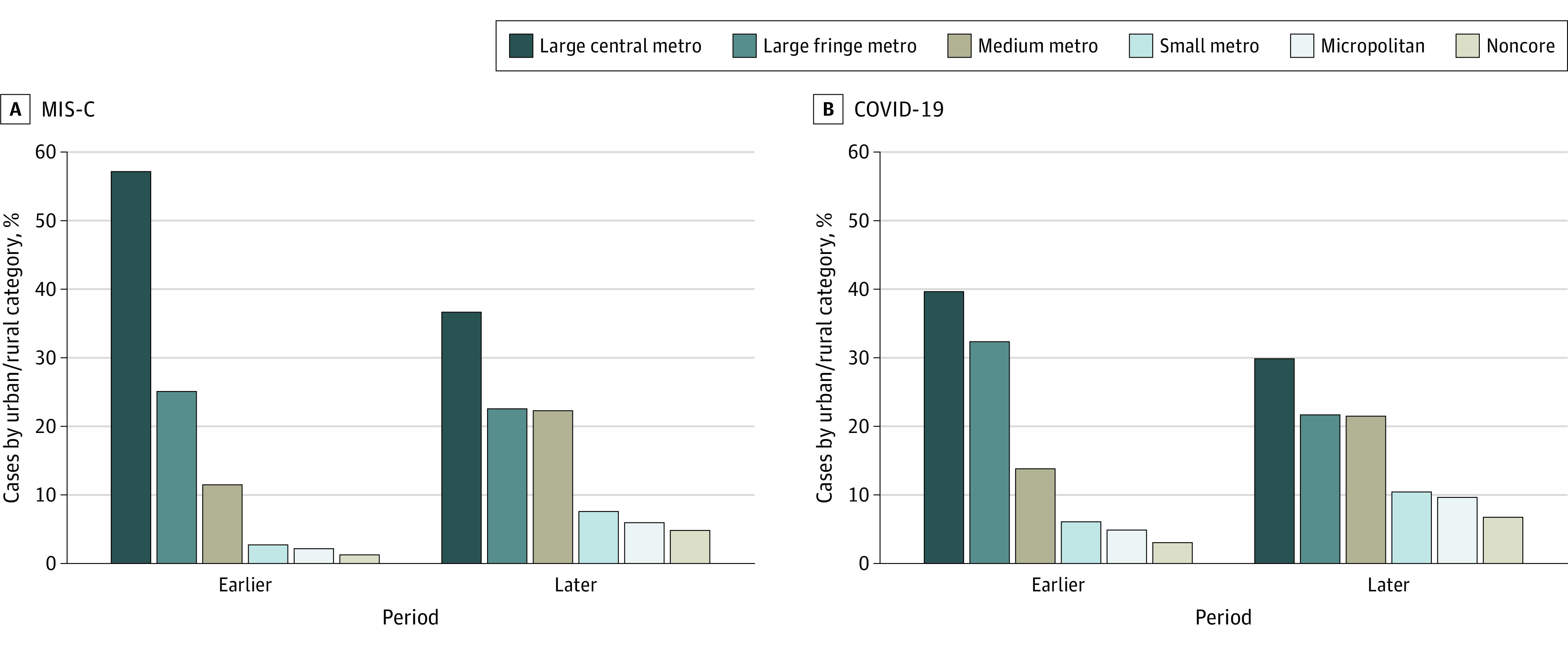
Main outcomes and measures: Geographic and temporal distribution of MIS-C was compared with that of COVID-19 nationally, by region, and level of urbanicity by county. Clinical and laboratory findings and changes over time were described by age group and by presence or absence of preceding COVID-19.
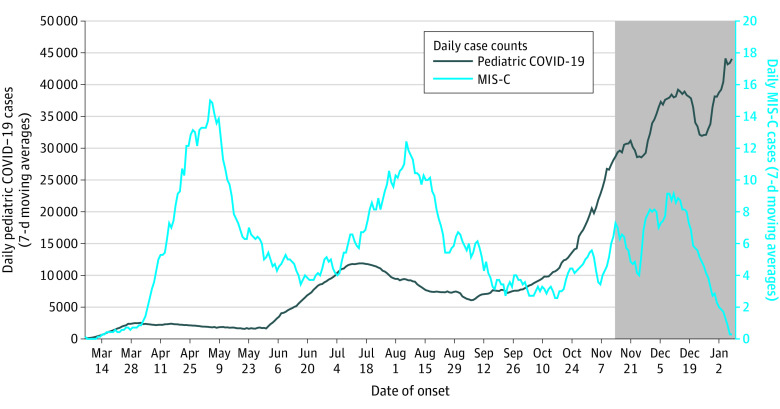
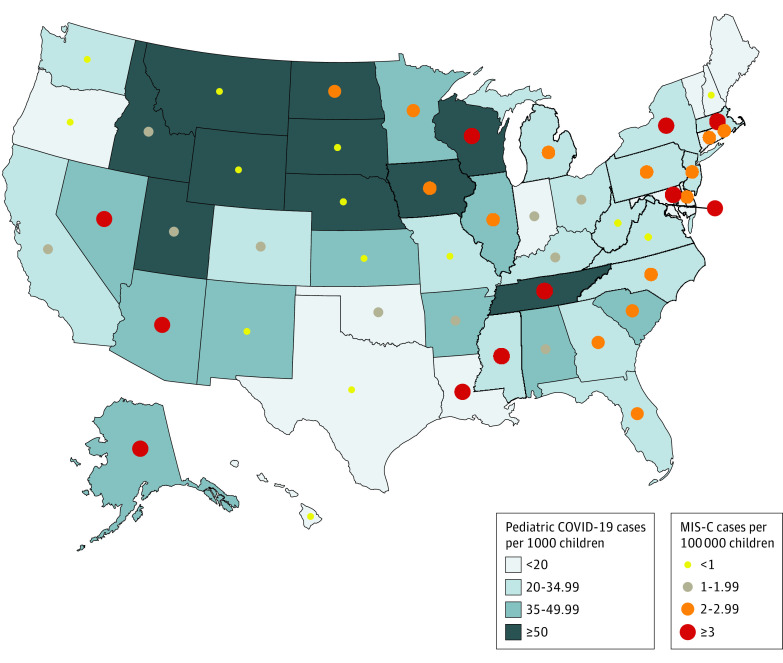
Results: A total of 1733 patients with MIS-C were identified; 994 (57.6%) were male and 1117 (71.3%) were Hispanic or non-Hispanic Black. Gastrointestinal symptoms, rash, and conjunctival hyperemia were reported by 53% (n = 931) to 67% (n = 1153) of patients. A total of 937 patients (54%) had hypotension or shock, and 1009 (58.2%) were admitted for intensive care. Cardiac dysfunction was reported in 484 patients (31.0%), pericardial effusion in 365 (23.4%), myocarditis in 300 (17.3%), and coronary artery dilatation or aneurysms in 258 (16.5%). Patients aged 0 to 4 years had the lowest proportion of severe manifestations, although 171 patients (38.4%) had hypotension or shock and 197 (44.3%) were admitted for intensive care. Patients aged 18 to 20 years had the highest proportions with myocarditis (17 [30.9%]), pneumonia (20 [36.4%]), acute respiratory distress syndrome (10 [18.2%]), and polymerase chain reaction positivity (39 [70.9%]). These older adolescents also had the highest proportion reporting preceding COVID-19-like illness (63%). Nationally, the first 2 MIS-C peaks followed the COVID-19 peaks by 2 to 5 weeks. The cumulative MIS-C incidence per 100 000 persons younger than 21 years was 2.1 and varied from 0.2 to 6.3 by state. Twenty-four patients (1.4%) died.
Conclusions and relevance: In this cross-sectional study of a large cohort of patients with MIS-C, 2 peaks that followed COVID-19 peaks by 2 to 5 weeks were identified. The geographic and temporal association of MIS-C with the COVID-19 pandemic suggested that MIS-C resulted from delayed immunologic responses to SARS-CoV-2 infection. The clinical manifestations varied by age and by presence or absence of preceding COVID-19.
Conflict of interest statement
Figures
Comment in
-
Epidemiology of Multisystem Inflammatory Syndrome in Children: A Step Closer to Understanding Who, Where, and When.JAMA Pediatr. 2021 Aug 1;175(8):783-785. doi: 10.1001/jamapediatrics.2021.0638. JAMA Pediatr. 2021. PMID: 33821888 No abstract available.
-
Challenges in Diagnosis and Treatment of Children With Multisystem Inflammatory Syndrome and Appendicitis.JAMA Pediatr. 2021 Nov 1;175(11):1180-1181. doi: 10.1001/jamapediatrics.2021.2420. JAMA Pediatr. 2021. PMID: 34279559 No abstract available.
References
-
- Dufort EM, Koumans EH, Chow EJ, et al. ; New York State and Centers for Disease Control and Prevention Multisystem Inflammatory Syndrome in Children Investigation Team . Multisystem inflammatory syndrome in children in New York state. N Engl J Med. 2020;383(4):347-358. doi: 10.1056/NEJMoa2021756 - DOI - PMC - PubMed
Publication types
MeSH terms
Supplementary concepts
LinkOut - more resources
Full Text Sources
Other Literature Sources
Medical
Miscellaneous