


Birth characteristics and risk of febrile seizures
- PMID: 33822360
- PMCID: PMC8178233
- DOI: 10.1111/ane.13420
Birth characteristics and risk of febrile seizures
Abstract
Objective: Febrile seizure is a common childhood disorder that affects 2-5% of all children, and is associated with later development of epilepsy and psychiatric disorders. This study determines how the incidence of febrile seizures correlates with birth characteristics, age, sex and brain development.
Methods: This is a cohort study of all children born Denmark between 1977 and 2011 who were alive at 3 months of age (N = 2,103,232). The Danish National Patient Register was used to identify children with febrile seizures up to 5 years of age. Follow-up ended on 31 December 2016 when all cohort members had potentially reached 5 years of age.
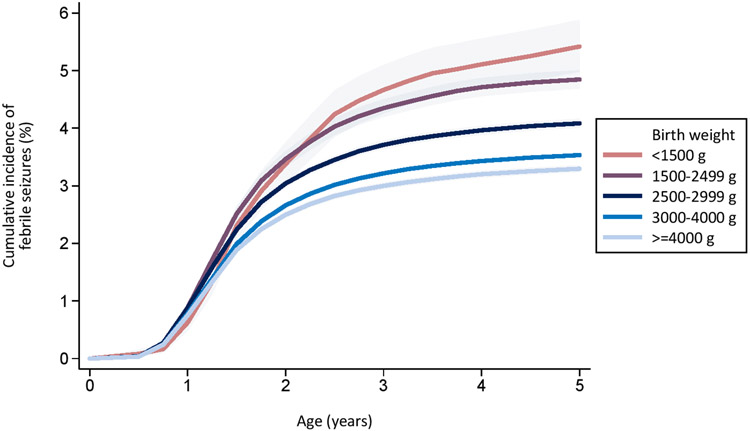
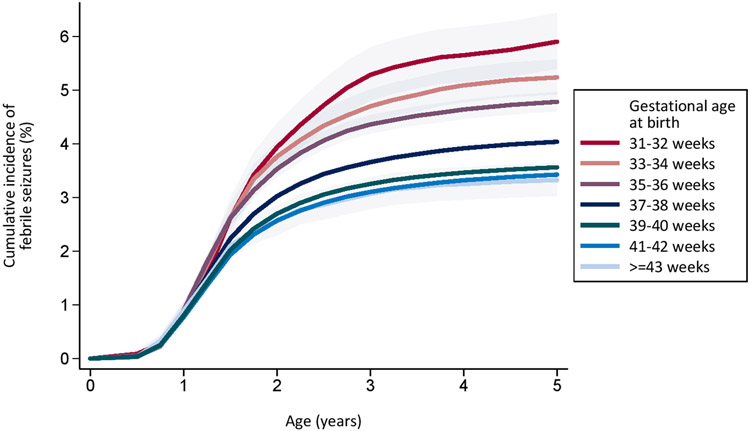
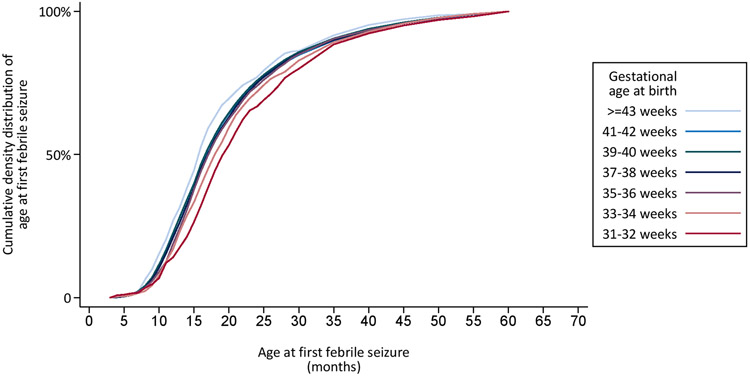
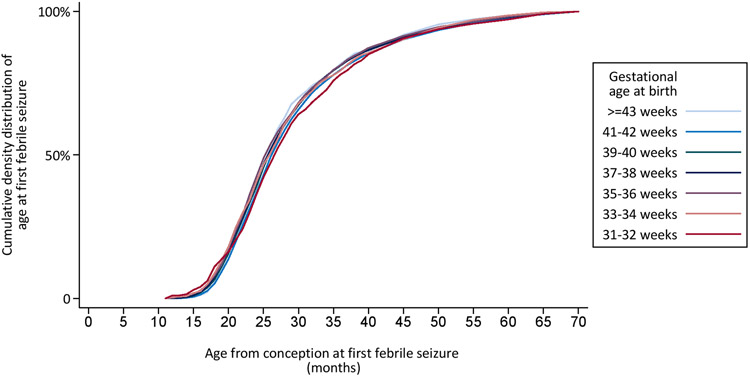
Results: In total, 75,593 (3.59%, 95% CI: 3.57-3.62%) were diagnosed with febrile seizures. Incidence peaked at 16.7 months of age (median: 16.7 months, interquartile range: 12.5-24.0). The 5-year cumulative incidence of febrile seizures increased with decreasing birth weight (<1500 g; 5.42% (95% CI: 4.98-5.88% vs. 3,000-4,000 g; 3.53% (95% CI: 3.50-3.56%)) and with decreasing gestational age at birth (31-32 weeks; 5.90% (95% CI: 5.40-6.44%) vs. 39-40 weeks; 3.56% (95% CI: 3.53-3.60)). Lower gestational age at birth was associated with higher age at onset of a first febrile seizure; an association that essentially disappeared when correcting for age from conception.
Conclusions: The risk of febrile seizures increased with decreasing birth weight and gestational age at birth. The association between low gestational age at birth and age at first febrile seizure suggests that onset of febrile seizures is associated with the stage of brain development.
Keywords: birth weight; brain development; febrile seizures and epilepsy; gestational age.
© 2021 John Wiley & Sons A/S. Published by John Wiley & Sons Ltd.
Conflict of interest statement
Competing interests
Jakob Christensen received honoraria from serving on the scientific advisory board of UCB Nordic and Eisai AB, received honoraria from giving lectures from UCB Nordic and Eisai AB, and received funding for a trip from UCB Nordic. The other authors report no conflicts of interests.
Figures
References
-
- Vestergaard M, Obel C, Henriksen TB, et al. The Danish National Hospital Register is a valuable study base for epidemiologic research in febrile seizures. J Clin Epidemiol. 2006;59(1):61–66. - PubMed
-
- Forsgren L, Sidenvall R, Blomquist HK, Heijbel J. A prospective incidence study of febrile convulsions. Acta Paediatr Scand. 1990;79(5):550–557. - PubMed
-
- Hauser WA. The prevalence and incidence of convulsive disorders in children. Epilepsia. 1994;35 Suppl 2:S1–6. - PubMed
-
- Guidelines for Epidemiologic Studies on Epilepsy. Epilepsia. 1993;34(4):592–596. - PubMed
MeSH terms
Grants and funding
LinkOut - more resources
Full Text Sources
Other Literature Sources
Medical
