Review
. 2021 Sep 8;45(5):fuab018.
doi: 10.1093/femsre/fuab018.

Ecological and Evolutionary responses to Antibiotic Treatment in the Human Gut Microbiota

Affiliations
Review

Ecological and Evolutionary responses to Antibiotic Treatment in the Human Gut Microbiota

Joseph Hugh Pennycook et al. FEMS Microbiol Rev. .

Abstract

The potential for antibiotics to affect the ecology and evolution of the human gut microbiota is well recognised and has wide-ranging implications for host health. Here, we review the findings of key studies that surveyed the human gut microbiota during antibiotic treatment. We find several broad patterns including the loss of diversity, disturbance of community composition, suppression of bacteria in the Actinobacteria phylum, amplification of bacteria in the Bacteroidetes phylum, and promotion of antibiotic resistance. Such changes to the microbiota were often, but not always, recovered following the end of treatment. However, many studies reported unique and/or contradictory results, which highlights our inability to meaningfully predict or explain the effects of antibiotic treatment on the human gut microbiome. This problem arises from variation between existing studies in three major categories: differences in dose, class and combinations of antibiotic treatments used; differences in demographics, lifestyles, and locations of subjects; and differences in measurements, analyses and reporting styles used by researchers. To overcome this, we suggest two integrated approaches: (i) a top-down approach focused on building predictive models through large sample sizes, deep metagenomic sequencing, and effective collaboration; and (ii) a bottom-up reductionist approach focused on testing hypotheses using model systems.

Keywords: antibiotics; diversity; ecology; evolution; gut microbiota.


Figures

Figure 1.
Figure 1.
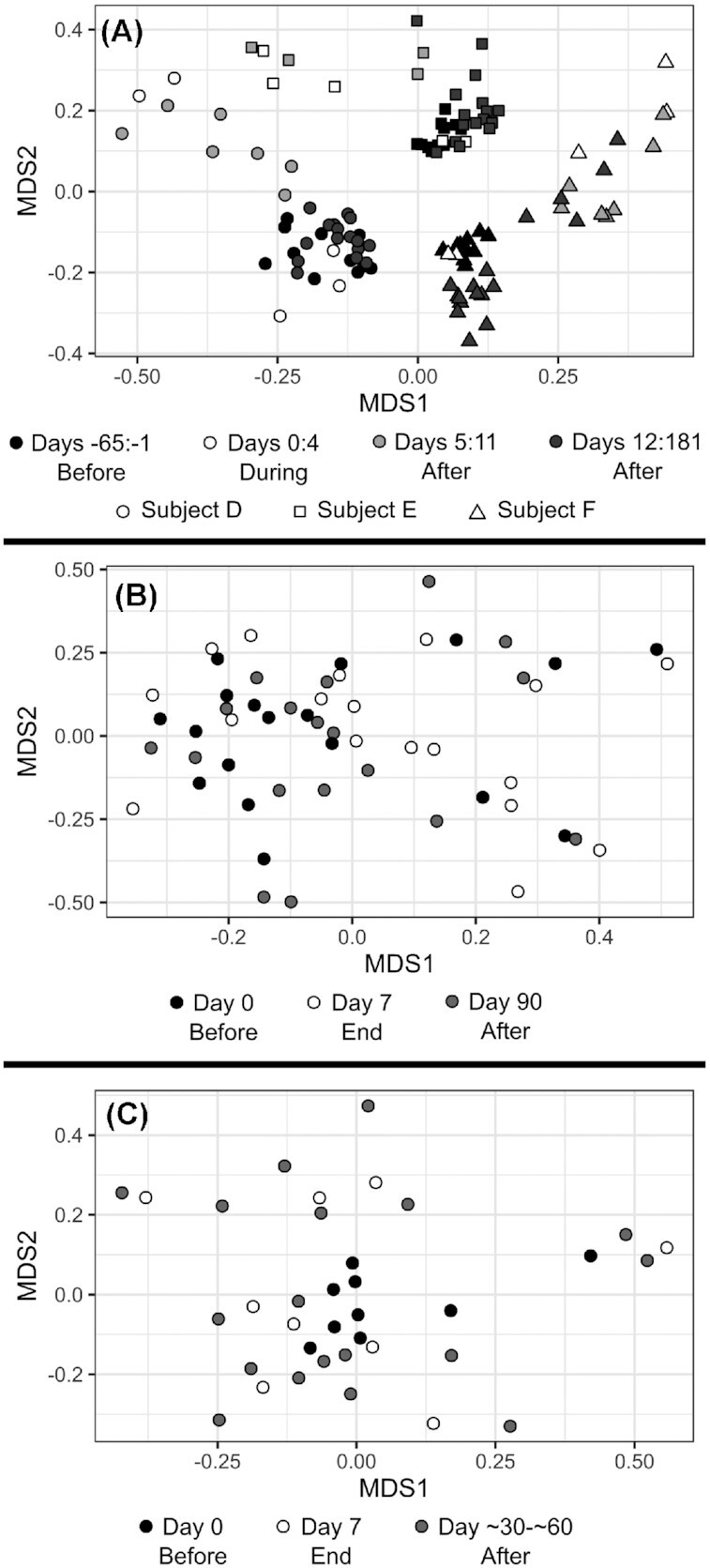
Example effects of antibiotic treatment on the community composition of the gut microbiota. All graphs show the relationship between samples via non-metric multidimensional scaling of Bray-Curtis dissimilarity. Data for all graphs was processed and visualised using the 'vegan' package and the 'ggplot2' package in the R programming language (Wickham ; Oksanen et al.; R Core Team 2020). (A) shows data from only the first round of treatment covered by Supplementary Dataset 1 of Dethlefsen & Relman., representing up to 40 samples from each of 3 subjects treated with ciprofloxacin, with a stress of 0.156849 (Dethlefsen and Relman 2011). (B) shows data from only the treated subjects covered by Raymond et al. and taxonomically classified by Supplementary Data 1 of Chng et al., representing 18 subjects treated with cefprozil, and with a stress of 0.2342019 (Raymond et al. ; Chng et al. 2020). (C) shows data from only the clindamycin treatments covered by Zaura et al. and taxonomically classified by Supplementary Data 1 of Chng et al., representing 9 subjects, and with a stress of 0.1898547 (Zaura et al. ; Chng et al. 2020).
Figure 2.
Figure 2.
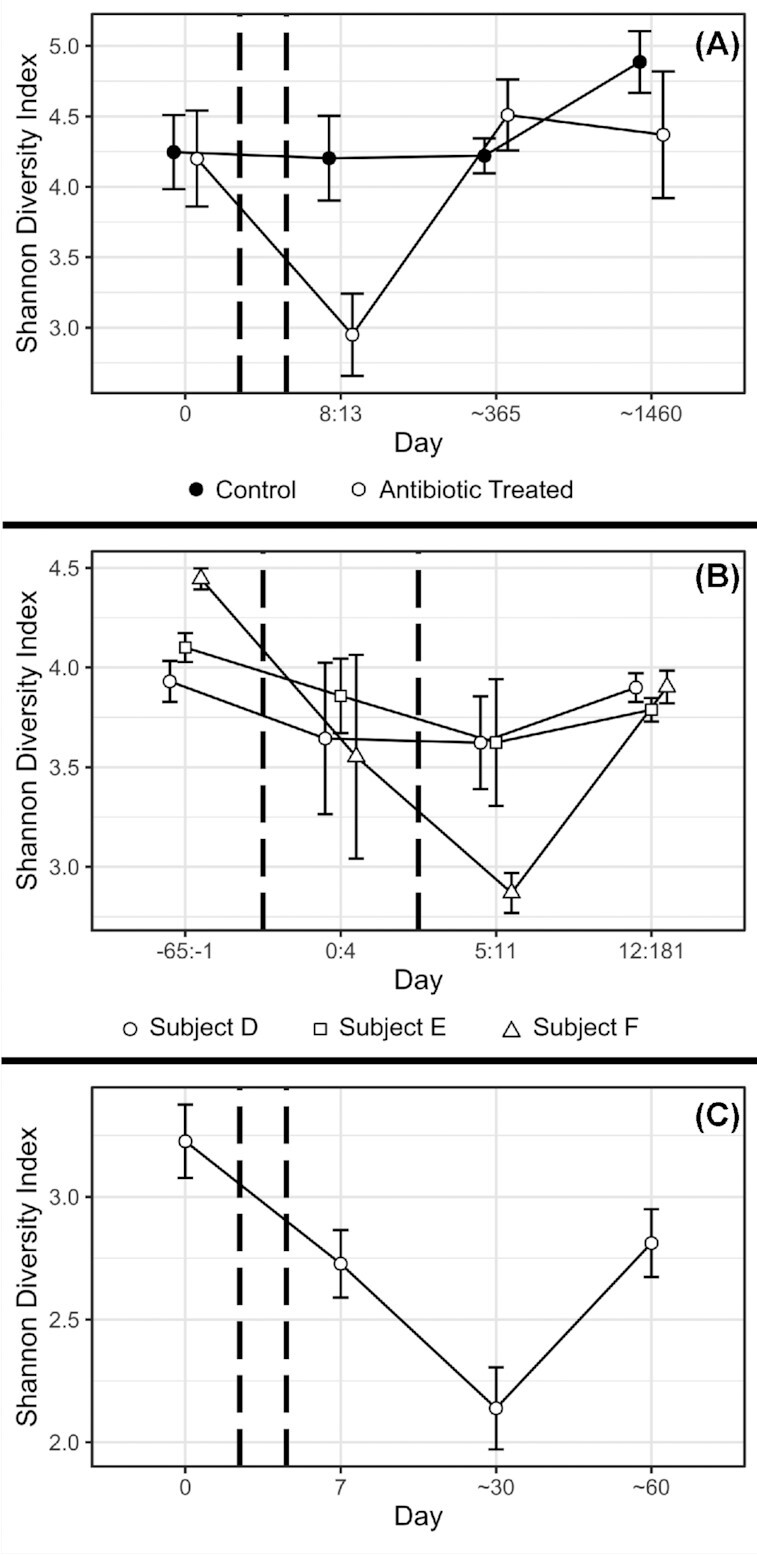
Example effects of antibiotic treatment on diversity of the gut microbiota. In all graphs, antibiotic treatment took place between pairs of dashed vertical lines, and error bars represent 1 standard error around the mean. Data for all graphs was processed and visualised using the 'vegan' package and the 'ggplot2' package in the R programming language (Wickham ; Oksanen et al.; R Core Team 2020). (A) Shows data from Table 5 (Supporting Information) of Jakobsson et al., representing three untreated controls and three subjects treated with a combination of two antibiotics (metronidazole and clarithromycin) and a proton pump inhibitor (omeprazole) (Jakobsson et al. 2010). (B) Shows data from only the first round of treatment covered by Supplementary Data set 1 of Dethlefsen & Relman, representing up to 40 samples from each of 3 subjects treated with ciprofloxacin (Dethlefsen and Relman 2011). (C) Shows data from only the clindamycin treatments covered by Zaura et al. and taxonomically classified by Supplementary Data 1 of Chng et al., representing nine subjects (Zaura et al. ; Chng et al. 2020).
Figure 3.
Figure 3.
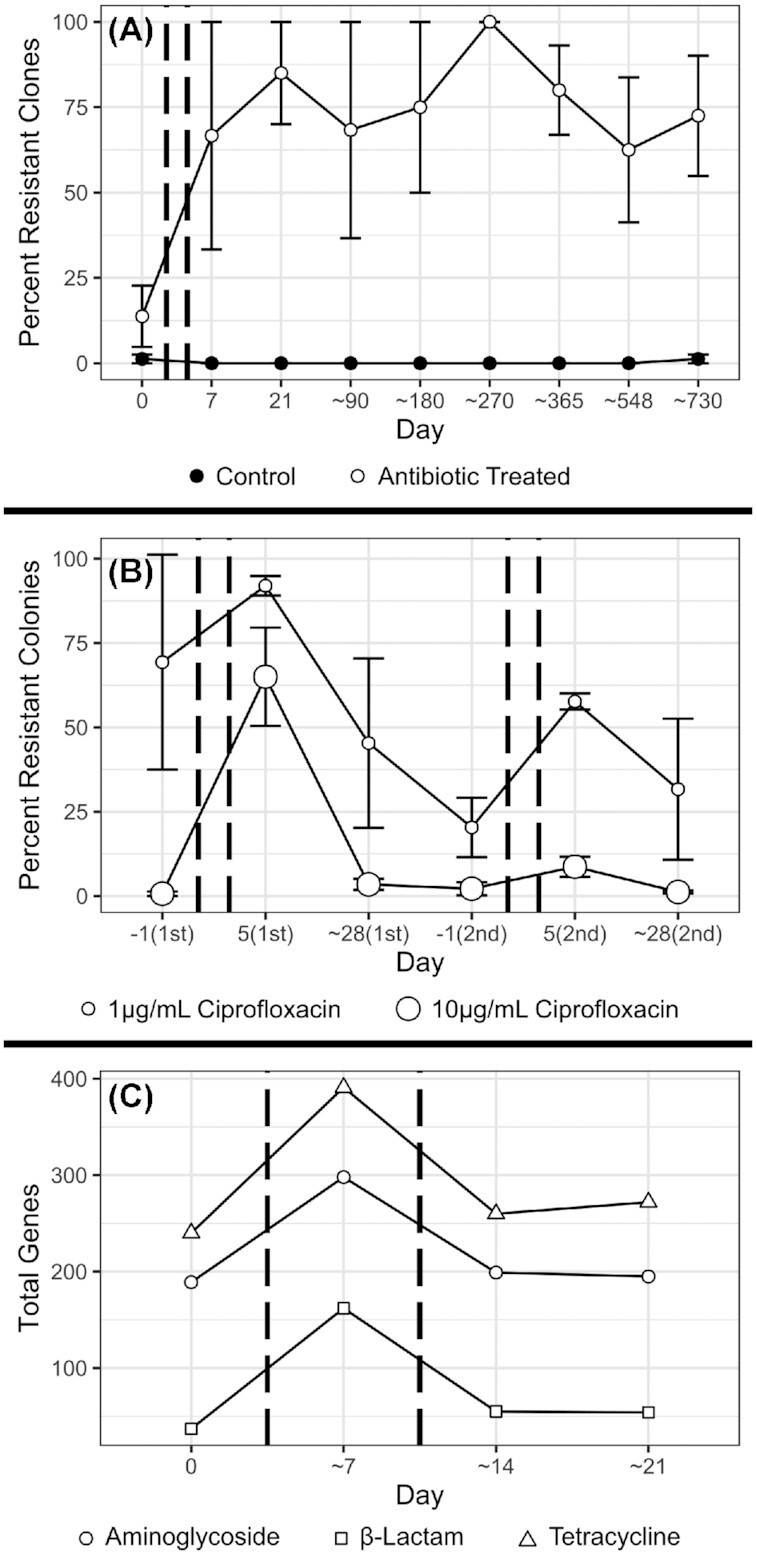
Example effects of antibiotic treatment on antibiotic resistance genes and phenotypes in the gut microbiota. In all graphs, antibiotic treatment took place between pairs of dashed vertical lines, and error bars, where present, represent one standard error around the mean. Data for all graphs was visualised using the 'ggplot2' package in the R programming language (Wickham ; R Core Team 2020). (A) shows data from Supplementary Figure 1 of Jernberg et al., representing the percentage of up to 20 Bacteroides clones from each of four untreated controls, and four subjects treated with clindamycin, which were not inhibited by 8 mg/L of clindamycin (Jernberg et al. 2007). (B) shows data from both rounds of treatment covered by Table 2 (Supporting Information) of Dethlefsen & Relman, representing the count of colonies grown on media supplemented with ciprofloxacin as a percentage of the count grown on media without ciprofloxacin, from 3 subjects treated with ciprofloxacin (Dethlefsen and Relman 2011). (C) shows data pooled from the placebo and probiotic treatments of Figure 7 of MacPherson et al., representing the total antibiotic resistance genes of 3 classes, detected in a microarray survey of samples from 70 subjects (MacPherson et al. 2018).
Figure 4.
Figure 4.
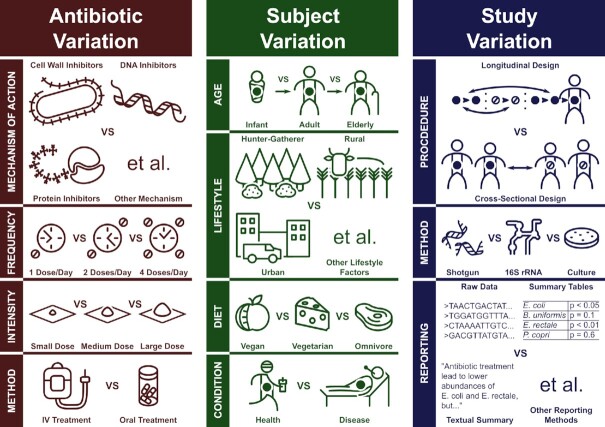
Summary of the main sources of variation that complicate investigation into the effects of antibiotic treatment on the ecology and evolution of the gut microbiome, as expanded upon in the main text.

References

    1. Abeles SR, Ly M, Santiago-Rodriguez TMet al. . Effects of long term antibiotic therapy on human oral and fecal viromes. PLoS One. 2015;10:e0134941. - PMC - PubMed
    1. Aminov R. A Brief History of the Antibiotic Era: lessons Learned and Challenges for the Future. Front Microbiol. 2010;1:134. - PMC - PubMed
    1. Aminov R. History of antimicrobial drug discovery: major classes and health impact. Biochem Pharmacol. 2017;133:4–19. - PubMed
    1. Amábile-Cuevas CF, Chicurel ME. Bacterial plasmids and gene flux. Cell. 1992;70:189–99. - PubMed
    1. Andersson DI, Hughes D.. Microbiological effects of sublethal levels of antibiotics. Nat Rev Microbiol. 2014;12:465–78. - PubMed

Publication types

MeSH terms

Substances