


Differentiation in stem and leaf traits among sympatric lianas, scandent shrubs and trees in a subalpine cold temperate forest
- PMID: 33823048
- PMCID: PMC8597974
- DOI: 10.1093/treephys/tpab049
Differentiation in stem and leaf traits among sympatric lianas, scandent shrubs and trees in a subalpine cold temperate forest
Abstract
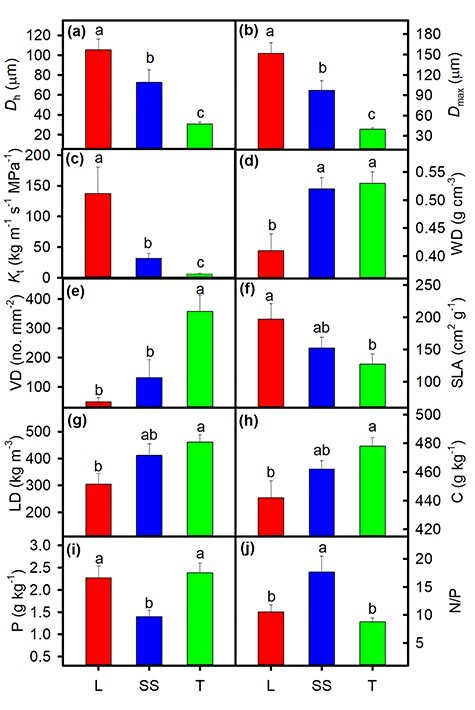
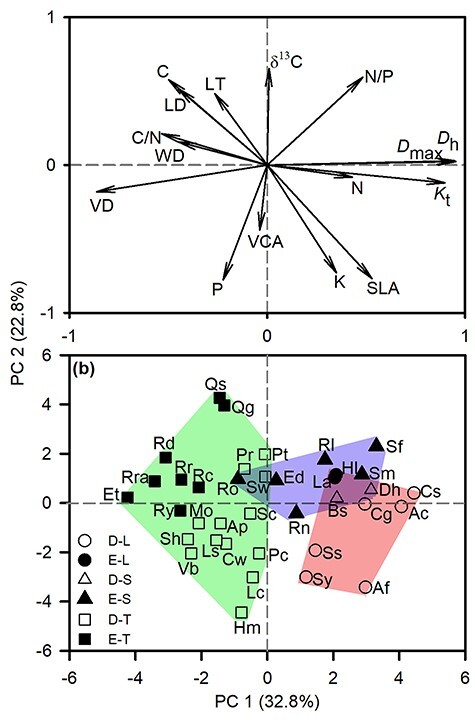
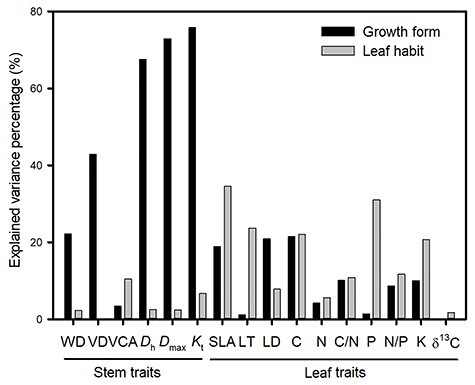
The scandent shrub plant form is a variant of liana that has upright and self-supporting stems when young but later becomes a climber. We aimed to explore the associations of stem and leaf traits among sympatric lianas, scandent shrubs and trees, and the effects of growth form and leaf habit on variation in stem or leaf traits. We measured 16 functional traits related to stem xylem anatomy, leaf morphology and nutrient stoichiometry in eight liana, eight scandent shrub and 21 tree species co-occurring in a subalpine cold temperate forest at an elevation of 2600-3200 m in Southwest China. Overall, lianas, scandent shrubs and trees were ordered along a fast-slow continuum of stem and leaf functional traits, with some traits overlapping. We found a consistent pattern of lianas > scandent shrubs > trees for hydraulically weighted vessel diameter, maximum vessel diameter and theoretical hydraulic conductivity. Vessel density and sapwood density showed a pattern of lianas = scandent shrubs < trees, and lianas < scandent shrubs = trees, respectively. Lianas had significantly higher specific leaf area and lower carbon concentration than co-occurring trees, with scandent shrubs showing intermediate values that overlapped with lianas and trees. The differentiation among lianas, scandent shrubs and trees was mainly explained by variation in stem traits. Additionally, deciduous lianas were positioned at the fast end of the trait spectrum, and evergreen trees at the slow end of the spectrum. Our results showed for the first time clear differentiation in stem and leaf traits among sympatric liana, scandent shrub and tree species in a subalpine cold temperate forest. This work will contribute to understanding the mechanisms responsible for variation in ecological strategies of different growth forms of woody plants.
Keywords: ecological strategy; functional traits; growth form; high elevation; leaf habit; nutrient stoichiometry; woody vine.
© The Author(s) 2021. Published by Oxford University Press.
Figures
Comment in
-
Stem functional traits, not just morphology, explain differentiation along the liana-tree continuum.Tree Physiol. 2021 Nov 8;41(11):1989-1991. doi: 10.1093/treephys/tpab117. Tree Physiol. 2021. PMID: 34505149 No abstract available.
Comment on
-
Stem functional traits, not just morphology, explain differentiation along the liana-tree continuum.Tree Physiol. 2021 Nov 8;41(11):1989-1991. doi: 10.1093/treephys/tpab117. Tree Physiol. 2021. PMID: 34505149 No abstract available.
References
-
- Asner GP, Martin RE (2012) Contrasting leaf chemical traits in tropical lianas and trees: implications for future forest composition. Ecol Lett 15:1001–1007. - PubMed
-
- Blomberg SP, Garland T, Ives AR (2003) Testing for phylogenetic signal in comparative data: behavioral traits are more labile. Evolution 57:717–745. - PubMed
-
- Campanello PI, Manzané E, Villagra Met al. (2016) Carbon allocation and water relations of lianas versus trees. In: Goldstein G, Santiago LS (eds) Tropical tree physiology. Springer, Cham, Switzerland, pp 103–124.
-
- Chave J, Coomes D, Jansen S, Lewis SL, Swenson NG, Zanne AE (2009) Towards a worldwide wood economics spectrum. Ecol Lett 12:351–366. - PubMed
Publication types
MeSH terms
LinkOut - more resources
Full Text Sources
Other Literature Sources
