


Barriers to physical distancing among healthcare workers on an academic hospital unit during the coronavirus disease 2019 (COVID-19) pandemic
- PMID: 33823950
- PMCID: PMC8111196
- DOI: 10.1017/ice.2021.154
Barriers to physical distancing among healthcare workers on an academic hospital unit during the coronavirus disease 2019 (COVID-19) pandemic
Abstract
Background: Physical distancing among healthcare workers (HCWs) is an essential strategy in preventing HCW-to-HCWs transmission of severe acute respiratory coronavirus virus 2 (SARS-CoV-2).
Objective: To understand barriers to physical distancing among HCWs on an inpatient unit and identify strategies for improvement.
Design: Qualitative study including observations and semistructured interviews conducted over 3 months.
Setting: A non-COVID-19 adult general medical unit in an academic tertiary-care hospital.
Participants: HCWs based on the unit.
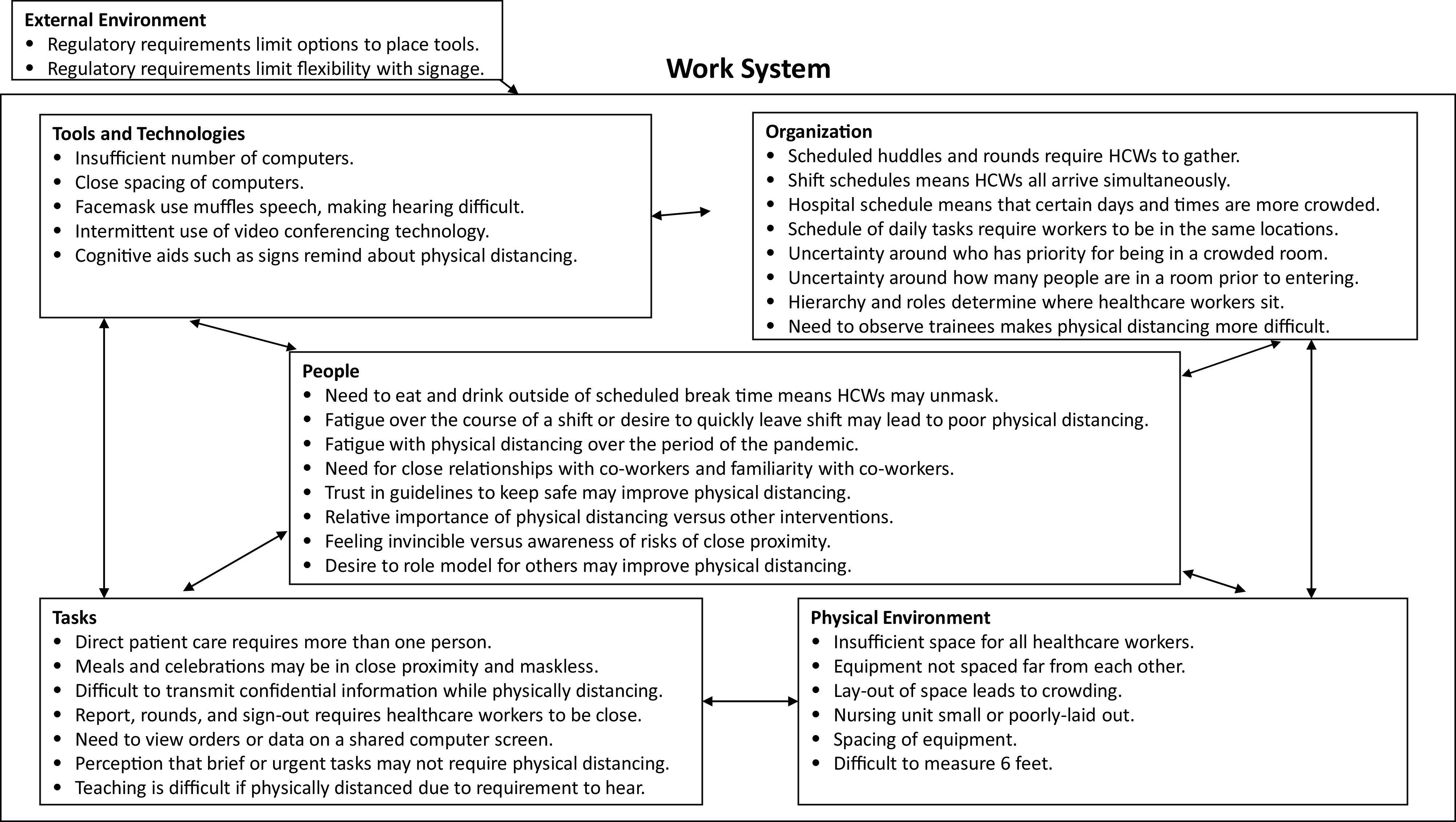
Methods: We performed a qualitative study in which we (1) observed HCW activities and proximity to each other on the unit during weekday shifts July-October 2020 and (2) conducted semi-structured interviews of HCWs to understand their experiences with and perspectives of physical distancing in the hospital. Qualitative data were coded based on a human-factors engineering model.
Results: We completed 25 hours of observations and 20 HCW interviews. High-risk interactions often occurred during handoffs of care at shift changes and patient rounds, when HCWs gathered regularly in close proximity for at least 15 minutes. Identified barriers included spacing and availability of computers, the need to communicate confidential patient information, and the desire to maintain relationships at work.
Conclusions: Physical distancing can be improved in hospitals by restructuring computer workstations, work rooms, and break rooms; applying visible cognitive aids; adapting shift times; and supporting rounds and meetings with virtual conferencing. Additional strategies to promote staff adherence to physical distancing include rewarding positive behaviors, having peer leaders model physical distancing, and encouraging additional safe avenues for social connection at a safe distance.
Figures
References
-
- Social distancing: keep a safe distance to stop the spread. Centers for Disease Control and Prevention website. https://www.cdc.gov/coronavirus/2019-ncov/prevent-getting-sick/social-di.... Published 2020. Updated November 17, 2020. Accessed March 19, 2021.
-
- Schneider S, Piening B, Nouri-Pasovsky PA, Kruger AC, Gastmeier P, Aghdassi SJS. SARS-CoV-2 cases in healthcare workers may not regularly originate from patient care: lessons from a university hospital on the underestimated risk of healthcare worker to healthcare worker transmission. Antimicrob Resist Infect Control 2020;9:192. - PMC - PubMed
-
- Knoll RL, Klopp J, Bonewitz G, et al. Containment of a large SARS-CoV-2 outbreak among healthcare workers in a pediatric intensive care unit. Pediatr Infect Dis J 2020;39(11):e336–e339. - PubMed
-
- Arora VM, Chivu M, Schram A, Meltzer D. Implementing physical distancing in the hospital: a key strategy to prevent nosocomial transmission of COVID-19. J Hosp Med 2020;15:290–291. - PubMed
-
- Wilson JR, Haines H, Morris W. Participatory ergonomics. In: Wilson JR, Corlett EN, eds. Evaluation of Human Work, 3rd edition. Boca Raton, FL: Taylor and Francis; 2005:933–962.
Publication types
MeSH terms
LinkOut - more resources
Full Text Sources
Other Literature Sources
Medical
Miscellaneous
