


'A bridge over troubled water': a case report
- PMID: 33824938
- PMCID: PMC8010337
- DOI: 10.1093/ehjcr/ytab109
'A bridge over troubled water': a case report
Abstract
Background: Myocardial bridge (MB) is the most common inborn coronary artery variant, in which a portion of myocardium overlies a major epicardial coronary artery segment. Myocardial bridge has been for long considered a benign condition, although it has been shown to cause effort-related ischaemia.
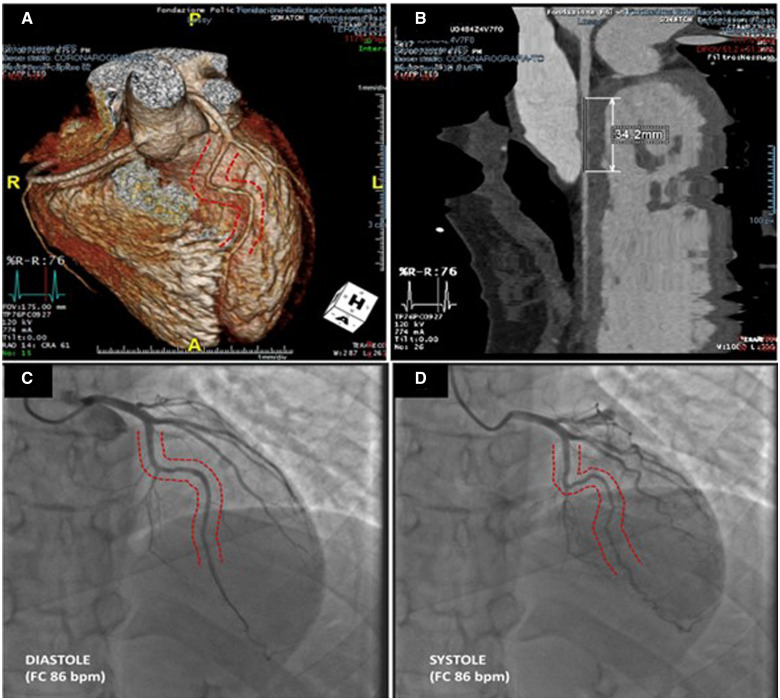
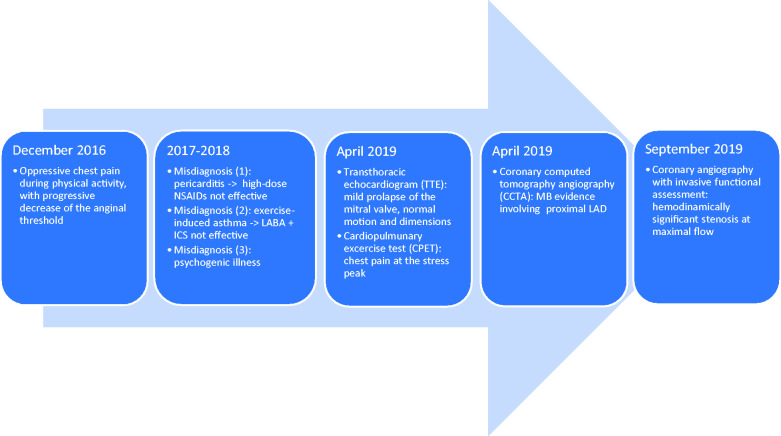
Case summary: We present the case of a 17-year-old female patient experiencing chest pain during physical activity. Since her symptoms became unbearable, electrocardiogram and echocardiography were performed together with a coronary computed tomography scan, revealing an MB on proximal-mid left anterior descending artery. In order to unequivocally unmask the ischaemic burden lent by MB, the patient underwent coronary angiography and physiological invasive test: instantaneous wave-free ratio (iFR) and fractional flow reserve (FFR) were calculated, both at baseline and after dobutamine infusion (5 µg/kg/min). At baseline, iFR value was borderline (= 0.89), whereas after dobutamine infusion and increase in the heart rate, the patient suffered chest pain. This symptom was associated with a decrease in the iFR value up to 0.77. Consistently, when FFR was performed, a value of 0.92 was observed at baseline, while after inotrope infusion the FFR reached the haemodynamic significance (= 0.79). Therefore, a medical treatment with bisoprolol was started.
Discussion: Our clinical case shows the importance of a comprehensive non-invasive and invasive assessment of MB in young patients experiencing chest pain, with significant limitation in the daily life. The coronary functional indexes allow to detect the presence of MB-derived ischaemia, thus guiding the decision to undertake a medical/surgical therapy.
Keywords: Case report; Chest pain; Functional intracoronary assessment; Ischaemic heart disease; Myocardial bridge.
© The Author(s) 2021. Published by Oxford University Press on behalf of the European Society of Cardiology.
Figures




References
-
- Ciçek D, Kalay N, Müderrisoğlu H.. Incidence, clinical characteristics, and 4-year follow-up of patients with isolated myocardial bridge: a retrospective, single-center, epidemiologic, coronary arteriographic follow-up study in southern Turkey. Cardiovasc Revasc Med 2011;12:25–28. - PubMed
-
- Pelliccia A, Adami PE, Quattrini F, Squeo MR, Caselli S, Verdile L. et al. Are Olympic athletes free from cardiovascular disease? Systematic investigation in 2352 participants from Athens 2004 to Sochi 2014. Br J Sports Med 2017;51:238–243. - PubMed
-
- Forsdahl SH, Rogers IS, Schnittger I, Tanaka S, Kimura T, Pargaonkar VS. et al. Myocardial bridges on coronary computed tomography angiography-correlation with intravascular ultrasound and fractional flow reserve. Circ J 2017;81:1894–1900. - PubMed
-
- Wang Y, Lv B, Chen J, Zhang Y, Luo F, Lu N. et al. Intramural coronary arterial course is associated with coronary arterial stenosis and prognosis of major cardiac events. Arterioscler Thromb Vasc Biol 2013;33:439–444. - PubMed
Publication types
LinkOut - more resources
Full Text Sources
Other Literature Sources
Medical
Miscellaneous