Review
. 2021 Jun 29;31(6):667-680.
doi: 10.1093/glycob/cwab024.

Vaginal sialoglycan foraging by Gardnerella vaginalis: mucus barriers as a meal for unwelcome guests?

Affiliations
Review

Vaginal sialoglycan foraging by Gardnerella vaginalis: mucus barriers as a meal for unwelcome guests?

Kavita Agarwal et al. Glycobiology. .

Abstract

Bacterial vaginosis (BV) is a condition of the vaginal microbiome in which there are few lactobacilli and abundant anaerobic bacteria. Members of the genus Gardnerella are often one of the most abundant bacteria in BV. BV is associated with a wide variety of poor health outcomes for women. It has been recognized since the 1980s that women with BV have detectable and sometimes markedly elevated levels of sialidase activity in vaginal fluids and that bacteria associated with this condition produce this activity in culture. Mounting evidence collected using diverse methodologies points to the conclusion that BV is associated with a reduction in intact sialoglycans in cervicovaginal secretions. Here we review evidence for the contributions of vaginal bacteria, especially Gardnerella, in the processes of mucosal sialoglycan degradation, uptake, metabolism and depletion. Our understanding of the impacts of vaginal sialoglycan degradation is still limited. However, the potential implications of sialic acid depletion are discussed in light of our current understanding of the roles played by sialoglycans in vaginal physiology.

Keywords: Gardnerella; bacterial vaginosis; microbiome; sialic acid; sialidase.


Figures

Fig. 1
Fig. 1
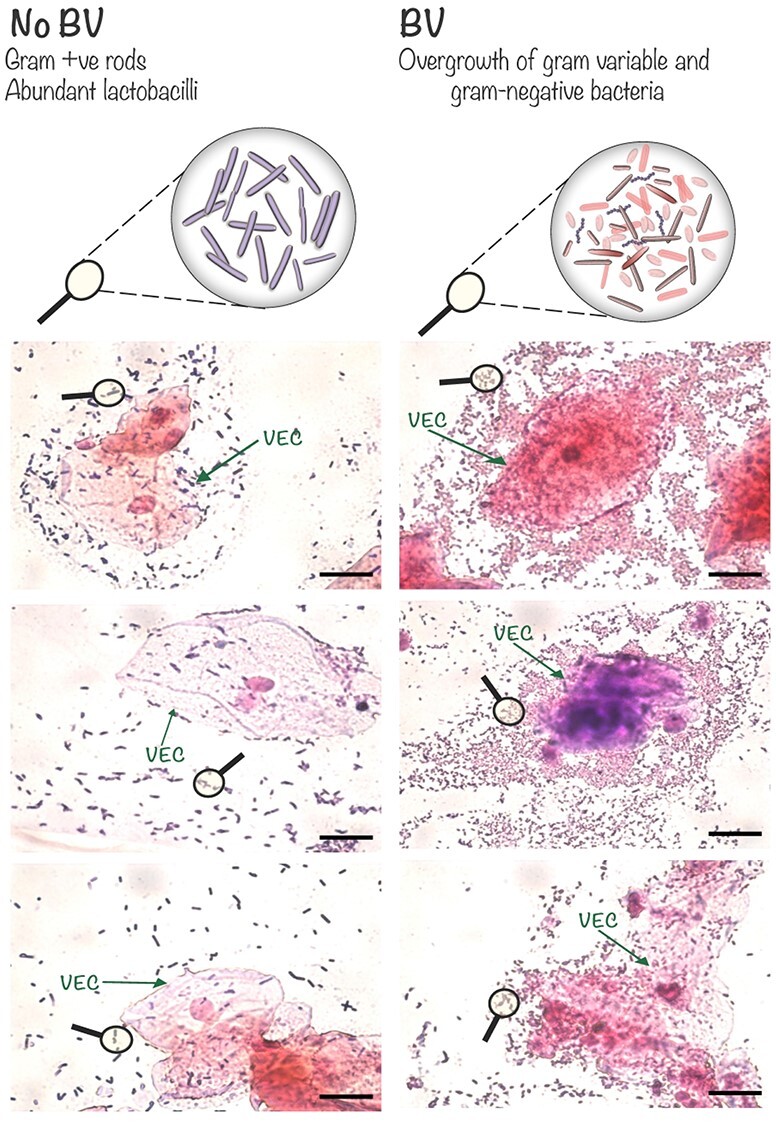
Images of Gram-stained vaginal smears depict some of the microscopic features of BV. Top: schematic magnification illustrating features of the Nugent scoring system (Nugent et al. 1991), in which an abundance of large Gram-positive (purple) rods contributes to a low score (0–3, No BV, left). In contrast, diverse morphotypes of Gram-negative (pink) and Gram-variable bacteria with low levels of long Gram-positive rods contributes to a high Nugent score (7–10, BV, right). Note the higher numbers of bacteria in BV specimens and their tendency to be concentrated around vaginal epithelial cells (VECs). Scale bars = 20 μm.
Fig. 2
Fig. 2
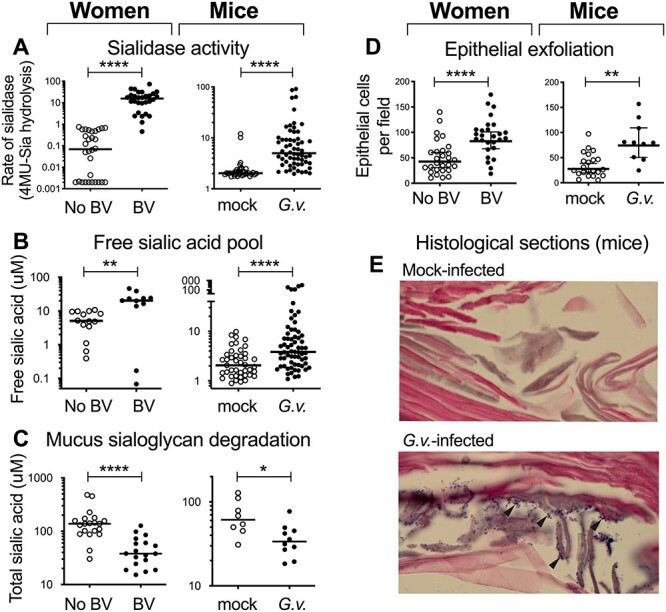
Mouse model of Gardnerella infection replicates features of BV. Representative data from multiple publications directly compare some of the phenotypes of G. vaginalis colonized mice to features of BV in women. (A) Sialidase activity in vaginal fluids measured with the 4-Methylumbelliferone (4MU)-Sia assay. (B-C) Free and total sialic acids measured by fluorescent derivatization and HPLC resolution. (D) Epithelial cells in vaginal washes counted by blinded observers. (E) Hematoxylin and eosin (H&E)-stained vaginal sections reveal bacteria (purple puncta indicated by arrowheads) on the epithelium (pink) of Gardnerella infected mice. *P < 0.05, **P < 0.01, ****P < 0.0001. Adapted from data previously published (Gilbert et al. 2013; Lewis et al. 2013).
Fig. 3
Fig. 3
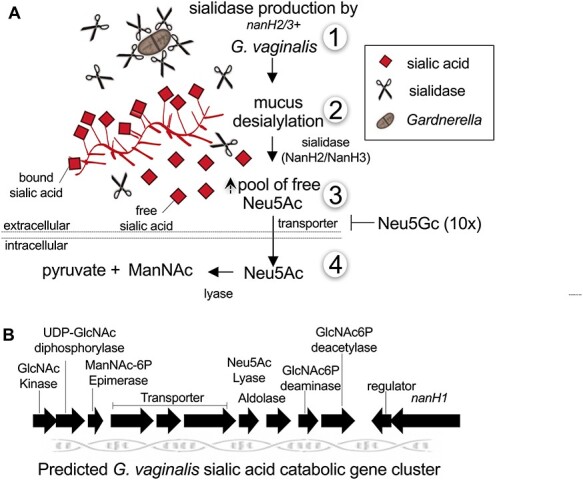
A model of Gardnerella sialoglycan foraging and depletion. (A) Model based on biochemical evidence for G. vaginalis sialoglycan degradation and foraging in the vagina. 1) G. vaginalis strains with nanH2 or nanH3 in their genomes produce sialidase activity in culture. 2) Free sialic acid is released by sialidases NanH2 or NanH3 from mucosal sialo-glycoconjugates such as mucin and secretory IgA. 3) Extracellular free Neu5Ac can be transported into the bacteria, depleting them from the culture or assay supernatant. In G. vaginalis the transport of Neu5Ac is inhibited by presence of high concentrations of Neu5Gc. 4) Intracellular sialic acid (Neu5Ac) is converted to N-acetyl mannosamine (ManNAc) and pyruvate by a sialic acid lyase. (B) The predicted sialic acid catabolic gene cluster of G. vaginalis. Predictions are based on homology and have not been functionally tested. Note that the sialidases of G. vaginalis, NanH2 and NanH3 are encoded elsewhere in the genome. There are some strains that encode putative catabolic machinery for sialic acid without encoding NanH2 or NanH3. Note that multiple BV bacteria encode sialidases and/or sialic acid catabolic machinery (Lewis et al. 2013).
Fig. 4
Fig. 4
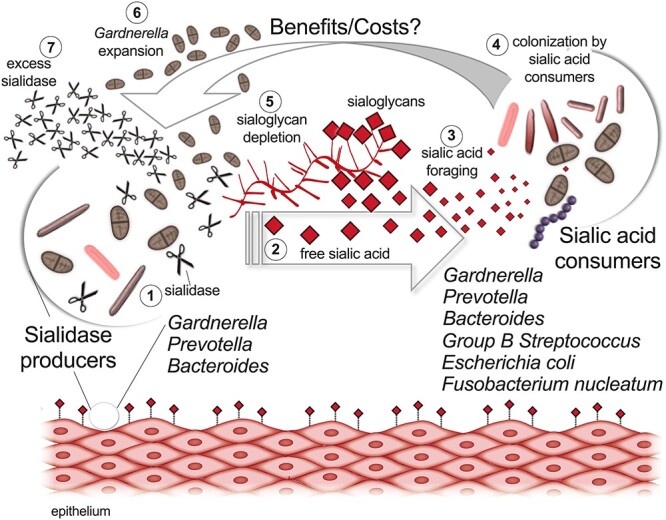
A model of sialoglycan degradation and foraging by vaginal bacteria. 1) Sialidase-producing bacteria including members of the Gardnerella, Prevotella and Bacteroides express sialidases, leading to sialidase activity in vaginal fluids, and 2) creating higher levels of free sialic acid. 3) Free sialic acid is taken up and catabolized by not only sialidase-producing bacteria, but taxonomic groups that do not encode their own sialidases, such as group B Streptococcus, E. coli and Fusobacterium nucleatum. 4) Improved growth or colonization by sialic acid consumers can in turn lead to 5) Sialoglycan depletion and 6) benefits or costs for other community members (e.g. expansion of Gardnerella) and 7) increase in sialidase (Agarwal et al. 2020).

References

    1. Agarwal K, Robinson LS, Aggarwal S, Foster LR, Hernandez-Leyva A, Lin H, Tortelli BA, O'Brien VP, Miller L, Kau AL, et al. 2020. Glycan cross-feeding supports mutualism between Fusobacterium and the vaginal microbiota. PLoS Biol. 18:e3000788. - PMC - PubMed
    1. Ali SR, Fong JJ, Carlin AF, Busch TD, Linden R, Angata T, Areschoug T, Parast M, Varki N, Murray J, et al. 2014. Siglec-5 and Siglec-14 are polymorphic paired receptors that modulate neutrophil and amnion signaling responses to group B Streptococcus. J Exp Med. 211:1231–1242. - PMC - PubMed
    1. Amsel R, Totten PA, Spiegel CA, Chen KC, Eschenbach D, Holmes KK. 1983. Nonspecific vaginitis. Diagnostic criteria and microbial and epidemiologic associations. Am J Med. 74:14–22. - PubMed
    1. Balashov SV, Mordechai E, Adelson ME, Gygax SE. 2014. Identification, quantification and subtyping of Gardnerella vaginalis in noncultured clinical vaginal samples by quantitative PCR. J Med Microbiol. 63:162–175. - PubMed
    1. Berardi-Grassias L, Roy O, Berardi JC, Furioli J. 1988. Neonatal meningitis due to Gardnerella vaginalis. Eur J Clin Microbiol Infect Dis. 7:406–407. - PubMed

Publication types