


MEVITEM-a phase I/II trial of vismodegib + temozolomide vs temozolomide in patients with recurrent/refractory medulloblastoma with Sonic Hedgehog pathway activation
- PMID: 33825892
- PMCID: PMC8563312
- DOI: 10.1093/neuonc/noab087
MEVITEM-a phase I/II trial of vismodegib + temozolomide vs temozolomide in patients with recurrent/refractory medulloblastoma with Sonic Hedgehog pathway activation
Abstract
Background: Vismodegib specifically inhibits Sonic Hedgehog (SHH). We report results of a phase I/II evaluating vismodegib + temozolomide (TMZ) in immunohistochemically defined SHH recurrent/refractory adult medulloblastoma.
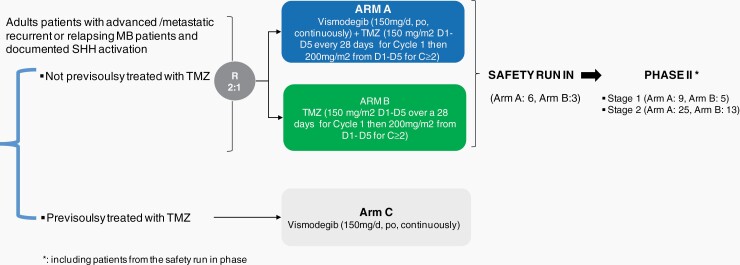
Methods: TMZ-naïve patients were randomized 2:1 to receive vismodegib + TMZ (arm A) or TMZ (arm B). Patients previously treated with TMZ were enrolled in an exploratory cohort of vismodegib (arm C). If the safety run showed no excessive toxicity, a Simon's 2-stage phase II design was planned to explore the 6-month progression-free survival (PFS-6). Stage II was to proceed if arm A PFS-6 was ≥3/9 at the end of stage I.
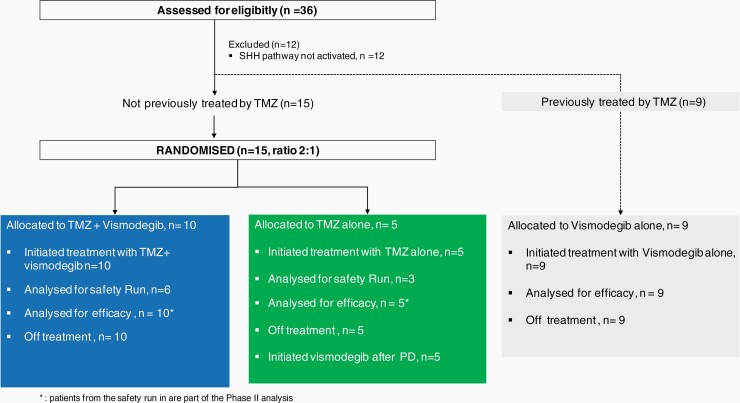
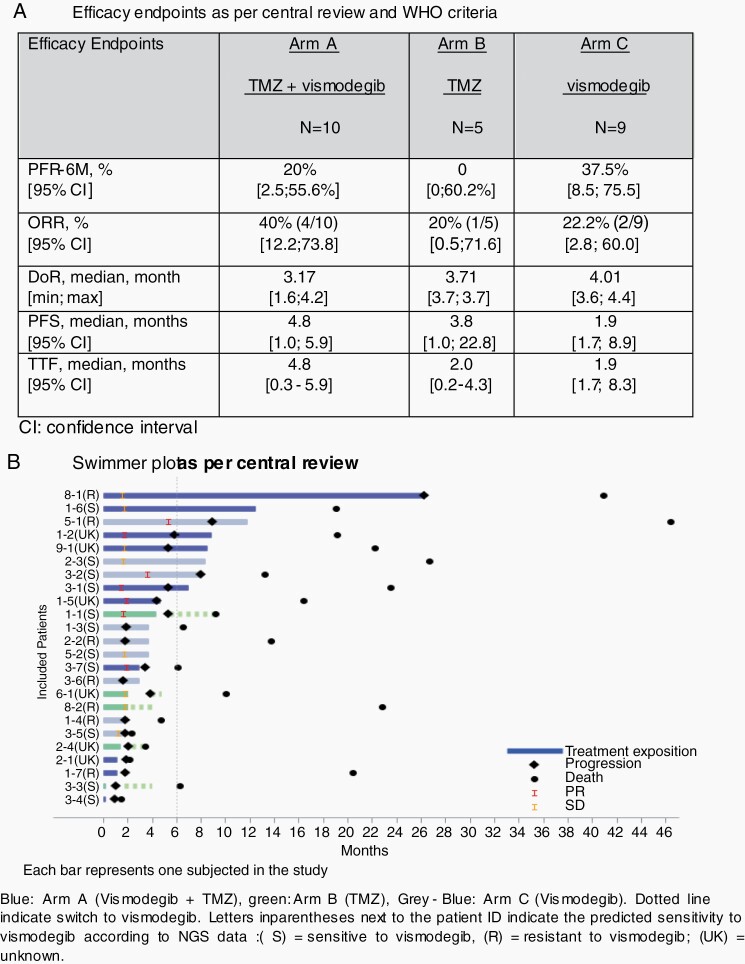
Results: A total of 24 patients were included: arm A (10), arm B (5), and arm C (9). Safety analysis showed no excessive toxicity. At the end of stage I, the PFS-6 of arm A was 20% (2/10 patients, 95% unilateral lower confidence limit: 3.7%) and the study was prematurely terminated. The overall response rates (ORR) were 40% (95% CI, 12.2-73.8) and 20% (95% CI, 0.5-71.6) in arm A and B, respectively. In arm C, PFS-6 was 37.5% (95% CI, 8.8-75.5) and ORR was 22.2% (95% CI, 2.8-60.0). Among 11 patients with an expected sensitivity according to new generation sequencing (NGS), 3 had partial response (PR), 4 remained stable disease (SD) while out of 7 potentially resistant patients, 1 had PR and 1 SD.
Conclusion: The addition of vismodegib to TMZ did not add toxicity but failed to improve PFS-6 in SHH recurrent/refractory medulloblastoma. Prediction of sensitivity to vismodegib needs further refinements.
Keywords: SHH pathway; SMO inhibition; medulloblastoma.
© The Author(s) 2021. Published by Oxford University Press on behalf of the Society for Neuro-Oncology. All rights reserved. For permissions, please e-mail: journals.permissions@oup.com.
Figures
Comment in
-
An early foray with targeted therapy and inspiring novel approaches to combat adult medulloblastoma.Neuro Oncol. 2021 Nov 2;23(11):1814-1815. doi: 10.1093/neuonc/noab179. Neuro Oncol. 2021. PMID: 34270765 Free PMC article. No abstract available.
-
Possible mechanisms and biomarkers of resistance to vismodegib in SHH medulloblastoma.Neuro Oncol. 2022 Jul 1;24(7):1210-1211. doi: 10.1093/neuonc/noac061. Neuro Oncol. 2022. PMID: 35552442 Free PMC article. No abstract available.
-
Reply to Roesler et al. concerning the MEVITEM trial.Neuro Oncol. 2022 Jul 1;24(7):1212. doi: 10.1093/neuonc/noac084. Neuro Oncol. 2022. PMID: 35552748 Free PMC article. No abstract available.
References
-
- Frappaz D, Faure-Conter C, Bonneville Levard A, Barritault M, Meyronet D, Sunyach MP. Medulloblastomas in adolescents and adults—can the pediatric experience be extrapolated? Neurochirurgie. 2021;67(1):76–82. - PubMed
-
- von Bueren AO, Friedrich C, von Hoff K, et al. Metastatic medulloblastoma in adults: outcome of patients treated according to the HIT2000 protocol. Eur J Cancer. 2015;51(16):2434–2443. - PubMed
-
- Franceschi E, Bartolotti M, Paccapelo A, et al. Adjuvant chemotherapy in adult medulloblastoma: is it an option for average-risk patients? J Neurooncol. 2016;128(2):235–240. - PubMed
-
- Carrie C, Lasset C, Alapetite C, et al. Multivariate analysis of prognostic factors in adult patients with medulloblastoma. Retrospective study of 156 patients. Cancer. 1994;74(8):2352–2360. - PubMed
Publication types
MeSH terms
Substances
LinkOut - more resources
Full Text Sources
Other Literature Sources
Research Materials
Miscellaneous
