


Sleep and asthma management in youth with poorly-controlled asthma and their caregivers: a qualitative approach
- PMID: 33827372
- PMCID: PMC10072859
- DOI: 10.1080/02770903.2021.1914650
Sleep and asthma management in youth with poorly-controlled asthma and their caregivers: a qualitative approach
Abstract
Objective: Youth with poorly-controlled asthma are at increased risk for sleep disturbances caused by nocturnal symptoms like coughing. Asthma-related sleep disturbances can have downstream consequences for youth with asthma and their families. This study aims to describe (1) sleep disturbances in adolescents with poorly-controlled asthma and their caregivers and (2) the relationship between sleep and asthma management.
Methods: Adolescents with poorly-controlled asthma and their caregivers completed the Family Asthma Management System Scale (FAMSS), a semi-structured interview that assesses youth asthma management within the family context. Interviews were audio-recorded and transcribed. Two authors coded each transcript for sleep-related data in NVivo using descriptive content analysis.
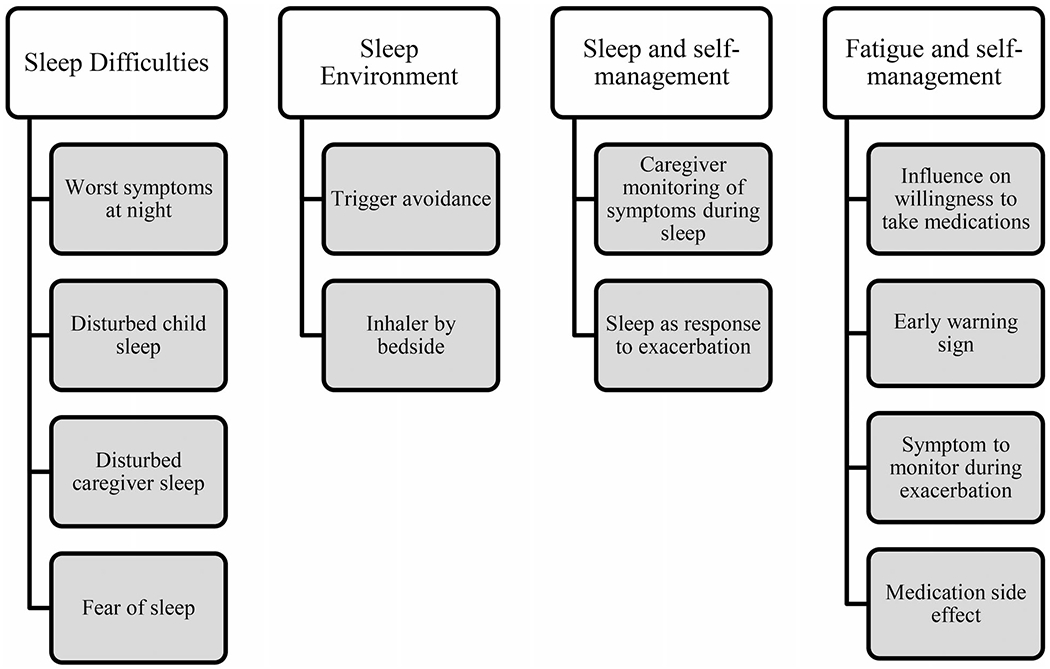
Results: Thirty-three adolescents ages 12-15 years old (M = 13.2, SD = 1.2) with poorly-controlled asthma and their caregivers participated in this study. Four main themes emerged: sleep difficulties, sleep environment, sleep and self-management, and fatigue and self-management. 42% of youth and caregivers reported worse nocturnal asthma symptoms (e.g. coughing) that caused frequent nighttime awakening. Approximately 27% of caregivers expressed distress over their child's nocturnal asthma and described their management strategies (e.g. co-sleeping, nighttime symptom monitoring). Adolescents described sleepiness as a barrier to asthma self-management tasks (e.g. medication adherence, response to exacerbation).
Conclusion: Interview responses demonstrated the considerable interrelationship of sleep and asthma management in adolescents with poorly-controlled asthma. Asthma providers should consider discussing sleep difficulties with their adolescent patients and their families. Addressing these difficulties may help adolescents improve their asthma self-management and help caregivers better cope with their child's disease.
Keywords: Adolescents; family; fatigue; self-management; sleep disturbance.
Conflict of interest statement
Declaration of interest
The authors report no conflicts of interest.
References
-
- Centers for Disease Control and Prevention. Most recent national asthma data. 2020. Available from: https://www.cdc.gov/asthma/most_recent_national_asthma_data.htm [last accessed 1 October 2020].
-
- National Heart, Lung, and Blood Institute. Expert Panel Report 3 (EPR-3): guidelines for the diagnosis and management of asthma-summary report 2007. Available from: https://www.nhlbi.nih.gov/sites/default/files/media/docs/EPR-3_Asthma_Fu... [last accessed 1 October 2020].
Publication types
MeSH terms
Grants and funding
LinkOut - more resources
Full Text Sources
Other Literature Sources
Medical
