


Psychosocial burden and professional and social support in patients with hereditary transthyretin amyloidosis (ATTRv) and their relatives in Italy
- PMID: 33827635
- PMCID: PMC8028211
- DOI: 10.1186/s13023-021-01812-6
Psychosocial burden and professional and social support in patients with hereditary transthyretin amyloidosis (ATTRv) and their relatives in Italy
Abstract
Background: Hereditary transthyretin amyloidosis (hATTR), alias ATTR variant (ATTRv) is a severe and disabling disease causing sensory and motor neuropathy, autonomic dysfunction, and cardiomyopathy. The progressive decline of patient's functional autonomy negatively affects the patient's quality of life and requires increasing involvement of relatives in the patient's daily life. Family caregiving may become particularly demanding when the patient is no longer able to move independently. This study is focused on the psychosocial aspects of ATTRv from the patient and relative perspectives. In particular, it explored: the practical and psychological burdens experienced by symptomatic patients with ATTRv and their key relatives and the professional and social network support they may rely on; whether burden varied in relation to patients' and relatives' socio-demographic variables, patients' clinical variables, and perceived professional and social network support; and, any difference in burden and support between patients and their matched relatives.
Methods: The study was carried out on symptomatic patients included in the ATTRv Italian national registry and living with at least one adult relative not suffering from severe illness and being free from ATTRv symptoms. Patients and relatives' assessments were performed using validated self-reported tools.
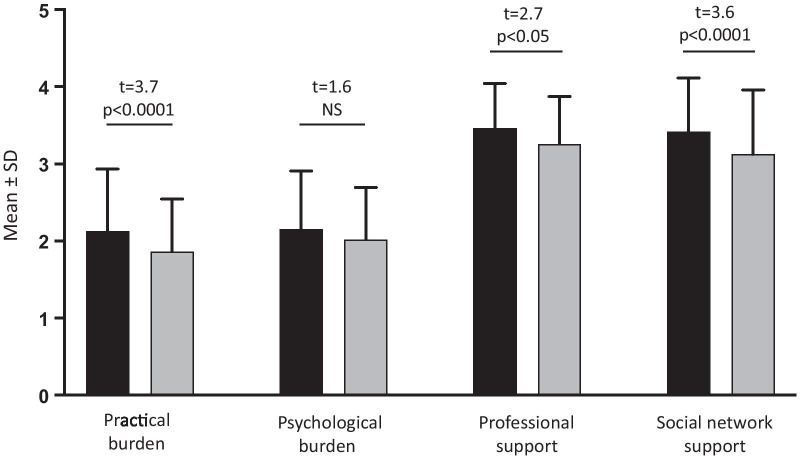
Results: Overall, 141 patients and 69 relatives were evaluated. Constraints of leisure activities, feelings of loss and worries for the future were the consequences of ATTRv most frequently reported by patients and relatives. Both in patients and their relatives, the burden increased with the duration of symptoms and the level of help in daily activities needed by the patient. In the 69 matched patient-relative pairs, the practical burden was significantly higher among the patients than among their relatives, while the psychological burden was similar in the two groups. Moreover, compared to their relatives, patients with ATTRv reported higher levels of professional and social network support.
Conclusions: These results show that ATTRv is a disease affecting quality of life of both patients and their families. Supporting interventions should be guaranteed to patients, to facilitate their adaptation to the disease, and to their families, to cope as best as possible with the difficulties that this pathology may involve.
Keywords: ATTRv; Burden; Caregiving; Hereditary transthyretin amyloidosis; Professional support; Social network support.
Conflict of interest statement
LO acknowledges speaker and consulting honoraria from Alnylam, Akcea and Pfizer; AM discloses having been on the advisory board for Alnylam, Akcea, and Pfizer; MR acknowledges speaker fee and consulting honoraria from Pfizer, and travel grant from Alnylam and Akcea; FC discloses being is in the Advisory Board of Pfizer and AKCEA; SF received speaking honoraria from Alnylam, Akcea, Pfizer, and travel grants from Alnylam and Akcea; ML received financial grants (honoraria and speaking) from Ackea, Alnylam, and Pfizer,and travel grants from Ackea, Alnylam, Pfizer, Kedrion, Csl Behring, and Grifols; MT reports a training grant from Pfizer and travel grant from Alnylam; LL received board grants from Akcea therapeutics; LGP received financial grants (honoraria and speaking) from Akcea and Alnylam, and travel grants from Akcea, Alnylam, and Pfizer; GC received a grant as temporary researcher in the GUP15010 study; AM received financial grants (honoraria and speaking) from Akcea and Alnylam; FM received speaker and consulting honoraria from Alnylam and Akcea; GA received advisory board honoraria and travel grant from Alnylam and Akcea; MG acknowledges donations from Sanofi Genzyme to support research activities, financial support from Pfizer, Alnylam and Sanofi Genzyme for participation in National and International Meetings; participation in Advisory Board of Pfizer; speaker honorarium from Sanofi Genzyme; GMF discloses having been on Advisory Boards for Alnylam and Akcea; he acknowledges speaker fee from Akcea and travel grant from Pfizer and Akcea; MS received financial grants (honoraria and speaking) from Ackea and Alnylam and travel grants from Grifols; DP served in advisory board for Alnylam and Akcea, received speaker honorarium from Alnylam and travel grants from Alnylam and Pfizer; FP acknowledges speaker fee and consulting honoraria from Alnylam, Akcea and Pfizer; FP Advisory Board Pfizer and AKCEA; GV acknowledges speaker fee and consulting honoraria from Alnylam, Akcea and Pfizer; LM, CS, GM, ST declare that they have no competing interests.
Figures
References
-
- Holmgren G, Costa PM, Andersson C, Asplund K, Steen L, Beckman L, Nylander PO, Teixeira A, Saraiva MJ, Costa PP. Geographical distribution of TTR met30 carriers in northern Sweden: discrepancy between carrier frequency and prevalence rate. J Med Genet. 1994;31(5):351–354. doi: 10.1136/jmg.31.5.351. - DOI - PMC - PubMed
-
- Parman Y, Adams D, Obici L, Galán L, Guergueltcheva V, Suhr OB, Coelho T, European Network for TTR-FAP (ATTReuNET). Sixty years of transthyretin familial amyloid polyneuropathy (TTR-FAP) in Europe: where are we now? A European network approach to defining the epidemiology and management patterns for TTR-FAP. Curr Opin Neurol. 2016;29:S3–S13. 10.1097/WCO.0000000000000288 - PMC - PubMed
Publication types
MeSH terms
Supplementary concepts
LinkOut - more resources
Full Text Sources
Other Literature Sources
Research Materials
