


Initial Upper Palaeolithic humans in Europe had recent Neanderthal ancestry
- PMID: 33828320
- PMCID: PMC8026394
- DOI: 10.1038/s41586-021-03335-3
Initial Upper Palaeolithic humans in Europe had recent Neanderthal ancestry
Abstract
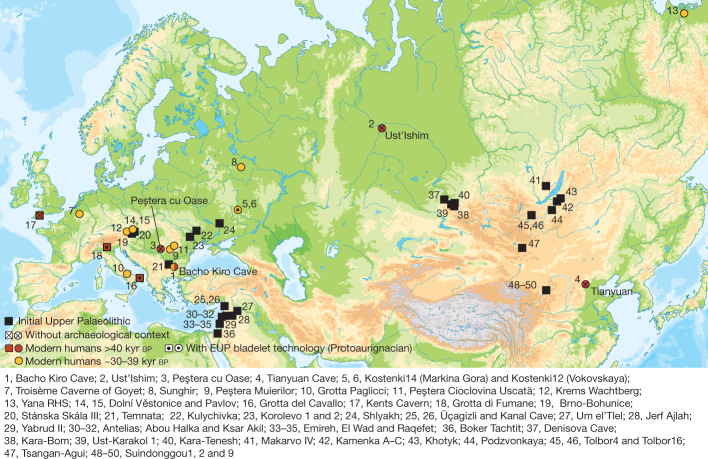
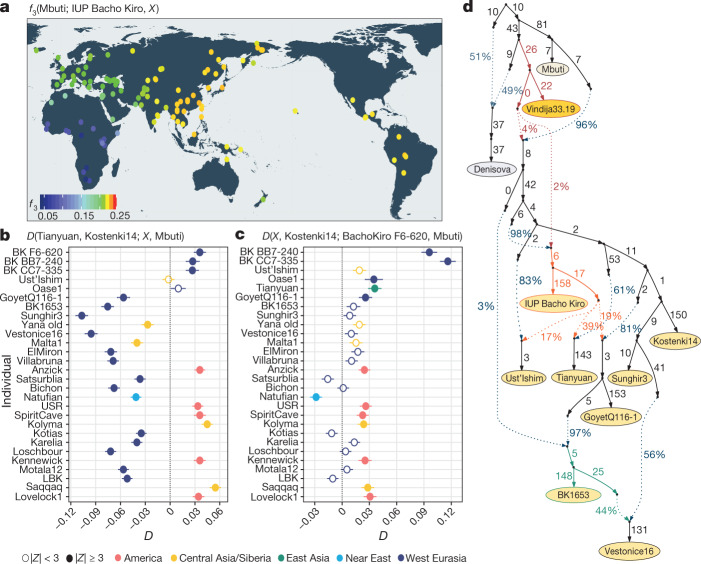
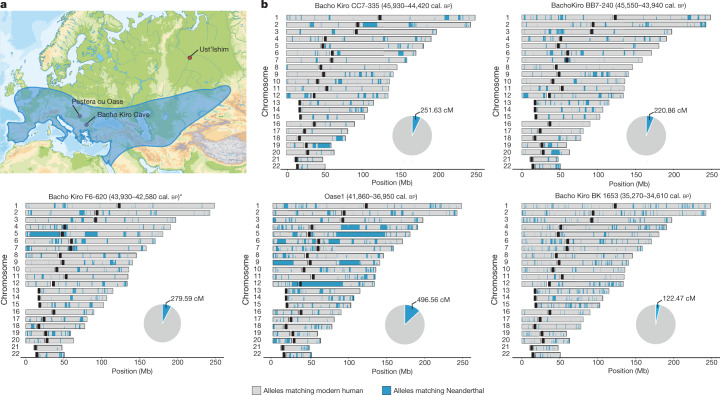
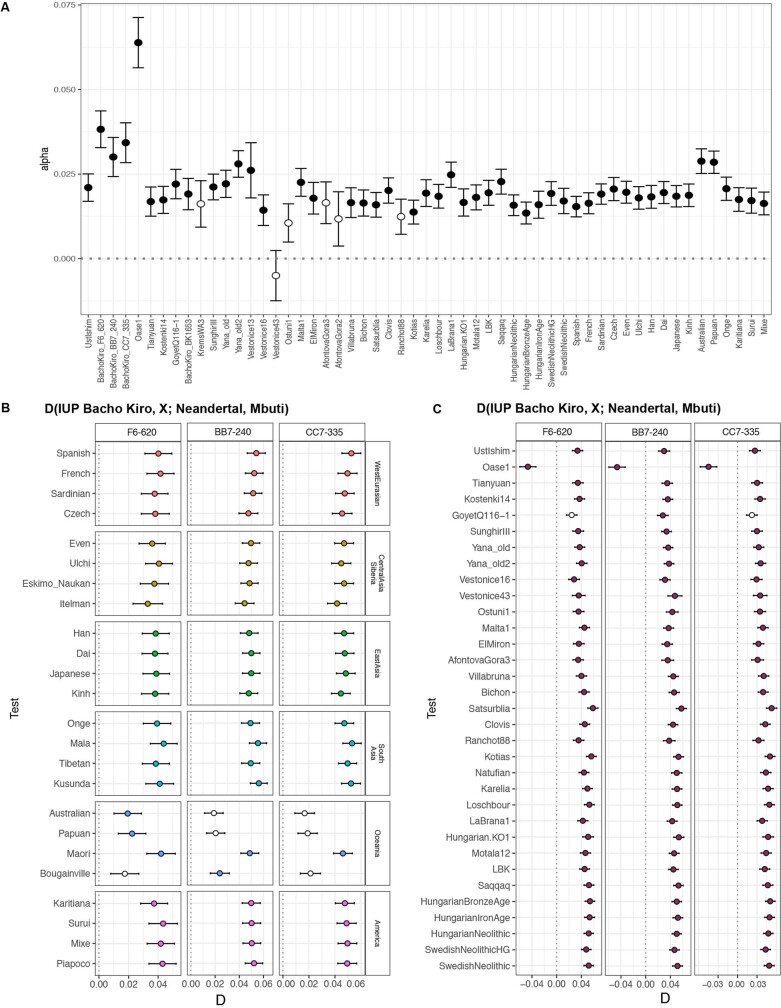
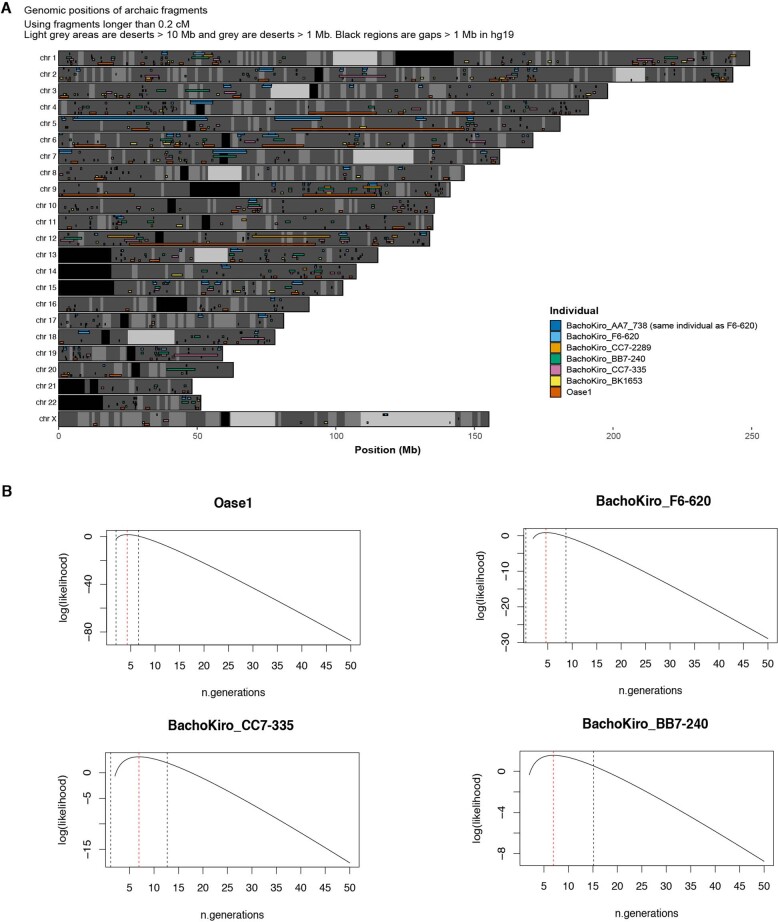
Modern humans appeared in Europe by at least 45,000 years ago1-5, but the extent of their interactions with Neanderthals, who disappeared by about 40,000 years ago6, and their relationship to the broader expansion of modern humans outside Africa are poorly understood. Here we present genome-wide data from three individuals dated to between 45,930 and 42,580 years ago from Bacho Kiro Cave, Bulgaria1,2. They are the earliest Late Pleistocene modern humans known to have been recovered in Europe so far, and were found in association with an Initial Upper Palaeolithic artefact assemblage. Unlike two previously studied individuals of similar ages from Romania7 and Siberia8 who did not contribute detectably to later populations, these individuals are more closely related to present-day and ancient populations in East Asia and the Americas than to later west Eurasian populations. This indicates that they belonged to a modern human migration into Europe that was not previously known from the genetic record, and provides evidence that there was at least some continuity between the earliest modern humans in Europe and later people in Eurasia. Moreover, we find that all three individuals had Neanderthal ancestors a few generations back in their family history, confirming that the first European modern humans mixed with Neanderthals and suggesting that such mixing could have been common.
Conflict of interest statement
The authors declare no competing interests.
Figures
Comment in
-
Neanderthal assimilation?Nat Ecol Evol. 2021 Jun;5(6):711-712. doi: 10.1038/s41559-021-01421-3. Nat Ecol Evol. 2021. PMID: 33828250 No abstract available.
-
Oldest DNA from a Homo sapiens reveals surprisingly recent Neanderthal ancestry.Nature. 2021 Apr;592(7854):339. doi: 10.1038/d41586-021-00916-0. Nature. 2021. PMID: 33828282 No abstract available.
-
My work digging up the shelters of our ancestors.Nature. 2022 Jun;606(7916):1035. doi: 10.1038/d41586-022-01593-3. Nature. 2022. PMID: 35676354 No abstract available.
References
-
- Hublin J-J, et al. Initial Upper Palaeolithic Homo sapiens from Bacho Kiro Cave, Bulgaria. Nature. 2020;581:299–302. - PubMed
-
- Fewlass H, et al. A 14C chronology for the Middle to Upper Palaeolithic transition at Bacho Kiro Cave. Bulgaria. Nat. Ecol. Evol. 2020;4:794–801. - PubMed
-
- Higham T, et al. The earliest evidence for anatomically modern humans in northwestern Europe. Nature. 2011;479:521–524. - PubMed
-
- Benazzi S, et al. Early dispersal of modern humans in Europe and implications for Neanderthal behaviour. Nature. 2011;479:525–528. - PubMed
-
- Hublin J-J. The modern human colonization of western Eurasia: when and where? Quat. Sci. Rev. 2015;118:194–210.
Publication types
MeSH terms
Substances
Grants and funding
LinkOut - more resources
Full Text Sources
Other Literature Sources
