


Livestock Manure Type Affects Microbial Community Composition and Assembly During Composting
- PMID: 33828537
- PMCID: PMC8019744
- DOI: 10.3389/fmicb.2021.621126
Livestock Manure Type Affects Microbial Community Composition and Assembly During Composting
Abstract
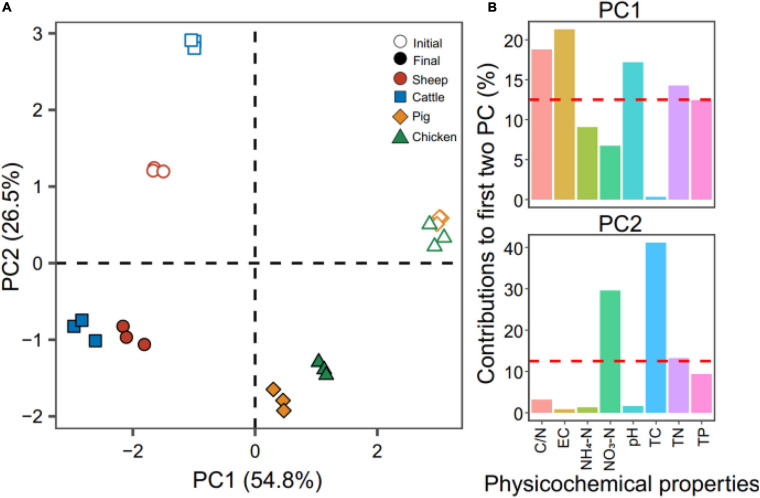
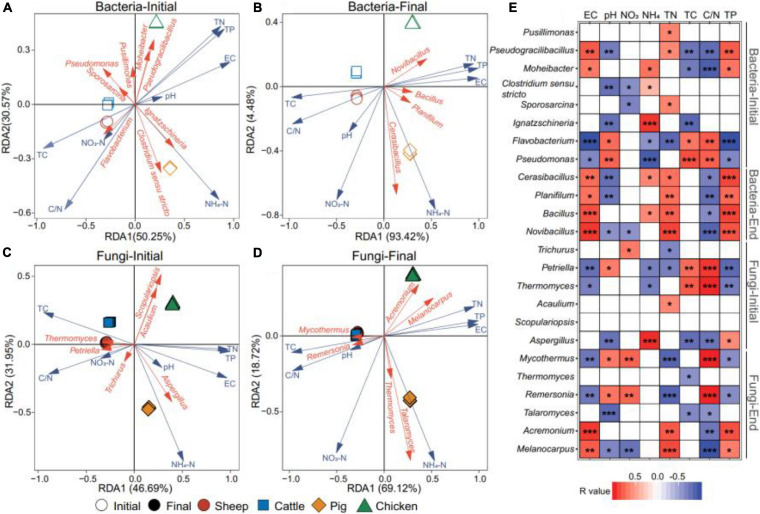
Composting is an environmentally friendly way to turn plant and animal wastes into organic fertilizers. However, it is unclear to what extent the source of animal waste products (such as manure) affects the physicochemical and microbiological properties of compost. Here, we experimentally tested how the type of livestock manure of herbivores (sheep and cattle) and omnivores (pig and chicken) influences the bacterial and fungal communities and physicochemical properties of compost. Higher pH, NO3-N, Total carbon (TC) content and C/N were found in sheep and cattle manure composts, while higher EC, NH4-N, Total nitrogen (TN) and total phosphorus (TP) content were measured in pig and chicken manure composts. Paired clustering between herbivore and omnivore manure compost metataxonomy composition was also observed at both initial and final phases of composting. Despite this clear clustering, all communities changed drastically during the composting leading to reduced bacterial and fungal diversity and large shifts in community composition and species dominance. While Proteobacteria and Chloroflexi were the major phyla in sheep and cattle manure composts, Firmicutes dominated in pig and chicken manure composts. Together, our results indicate that feeding habits of livestock can determine the biochemical and biological properties of manures, having predictable effects on microbial community composition and assembly during composting. Manure metataxonomy profiles could thus potentially be used to steer and manage composting processes.
Keywords: composting; feeding habit; livestock manures; microbial community; physicochemical properties.
Copyright © 2021 Wan, Wang, Yang, Wei, Banerjee, Friman, Mei, Xu and Shen.
Conflict of interest statement
The authors declare that the research was conducted in the absence of any commercial or financial relationships that could be construed as a potential conflict of interest.
Figures


References
-
- Arif M. S., Riaz M., Shahzad S. M., Yasmeen T., Ali S., Akhtar M. J. (2017). Phosphorus-mobilizing rhizobacterial strain Bacillus cereus GS6 improves symbiotic efficiency of soybean on an aridisol amended with phosphorus-enriched compost. Pedosphere 27 1049–1061. 10.1016/S1002-0160(17)60366-7 - DOI
-
- Awasthi M. K., Chen H. Y., Liu T., Awasthi S. K., Wang Q., Ren X. N., et al. (2019). Respond of clay amendment in chicken manure composts to understand the antibiotic resistant bacterial diversity and its correlation with physicochemical parameters. J. Cleaner Product. 236:117715. 10.1016/j.jclepro.2019.117715 - DOI
-
- Awasthi M. K., Zhang Z. Q., Wang Q., Shen F., Li R. H., Li D. S., et al. (2017). New insight with the effects of biochar amendment on bacterial diversity as indicators of biomarkers support the thermophilic phase during sewage sludge composting. Bioresour. Technol. 238 589–601. 10.1016/j.biortech.2017.04.100 - DOI - PubMed
LinkOut - more resources
Full Text Sources
Other Literature Sources
