


The P1 Protein of Watermelon mosaic virus Compromises the Activity as RNA Silencing Suppressor of the P25 Protein of Cucurbit yellow stunting disorder virus
- PMID: 33828542
- PMCID: PMC8019732
- DOI: 10.3389/fmicb.2021.645530
The P1 Protein of Watermelon mosaic virus Compromises the Activity as RNA Silencing Suppressor of the P25 Protein of Cucurbit yellow stunting disorder virus
Abstract
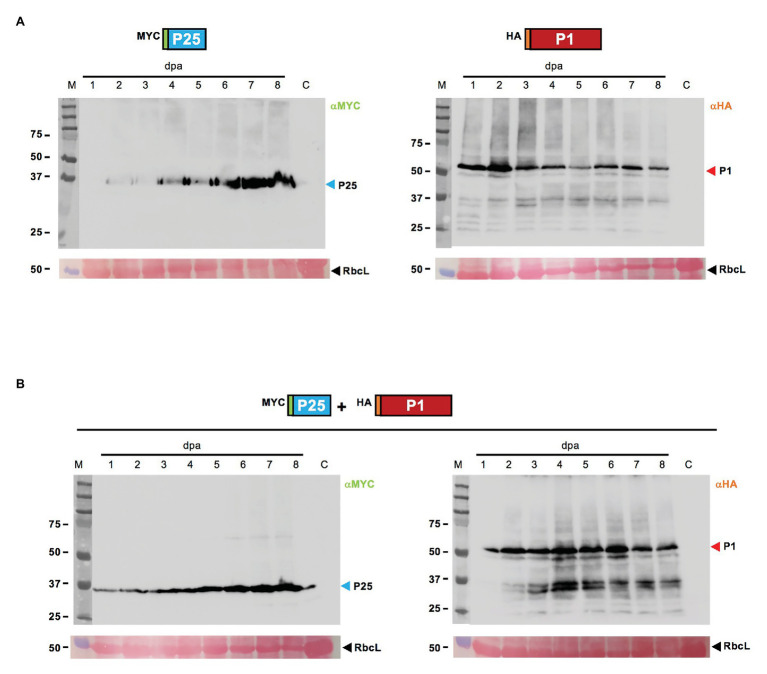
Mixed viral infections in plants involving a potyvirus and other unrelated virus often result in synergistic effects, with significant increases in accumulation of the non-potyvirus partner, as in the case of melon plants infected by the potyvirus Watermelon mosaic virus (WMV) and the crinivirus Cucurbit yellow stunting disorder virus (CYSDV). To further explore the synergistic interaction between these two viruses, the activity of RNA silencing suppressors (RSSs) was addressed in transiently co-expressed combinations of heterologous viral products in Nicotiana benthamiana leaves. While the strong RSS activity of WMV Helper Component Proteinase (HCPro) was unaltered, including no evident additive effects observed when co-expressed with the weaker CYSDV P25, an unexpected negative effect of WMV P1 was found on the RSS activity of P25. Analysis of protein expression during the assays showed that the amount of P25 was not reduced when co-expressed with P1. The detrimental action of P1 on the activity of P25 was dose-dependent, and the subcellular localization of fluorescently labeled variants of P1 and P25 when transiently co-expressed showed coincidences both in nucleus and cytoplasm. Also, immunoprecipitation experiments showed interaction of tagged versions of the two proteins. This novel interaction, not previously described in other combinations of potyviruses and criniviruses, might play a role in modulating the complexities of the response to multiple viral infections in susceptible plants.
Keywords: RNA silencing suppression; cucurbit yellow stunting disease crinivirus; plant virus mixed infection; virus pathogenesis in plants; watermelon mosaic potyvirus.
Copyright © 2021 Domingo-Calap, Chase, Estapé, Moreno and López-Moya.
Conflict of interest statement
The authors declare that the research was conducted in the absence of any commercial or financial relationships that could be construed as a potential conflict of interest.
Figures




References
-
- Aragonés V., Pérez-de-Castro A., Cordero T., Cebolla-Cornejo J., López C., Picó B., et al. (2019). A watermelon mosaic virus clone tagged with the yellow visual maker phytoene synthase facilitates scoring infectivity in melon breeding programs. Eur. J. Plant Pathol. 153, 1317–1323. 10.1007/s10658-018-01621-x - DOI
LinkOut - more resources
Full Text Sources
Other Literature Sources
