


Diagnosing Covid-19 chest x-rays with a lightweight truncated DenseNet with partial layer freezing and feature fusion
- PMID: 33828610
- PMCID: PMC8015405
- DOI: 10.1016/j.bspc.2021.102583
Diagnosing Covid-19 chest x-rays with a lightweight truncated DenseNet with partial layer freezing and feature fusion
Abstract
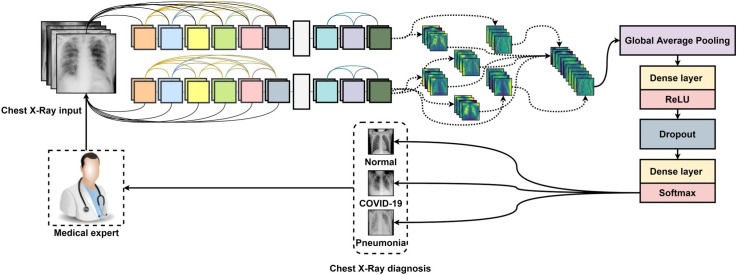
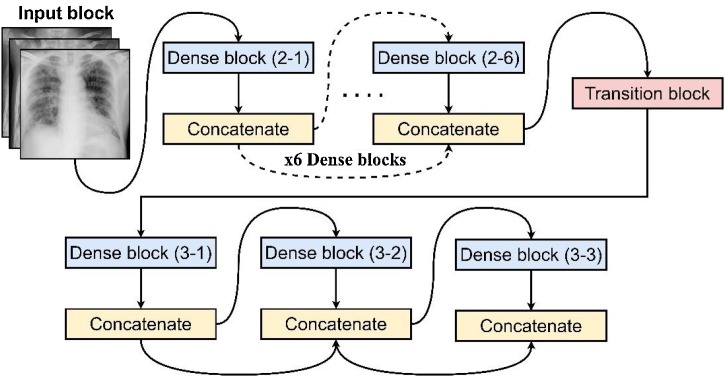
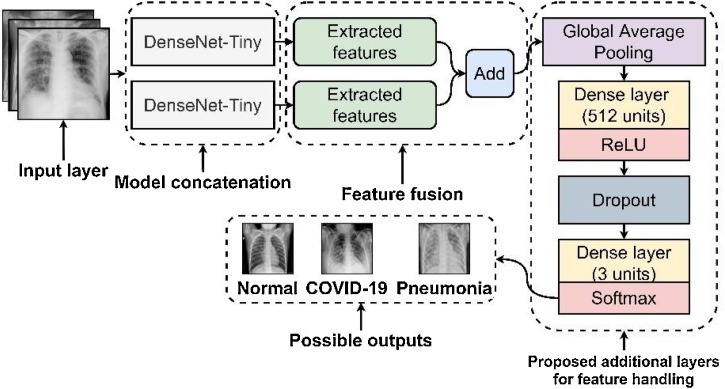
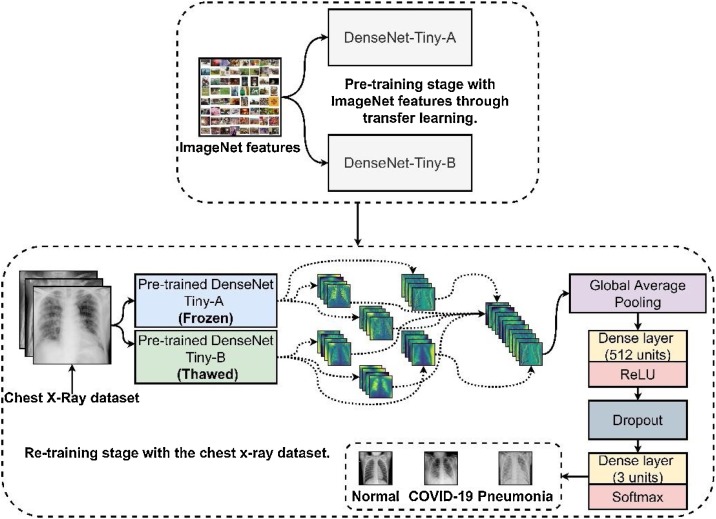
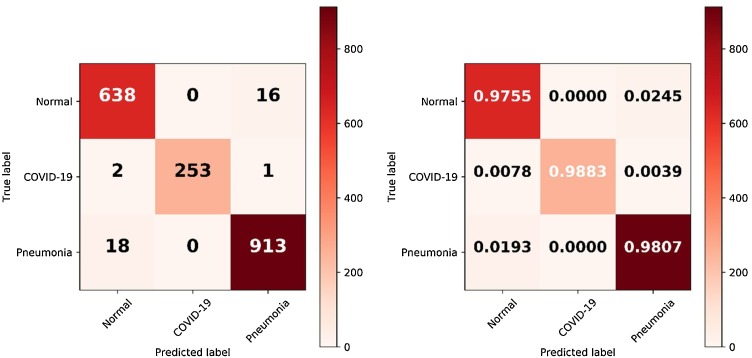
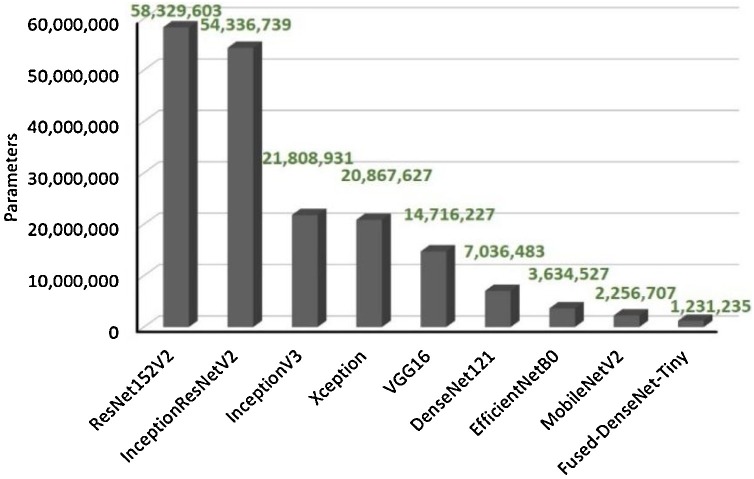
Due to the unforeseen turn of events, our world has undergone another global pandemic from a highly contagious novel coronavirus named COVID-19. The novel virus inflames the lungs similarly to Pneumonia, making it challenging to diagnose. Currently, the common standard to diagnose the virus's presence from an individual is using a molecular real-time Reverse-Transcription Polymerase Chain Reaction (rRT-PCR) test from fluids acquired through nasal swabs. Such a test is difficult to acquire in most underdeveloped countries with a few experts that can perform the test. As a substitute, the widely available Chest X-Ray (CXR) became an alternative to rule out the virus. However, such a method does not come easy as the virus still possesses unknown characteristics that even experienced radiologists and other medical experts find difficult to diagnose through CXRs. Several studies have recently used computer-aided methods to automate and improve such diagnosis of CXRs through Artificial Intelligence (AI) based on computer vision and Deep Convolutional Neural Networks (DCNN), which some require heavy processing costs and other tedious methods to produce. Therefore, this work proposed the Fused-DenseNet-Tiny, a lightweight DCNN model based on a densely connected neural network (DenseNet) truncated and concatenated. The model trained to learn CXR features based on transfer learning, partial layer freezing, and feature fusion. Upon evaluation, the proposed model achieved a remarkable 97.99 % accuracy, with only 1.2 million parameters and a shorter end-to-end structure. It has also shown better performance than some existing studies and other massive state-of-the-art models that diagnosed COVID-19 from CXRs.
Keywords: AP, Average Pooling; AUC, Area Under the Curve; BN, Batch Normalization; BS, Batch Size; CAD, Computer-Aided Diagnosis; CCE, Categorical Cross-Entropy; CNN, Convolutional Neural Networks; CT, Computer Tomography; CV, Computer Vision; CXR, Chest X-Rays; Chest x-rays; Computer-aided diagnosis; Covid-19; DCNN, Deep Convolutional Neural Networks; DL, Deep Learning; DR, Dropout Rate; Deep learning; Densely connected neural networks; GAP, Global Average Pooling; GRAD-CAM, Gradient-Weighted Class Activation Maps; JPG, Joint Photographic Group; LR, Learning Rate; MP, Max-Pooling; P-R, Precision-Recall; PEPX, Projection-Expansion-Projection-Extension; ROC, Receiver Operating Characteristic; ReLU, Rectified Linear Unit; SGD, Stochastic Gradient Descent; WHO, World Health Organization; rRT-PCR, real-time Reverse-Transcription Polymerase Chain Reaction.
© 2021 Elsevier Ltd. All rights reserved.
Figures
References
-
- Hui D.S., Azhar E.I., Madani T.A., Ntoumi F., Kock R., Dar O., Ippolito G., Mchugh T.D., Memish Z.A., Drosten C., Zumla A., Petersen E. The continuing 2019-nCoV epidemic threat of novel coronaviruses to global health—the latest 2019 novel coronavirus outbreak in Wuhan, China. Int. J. Infect. Dis. 2020;91(October):264–266. doi: 10.1016/j.ijid.2020.01.009. - DOI - PMC - PubMed
-
- Cascella M., Rajnik M., Cuomo A., Dulebohn S.C., Di Napoli R. StatPearls Publishing; Treasure Island, FL, USA: 2020. Features, Evaluation and Treatment Coronavirus (COVID-19) [updated 2020 Apr 6]https://www.ncbi.nlm.nih.gov/books/NBK554776/ in StatPearls [Internet]Jan. [Online]. Available: - PubMed
LinkOut - more resources
Full Text Sources
Other Literature Sources
Research Materials
Miscellaneous