Review
. 2021 Mar 22:11:643326.
doi: 10.3389/fcimb.2021.643326. eCollection 2021.

Virus-Induced Changes of the Respiratory Tract Environment Promote Secondary Infections With Streptococcus pneumoniae

Affiliations
Review

Virus-Induced Changes of the Respiratory Tract Environment Promote Secondary Infections With Streptococcus pneumoniae

Vicky Sender et al. Front Cell Infect Microbiol. .

Abstract

Secondary bacterial infections enhance the disease burden of influenza infections substantially. Streptococcus pneumoniae (the pneumococcus) plays a major role in the synergism between bacterial and viral pathogens, which is based on complex interactions between the pathogen and the host immune response. Here, we discuss mechanisms that drive the pathogenesis of a secondary pneumococcal infection after an influenza infection with a focus on how pneumococci senses and adapts to the influenza-modified environment. We briefly summarize what is known regarding secondary bacterial infection in relation to COVID-19 and highlight the need to improve our current strategies to prevent and treat viral bacterial coinfections.

Keywords: COVID-19; Streptococcus pneumoniae; coinfection; influenza virus; influenza-pneumococcal coinfection; pneumococci; respiratory tract infections.


Conflict of interest statement

The authors declare that the research was conducted in the absence of any commercial or financial relationships that could be construed as a potential conflict of interest.

Figures
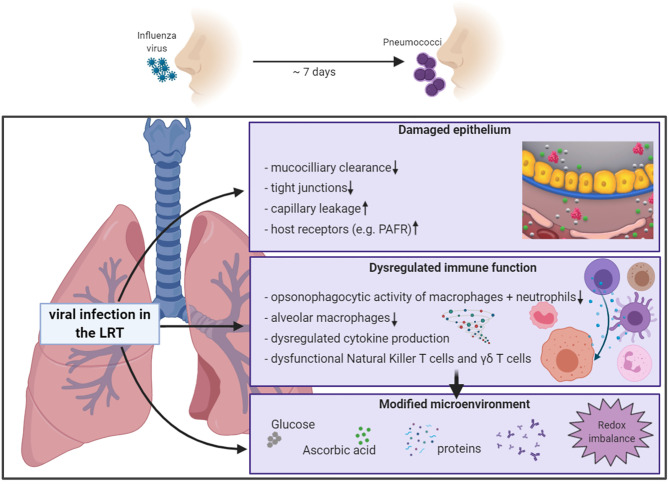
Figure 1
Figure 1
Schematic overview of influenza-induced alterations of the pulmonary host response. Increased sensitivity to secondary bacterial infection is partly mediated by influenza-induced effects on the pulmonary host response, including compromised epithelial barrier functions, innate and adaptive immune responses, and changes of the microenvironment in the respiratory tract. Partly adopted from Sender et al., 2020. Created with BioRender.com.
Figure 2
Figure 2
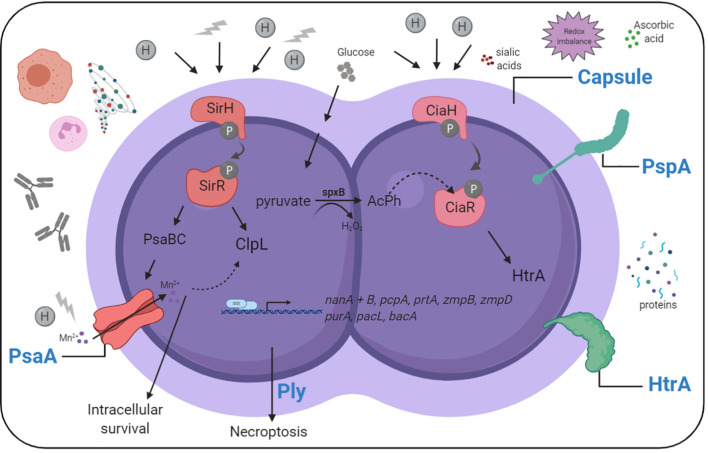
Simplified overview of pneumococcal sensing and adaptation in the influenza-infected respiratory tract. Pneumococci need to adapt to nutritional and environmental changes in the influenza-infected respiratory tract to cause disease. Sensing and adaptation of pneumococci in the influenza-infected respiratory tract includes activation of two component systems, and the expression of effector proteins helping the bacteria to grow and resist stress in this environment. Created with BioRender.com.

References

    1. Abramson J. S., Mills E. L., Giebink G. S., Quie P. G. (1982). Depression of monocyte and polymorphonuclear leukocyte oxidative metabolism and bactericidal capacity by influenza A virus. Infect. Immun. 35, 350–355. 10.1128/IAI.35.1.350-355.1982 - DOI - PMC - PubMed
    1. Ackermann M., Verleden S. E., Kuehnel M., Haverich A., Welte T., Laenger F., et al. . (2020). Pulmonary Vascular Endothelialitis, Thrombosis, and Angiogenesis in Covid-19. N. Engl. J. Med. 383, 120–128. 10.1056/NEJMoa2015432 - DOI - PMC - PubMed
    1. Akhter F., Womack E., Vidal J. E., Le Breton Y., Mciver K. S., Pawar S., et al. . (2020). Hemoglobin stimulates vigorous growth of Streptococcus pneumoniae and shapes the pathogen’s global transcriptome. Sci. Rep. 10, 15202. 10.1038/s41598-020-71910-1 - DOI - PMC - PubMed
    1. Arredouani M., Yang Z., Ning Y., Qin G., Soininen R., Tryggvason K., et al. . (2004). The scavenger receptor MARCO is required for lung defense against pneumococcal pneumonia and inhaled particles. J. Exp. Med. 200, 267–272. 10.1084/jem.20040731 - DOI - PMC - PubMed
    1. Astry C. L., Jakab G. J. (1984). Influenza virus-induced immune complexes suppress alveolar macrophage phagocytosis. J. Virol. 50, 287–292. 10.1128/JVI.50.2.287-292.1984 - DOI - PMC - PubMed

Publication types

MeSH terms