


Proton Beam Therapy in the Treatment of Periorbital Malignancies
- PMID: 33829072
- PMCID: PMC8019573
- DOI: 10.14338/IJPT-20-00025.1
Proton Beam Therapy in the Treatment of Periorbital Malignancies
Abstract
Purpose: Periorbital tumor location presents a significant challenge with 3-dimensional conformal radiation therapy or intensity modulated radiation therapy due to high tumor dose needed in the setting of close proximity to orbital structures with lower tolerance. Proton beam therapy (PBT) is felt to be an effective modality in such cases due to its sharp dose gradient.
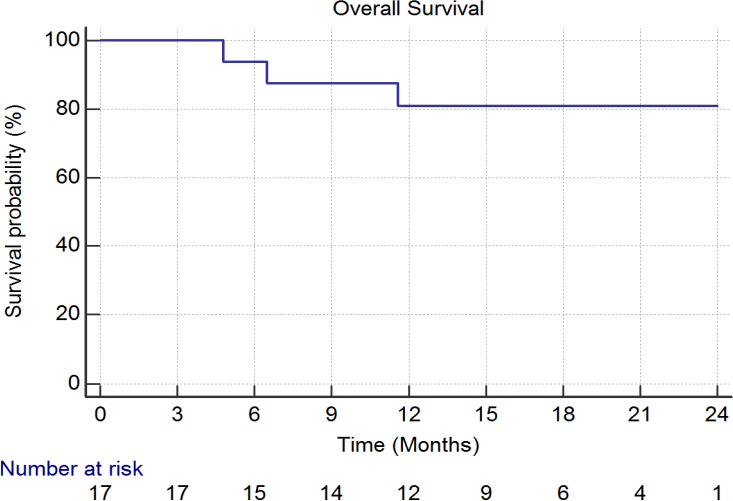
Materials and methods: We reviewed our institutional PBT registry and identified 17 patients with tumor epicenters within 2 cm of the eye and optic apparatus treated with passive scatter PBT with comparison volumetric arc therapy plans available. Maximum and mean doses to organs at risk of interest, including optic nerves, optic chiasm, lens, eye ball, pituitary, cochlea, lacrimal gland, and surrounding brain, were compared using the paired Wilcoxon signed rank test. Overall survival was determined using the Kaplan-Meier method.
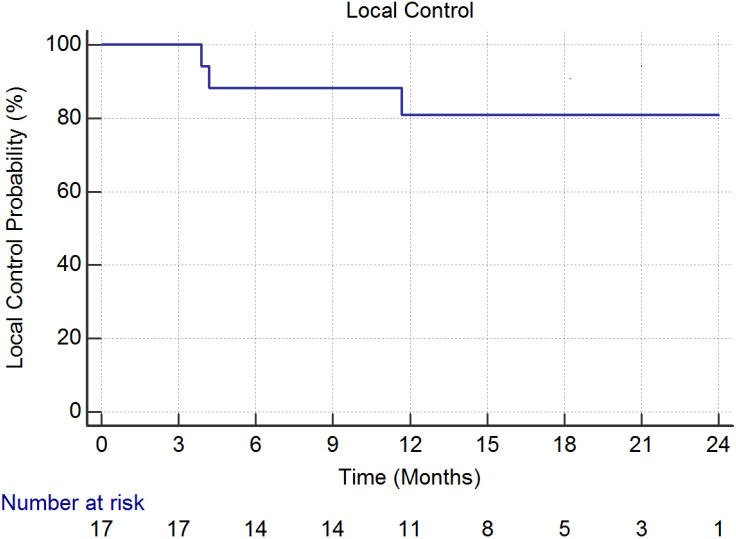
Results: Median age was 67. Median follow-up was 19.7 months. Fourteen patients underwent upfront resection and received postoperative radiation and 3 received definitive radiation. One patient received elective neck radiation, 2 underwent reirradiation, and 3 had concurrent chemotherapy. There was a statistically significant reduction in mean dose to the optic nerves and chiasm, brain, pituitary gland, lacrimal glands, and cochlea as well as in the maximum dose to the optic nerves and chiasm, pituitary gland, lacrimal glands, and cochlea with PBT. The 18-month cumulative incidence of local failure was 19.1% and 1-year overall survival was 80.9%.
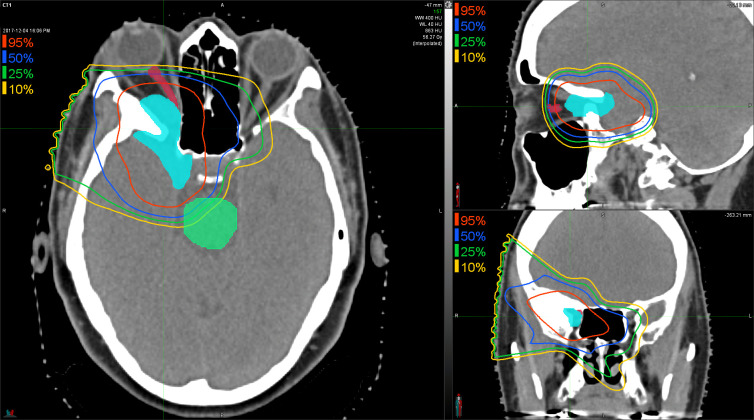
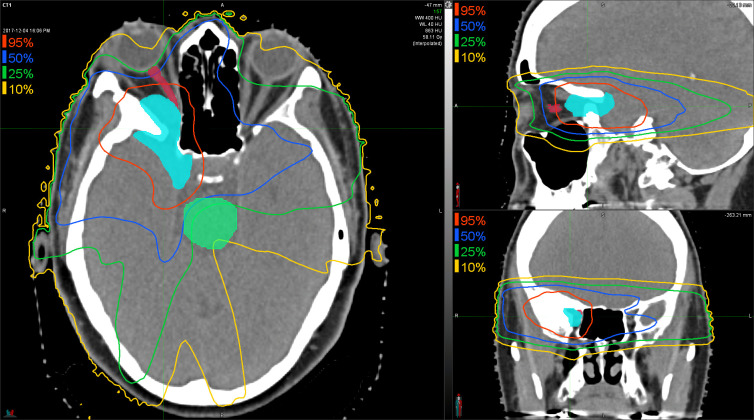
Conclusion: Proton beam therapy resulted in significant dose reductions to several periorbital and optic structures compared with volumetric arc therapy. Proton beam therapy appears to be the optimal radiation modality in such cases to minimize risk of toxicity to periorbital organs at risk.
Keywords: cochlea; optics; periorbital; pituitary; proton.
©Copyright 2021 The Author(s).
Conflict of interest statement
Conflicts of Interest: Mitchell X. Machtay, MD reports travel funding from Mevion Inc. and Varian Inc., and grants and travel funding from Elekta Inc., outside the submitted work. The authors have no other relevant conflicts of interest to disclose.
Figures
References
-
- Schlienger P, Brunin F, Desjardins L, Laurent M, Haye C, Vilcoq JR. External radiotherapy for carcinoma of the eyelid: report of 850 cases treated. Int J Radiat Oncol Biol Phys. 1996;34:277–87. - PubMed
-
- Bhatia S, Paulino AC, Buatti JM, Mayr NA, Wen BC. Curative radiotherapy for primary orbital lymphoma. Int J Radiat Oncol Biol Phys. 2002;54:818–23. - PubMed
-
- DeLaney TF. Proton therapy in the clinic. Front Radiat Ther Oncol. 2011;43:465–85. - PubMed
Grants and funding
LinkOut - more resources
Full Text Sources
Other Literature Sources