Review
. 2021 May;12(5):1227-1247.
doi: 10.1007/s13300-021-01035-9. Epub 2021 Apr 8.

Diabetes and Frailty: An Expert Consensus Statement on the Management of Older Adults with Type 2 Diabetes

Affiliations
Review

Diabetes and Frailty: An Expert Consensus Statement on the Management of Older Adults with Type 2 Diabetes

W David Strain et al. Diabetes Ther. 2021 May.

Abstract

Prognosis and appropriate treatment goals for older adults with diabetes vary greatly according to frailty. It is now recognised that changes may be needed to diabetes management in some older people. Whilst there is clear guidance on the evaluation of frailty and subsequent target setting for people living with frailty, there remains a lack of formal guidance for healthcare professionals in how to achieve these targets. The management of older adults with type 2 diabetes is complicated by comorbidities, shortened life expectancy and exaggerated consequences of adverse effects from treatment. In particular, older adults are more prone to hypoglycaemia and are more vulnerable to its consequences, including falls, fractures, hospitalisation, cardiovascular events and all-cause mortality. Thus, assessment of frailty should be a routine component of a diabetes review for all older adults, and glycaemic targets and therapeutic choices should be modified accordingly. Evidence suggests that over-treatment of older adults with type 2 diabetes is common, with many having had their regimens intensified over preceding years when they were in better health, or during more recent acute hospital admissions when their blood glucose levels might have been atypically high, and nutritional intake may vary. In addition, assistance in taking medications, as often occurs in later life following implementation of community care strategies or admittance to a care home, may dramatically improve treatment adherence, leading to a fall in glycated haemoglobin (HbA1c) levels. As a person with diabetes gets older, simplification, switching or de-escalation of the therapeutic regimen may be necessary, depending on their level of frailty and HbA1c levels. Consideration should be given, in particular, to de-escalation of therapies that may induce hypoglycaemia, such as sulphonylureas and shorter-acting insulins. We discuss the use of available glucose-lowering therapies in older adults and recommend simple glycaemic management algorithms according to their level of frailty.

Keywords: Elderly; Frailty; Treatment choices; Type 2 diabetes.


Figures
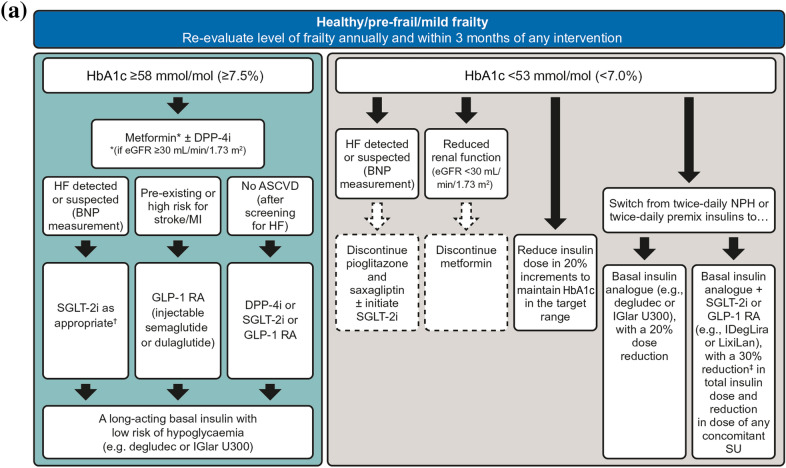
Fig. 1
Fig. 1
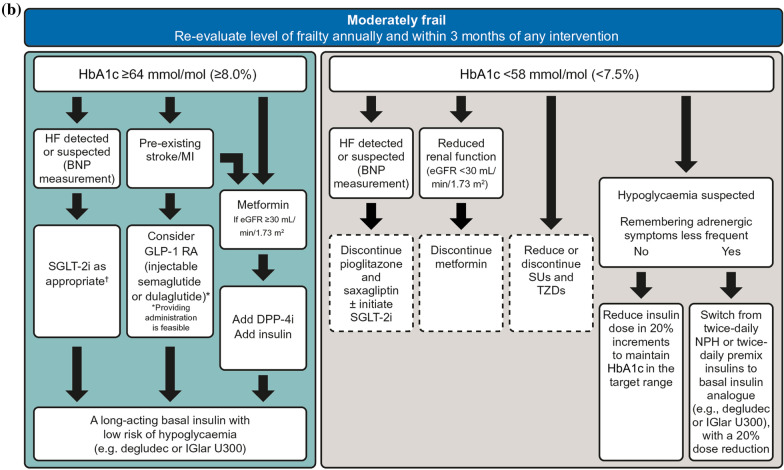
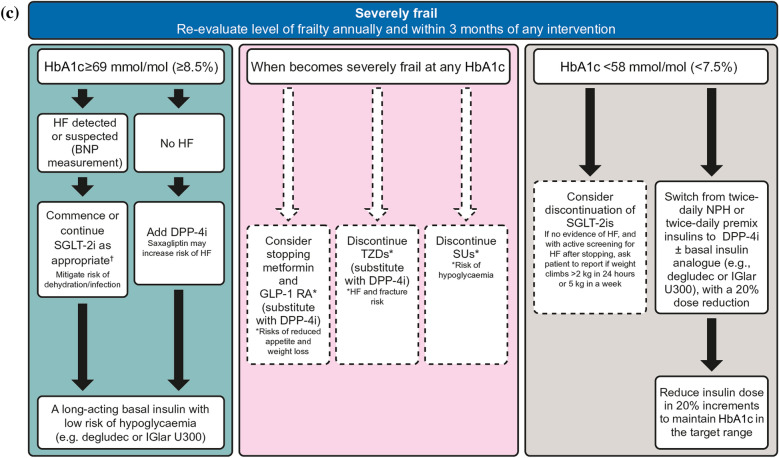
Treatment escalation and simplification/de-escalation plan for older adults living with type 2 diabetes and with no or mild frailty (a), moderate frailty (b) or severe frailty (c). Moderate frailty is defined as individuals with > 2 comorbidities, some impairments in activities of daily living with a reduced life expectancy. Severe frailty comprises significant comorbidity, functional deficits and limited independence; i.e. conditions likely to cause a markedly reduced life expectancy. Severe frailty guidelines are largely ‘evidence-free’ and represent stakeholders’ recommendations. Patients may already be receiving treatment with metformin, SUs or their combination plus or minus basal or premix insulin. At time of publication, treatment with any SGLT-2i can be initiated at eGFR > 60 mL/min/1.73 m2 for the management of hyperglycaemia: canagliflozin can be initiated at > 45 mL/min/1.73 m2 or > 30 mL/min/1.73 m2 in people with proteinuria; dapagliflozin can be initiated at any HbA1c for the management of heart failure. All SGLT-2is are less efficacious at reducing hyperglycaemia at lower eGFRs. Expert recommendation. ASCVD Atherosclerotic cardiovascular disease, BNP B-type natriuretic peptide, degludec insulin degludec, DPP-4i dipeptidyl peptidase-4 inhibitor, eGFR estimated glomerular filtration rate, FPG fasting plasma glucose, GLP-1 RA glucagon-like peptide-1 receptor agonist, HbA1c glycated haemoglobin, HF heart failure, IDegLira fixed-ratio combination of insulin degludec and liraglutide, IGlar U300 insulin glargine 300 units/mL, LixiLan fixed-ratio combination of insulin glargine and lixisenatide, NPH neutral protamine Hagedorn, SU sulphonylurea, SGLT-2i sodium-glucose cotransporter-2 inhibitor, TZD thiazolidinedione
Fig. 1
Fig. 1
Treatment escalation and simplification/de-escalation plan for older adults living with type 2 diabetes and with no or mild frailty (a), moderate frailty (b) or severe frailty (c). Moderate frailty is defined as individuals with > 2 comorbidities, some impairments in activities of daily living with a reduced life expectancy. Severe frailty comprises significant comorbidity, functional deficits and limited independence; i.e. conditions likely to cause a markedly reduced life expectancy. Severe frailty guidelines are largely ‘evidence-free’ and represent stakeholders’ recommendations. Patients may already be receiving treatment with metformin, SUs or their combination plus or minus basal or premix insulin. At time of publication, treatment with any SGLT-2i can be initiated at eGFR > 60 mL/min/1.73 m2 for the management of hyperglycaemia: canagliflozin can be initiated at > 45 mL/min/1.73 m2 or > 30 mL/min/1.73 m2 in people with proteinuria; dapagliflozin can be initiated at any HbA1c for the management of heart failure. All SGLT-2is are less efficacious at reducing hyperglycaemia at lower eGFRs. Expert recommendation. ASCVD Atherosclerotic cardiovascular disease, BNP B-type natriuretic peptide, degludec insulin degludec, DPP-4i dipeptidyl peptidase-4 inhibitor, eGFR estimated glomerular filtration rate, FPG fasting plasma glucose, GLP-1 RA glucagon-like peptide-1 receptor agonist, HbA1c glycated haemoglobin, HF heart failure, IDegLira fixed-ratio combination of insulin degludec and liraglutide, IGlar U300 insulin glargine 300 units/mL, LixiLan fixed-ratio combination of insulin glargine and lixisenatide, NPH neutral protamine Hagedorn, SU sulphonylurea, SGLT-2i sodium-glucose cotransporter-2 inhibitor, TZD thiazolidinedione
Fig. 1
Fig. 1
Treatment escalation and simplification/de-escalation plan for older adults living with type 2 diabetes and with no or mild frailty (a), moderate frailty (b) or severe frailty (c). Moderate frailty is defined as individuals with > 2 comorbidities, some impairments in activities of daily living with a reduced life expectancy. Severe frailty comprises significant comorbidity, functional deficits and limited independence; i.e. conditions likely to cause a markedly reduced life expectancy. Severe frailty guidelines are largely ‘evidence-free’ and represent stakeholders’ recommendations. Patients may already be receiving treatment with metformin, SUs or their combination plus or minus basal or premix insulin. At time of publication, treatment with any SGLT-2i can be initiated at eGFR > 60 mL/min/1.73 m2 for the management of hyperglycaemia: canagliflozin can be initiated at > 45 mL/min/1.73 m2 or > 30 mL/min/1.73 m2 in people with proteinuria; dapagliflozin can be initiated at any HbA1c for the management of heart failure. All SGLT-2is are less efficacious at reducing hyperglycaemia at lower eGFRs. Expert recommendation. ASCVD Atherosclerotic cardiovascular disease, BNP B-type natriuretic peptide, degludec insulin degludec, DPP-4i dipeptidyl peptidase-4 inhibitor, eGFR estimated glomerular filtration rate, FPG fasting plasma glucose, GLP-1 RA glucagon-like peptide-1 receptor agonist, HbA1c glycated haemoglobin, HF heart failure, IDegLira fixed-ratio combination of insulin degludec and liraglutide, IGlar U300 insulin glargine 300 units/mL, LixiLan fixed-ratio combination of insulin glargine and lixisenatide, NPH neutral protamine Hagedorn, SU sulphonylurea, SGLT-2i sodium-glucose cotransporter-2 inhibitor, TZD thiazolidinedione

References

    1. Strain WD, Hope SV, Green A, Kar P, Valabhji J, Sinclair AJ. Type 2 diabetes mellitus in older people: a brief statement of key principles of modern day management including the assessment of frailty. A national collaborative stakeholder initiative. Diabet Med. 2018;35:838–845. - PubMed
    1. International Diabetes Federation. Global guideline for managing older people with type 2 diabetes. 2013. https://www.idf.org/e-library/guidelines/78-global-guideline-for-managin.... Accessed 14 Oct 2020.
    1. LeRoith D, Biessels GJ, Braithwaite SS, et al. Treatment of diabetes in older adults: an Endocrine Society* clinical practice guideline. J Clin Endo Metab. 2019;104:1520–1574. - PMC - PubMed
    1. Sinclair AJ, Abdelhafiz A, Dunning T, et al. An international position statement on the management of frailty in diabetes mellitus: summary of recommendations 2017. J Frailty Aging. 2018;7:10–20. - PubMed
    1. Hambling CE, Khunti K, Cos X, et al. Factors influencing safe glucose-lowering in older adults with type 2 diabetes: a PeRsOn-centred ApproaCh To IndiVidualisEd (PROACTIVE) Glycemic Goals for older people: a position statement of Primary Care Diabetes Europe. Prim Care Diabetes. 2019;13:330–352. - PubMed

LinkOut - more resources