


Post-COVID-19 syndrome among symptomatic COVID-19 patients: A prospective cohort study in a tertiary care center of Bangladesh
- PMID: 33831043
- PMCID: PMC8031743
- DOI: 10.1371/journal.pone.0249644
Post-COVID-19 syndrome among symptomatic COVID-19 patients: A prospective cohort study in a tertiary care center of Bangladesh
Abstract
Background: Post-coronavirus disease (COVID-19) syndrome includes persistence of symptoms beyond viral clearance and fresh development of symptoms or exaggeration of chronic diseases within a month after initial clinical and virological cure of the disease with a viral etiology. We aimed to determine the incidence, association, and risk factors associated with development of the post-COVID-19 syndrome.
Methods: We conducted a prospective cohort study at Dhaka Medical College Hospital between June 01, 2020 and August 10, 2020. All the enrolled patients were followed up for a month after clinical improvement, which was defined according the World Health Organization and Bangladesh guidelines as normal body temperature for successive 3 days, significant improvement in respiratory symptoms (respiratory rate <25/breath/minute with no dyspnea), and oxygen saturation >93% without assisted oxygen inhalation.
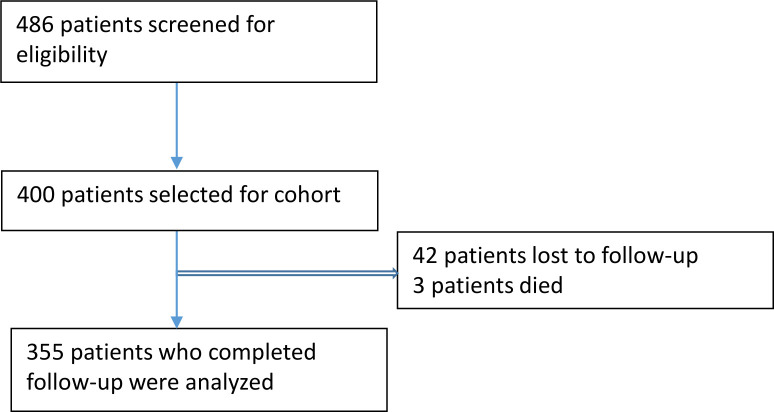
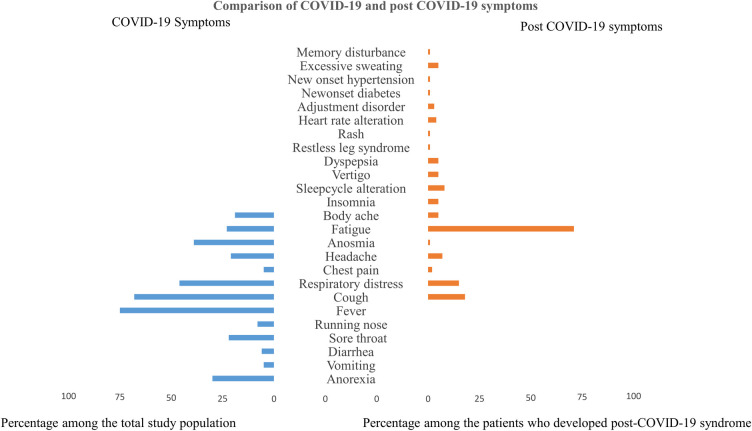
Findings: Among the 400 recruited patients, 355 patients were analyzed. In total, 46% patients developed post-COVID-19 symptoms, with post-viral fatigue being the most prevalent symptom in 70% cases. The post-COVID-19 syndrome was associated with female gender (relative risk [RR]: 1.2, 95% confidence interval [CI]: 1.02-1.48, p = 0.03), those who required a prolonged time for clinical improvement (p<0.001), and those showing COVID-19 positivity after 14 days (RR: 1.09, 95% CI: 1.00-1.19, p<0.001) of initial positivity. Patients with severe COVID-19 at presentation developed post-COVID-19 syndrome (p = 0.02). Patients with fever (RR: 1.5, 95% CI: 1.05-2.27, p = 0.03), cough (RR: 1.36, 95% CI: 1.02-1.81, p = 0.04), respiratory distress (RR: 1.3, 95% CI: 1.4-1.56, p = 0.001), and lethargy (RR: 1.2, 95% CI: 1.06-1.35, p = 0.003) as the presenting features were associated with the development of the more susceptible to develop post COVID-19 syndrome than the others. Logistic regression analysis revealed female sex, respiratory distress, lethargy, and long duration of the disease as risk factors.
Conclusion: Female sex, respiratory distress, lethargy, and long disease duration are critical risk factors for the development of post-COVID-19 syndrome.
Conflict of interest statement
The authors have declared that no competing interests exist.
Figures
References
-
- World Health Organization. GCM teleconference–Note for the Records. 10 January 2020. Subject: Pneumonia in Wuhan, China. Available from: https://www.WHO.int/blueprint/10-01-2020-nfr-gcm.pdf?ua=. Accessed 22 september,2020.
-
- Rodriguez-Morales AJ, Cardona-Ospina JA, Gutie´rrez-Ocampo E, Villamizar-Pen˜a R, Holguin-Rivera Y, Escalera-Antezana JP, et al. Clinical, laboratory and imaging features of COVID-19: a systematic review and meta-analysis. Travel Med Infect Dis. 2020; 34:101623. 10.1016/j.tmaid.2020.101623 - DOI - PMC - PubMed
-
- Lechien JR, Chiesa-Estomba CM, Place S, Van Laethem Y, Cabaraux P, Mat Q, et al. Clinical and epidemiological characteristics of 1420 European patients with mild-to-moderate coronavirus disease 2019. J Intern Med. 2020. September; 288(3):335–344. 10.1111/joim.13089 Epub 2020 Jun 17. ; PMCID: PMC7267446. - DOI - PMC - PubMed
Publication types
MeSH terms
LinkOut - more resources
Full Text Sources
Other Literature Sources
Medical
