


Feasibility of Continuous Ketone Monitoring in Subcutaneous Tissue Using a Ketone Sensor
- PMID: 33832353
- PMCID: PMC8252149
- DOI: 10.1177/19322968211008185
Feasibility of Continuous Ketone Monitoring in Subcutaneous Tissue Using a Ketone Sensor
Abstract
Background: The feasibility of measuring β-hydroxybutyrate in ISF using a continuous ketone monitoring (CKM) sensor using a single calibration without further adjustments over 14 days is described.
Methods: A CKM sensor was developed using wired enzyme technology with β-hydroxybutyrate dehydrogenase chemistry. In vitro characterization of the sensor was performed in phosphate buffered saline at 37°C. In vivo performance was evaluated in 12 healthy participants on low carbohydrate diets, who wore 3 ketone sensors on the back of their upper arms to continuously measure ketone levels over 14 days. Reference capillary ketone measurements were performed using Precision Xtra® test strips at least 8 times a day.
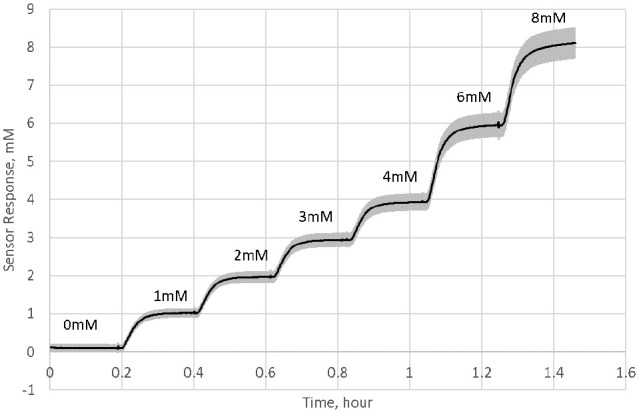
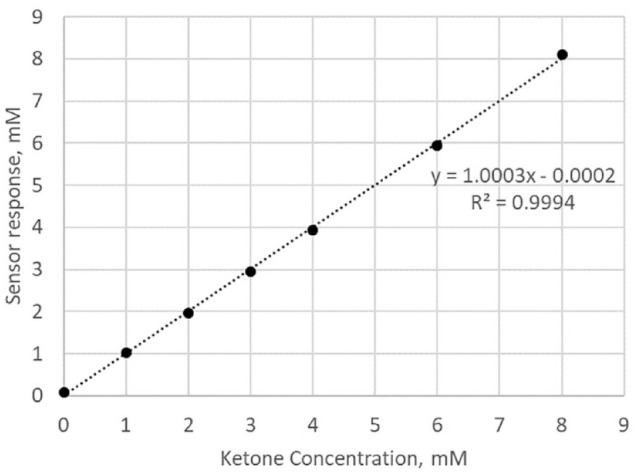
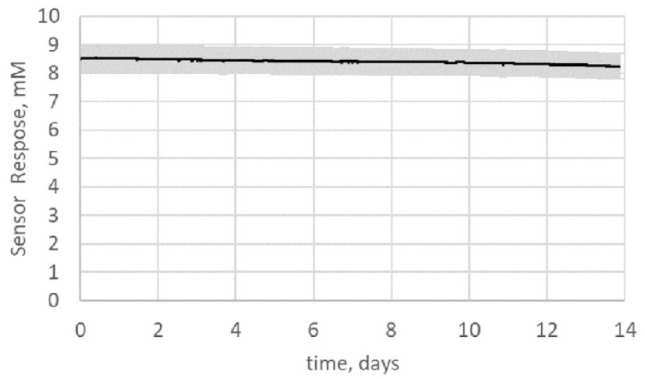
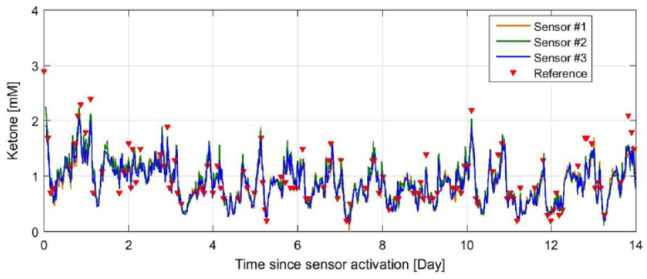
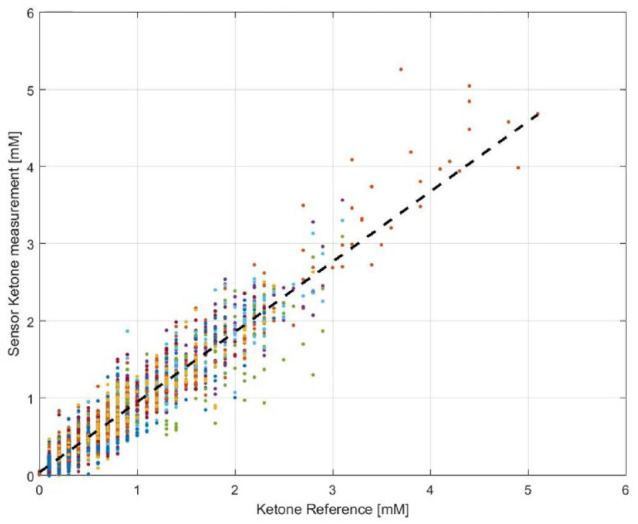
Results: The sensor is stable over 14 days and has a linear response over the 0-8 mM range. The operational stability of the sensor is very good with a 2.1% signal change over 14 days. The first human study of the CKM sensor demonstrated that the sensor can continuously track ketones well through the entire 14 days of wear. The performance with a single retrospective calibration of the sensor showed 82.4% of data pairs within 0.225 mM/20% and 91.4% within 0.3 mM/30% of the capillary ketone reference (presented as mM at <1.5 mM and as percentage at or above 1.5 mM). This suggests that the sensor can be used with a single calibration for the 14 days of use.
Conclusions: Measuring ketones in ISF using a continuous ketone sensor is feasible. Additional studies are required to evaluate the performance in intended patient populations, including conditions of ketosis and diabetic ketoacidosis.
Keywords: continuous ketone monitoring; diabetes ketoacidosis; factory calibration; ketogenic; β-hydroxybutyrate.
Conflict of interest statement
Figures
References
-
- Musa-Veloso K, Likhodii SS, Cunnane SC. Breath acetone is a reliable indicator of ketosis in adults consuming ketogenic meals. Am J Clin Nutr. 2002;76:65-70. - PubMed
Publication types
MeSH terms
Substances
LinkOut - more resources
Full Text Sources
Other Literature Sources
Miscellaneous
