


Echinacea reduces antibiotic usage in children through respiratory tract infection prevention: a randomized, blinded, controlled clinical trial
- PMID: 33832544
- PMCID: PMC8028575
- DOI: 10.1186/s40001-021-00499-6
Echinacea reduces antibiotic usage in children through respiratory tract infection prevention: a randomized, blinded, controlled clinical trial
Abstract
Background: In children, up to 30% of viral respiratory tract infections (RTIs) develop into bacterial complications associated with pneumonia, sinusitis or otitis media to trigger a tremendous need for antibiotics. This study investigated the efficacy of Echinacea for the prevention of viral RTIs, for the prevention of secondary bacterial complications and for reducing rates of antibiotic prescriptions in children.
Methods: Echinaforce® Junior tablets [400 mg freshly harvested Echinacea purpurea alcoholic extract] or vitamin C [50 mg] as control were given three times daily for prevention to children 4-12 years. Two × 2 months of prevention were separated by a 1-week treatment break. Parents assessed respiratory symptoms in children via e-diaries and collected nasopharyngeal secretions for screening of respiratory pathogens (Allplex® RT-PCR).
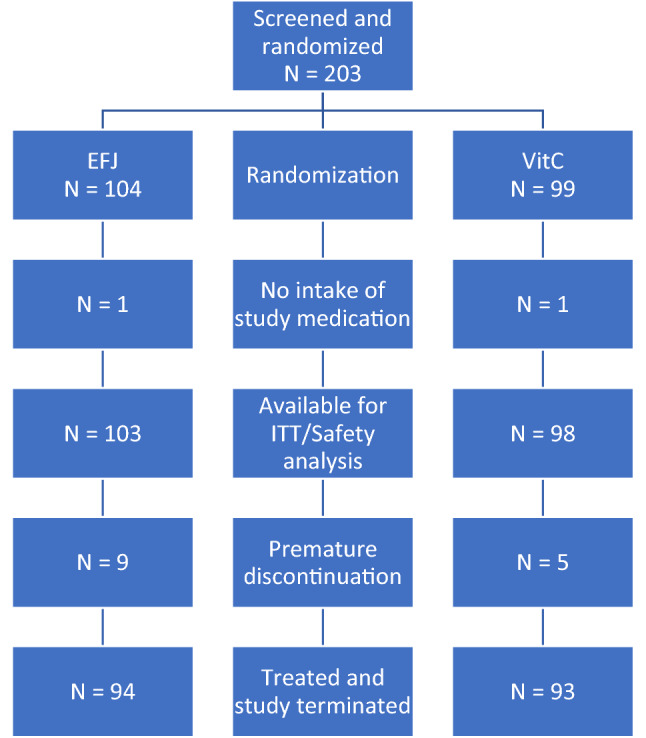
Results: Overall, 429 cold days occurred in NITT = 103 children with Echinacea in comparison to 602 days in NITT = 98 children with vitamin C (p < 0.001, Chi-square test). Echinacea prevented 32.5% of RTI episodes resulting in an odds ratio of OR = 0.52 [95% CI 0.30-0.91, p = 0.021]. Six children (5.8%) with Echinacea and 15 children (15.3%) with vitamin C required 6 and 24 courses of antibiotic treatment, respectively (reduction of 76.3%, p < 0.001). A total of 45 and 216 days of antibiotic therapy were reported in the two groups, respectively (reduction of 80.2% (p < 0.001). Eleven and 30 events of RTI complications (e.g., otitis media, sinusitis or pneumonia) occurred with Echinacea and vitamin C, respectively (p = 0.0030). Echinacea significantly prevented influenza (3 vs. 20 detections, p = 0.012) and enveloped virus infections (29 vs. 47 detections, p = 0.0038). Finally, 76 adverse events occurred with Echinacea and 105 events with vitamin C (p = 0.016), only three events were reported possibly related with Echinacea.
Conclusions: Our results support the use of Echinacea for the prevention of RTIs and reduction of associated antibiotic usage in children. Trial registration clinicaltrials.gov, NCT02971384, 23th Nov 2016.
Keywords: Antibiotics; Antiviral; Complications; Echinacea; Prevention; Respiratory tract infections.
Conflict of interest statement
MO and PK declare no conflict of interest. SLJ is a consultant to A. Vogel AG, Switzerland. Data evaluation was carried out by an independent provider of data management and statistical services (d.s.h. GmbH, Germany). RS is an employee at A. Vogel AG, Switzerland, who was however not involved in data collection or analysis.
Figures
References
Publication types
MeSH terms
Substances
Associated data
LinkOut - more resources
Full Text Sources
Other Literature Sources
Medical
