


Optimising Antimicrobial Selection and Duration in the Treatment of Febrile Neutropenia in Children
- PMID: 33833534
- PMCID: PMC8019605
- DOI: 10.2147/IDR.S238567
Optimising Antimicrobial Selection and Duration in the Treatment of Febrile Neutropenia in Children
Abstract
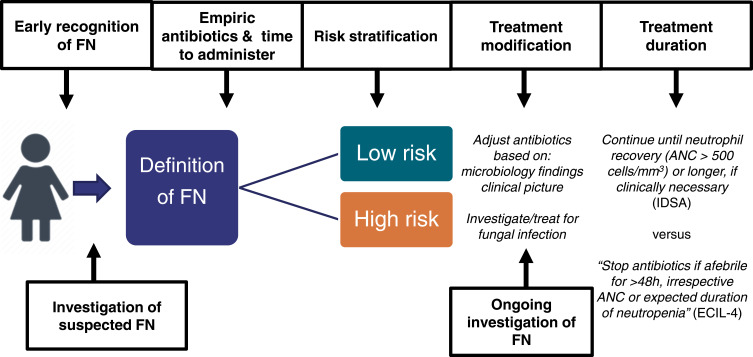
Febrile neutropenia (FN) is a frequent complication of cancer treatment in children. Owing to the potential for overwhelming bacterial sepsis, the recognition and management of FN requires rapid implementation of evidenced-based management protocols. Treatment paradigms have progressed from hospitalisation with broad spectrum antibiotics for all patients, through to risk adapted approaches to management. Such risk adapted approaches aim to provide safe care through incorporating antimicrobial stewardship (AMS) principles such as implementation of comprehensive clinical pathways incorporating de-escalation strategies with the imperative to reduce hospital stay and antibiotic exposure where possible in order to improve patient experience, reduce costs and diminish the risk of nosocomial infection. This review summarises the principles of risk stratification in FN, the current key considerations for optimising empiric antimicrobial selection including knowledge of antimicrobial resistance patterns and emerging technologies for rapid diagnosis of specific infections and summarises existing evidence on time to treatment, investigations required and duration of treatment. To aid treating physicians we suggest the key features based on current evidence that should be part of any FN management guideline and highlight areas for future research. The focus is on treatment of bacterial infections although fungal and viral infections are also important in this patient group.
Keywords: antimicrobials; febrile neutropenia; paediatric.
© 2021 Morgan et al.
Conflict of interest statement
JCC is supported by the Royal Marsden Cancer Charity and by National Health Service funding to the National Institute for Health Research Biomedical Research Centre of The Royal Marsden Hospital. JCC also served on an advisory board and reports educational presentation fees from Bayer. GMH reports grants from Medical Research Future Fund and Victorian Cancer Agency, outside the submitted work. JEM is supported by an NIHR Clinical Lectureship. The authors report no other conflicts of interest in this work.
Figures
References
Publication types
Grants and funding
LinkOut - more resources
Full Text Sources
Other Literature Sources
Miscellaneous
