Review
. 2021 Mar 30:14:849-856.
doi: 10.2147/JPR.S278285. eCollection 2021.

P-Selectin Blockade in the Treatment of Painful Vaso-Occlusive Crises in Sickle Cell Disease: A Spotlight on Crizanlizumab

Affiliations
Review

P-Selectin Blockade in the Treatment of Painful Vaso-Occlusive Crises in Sickle Cell Disease: A Spotlight on Crizanlizumab

Nabin Raj Karki et al. J Pain Res. .

Abstract

Microvascular vaso-occlusion driven pain crisis is the hallmark of sickle cell disease with profound morbidity and increased mortality. Selectins, most notably P-selectins have an integral role in this phenomenon. P-selection was first identified in 1989. In 2019, after 3 decades of basic, translational, and clinical work with this pathway, the US Food and Drug Administration approved a P-selectin antibody, crizanlizumab to reduce frequency of pain crisis in patients more than 16 years with sickle cell disease. We review the fundamentals of P-selectin pathobiology, P-selectin blocking agents, clinical data with the use of crizanlizumab and prospects of this novel class of drugs in the context of other treatments for painful vaso-occlusive episodes.

Keywords: P-selectin; crizanlizumab; pain crisis; sickle cell disease.


Conflict of interest statement

Dr Abdullah Kutlar reports grants, personal fees, non-financial support from Novartis Pharmaceuticals, and is a Data Safety Monitoring Board member for Bluebird Bio, during the conduct of the study. The authors report no other conflicts of interest in this work.

Figures
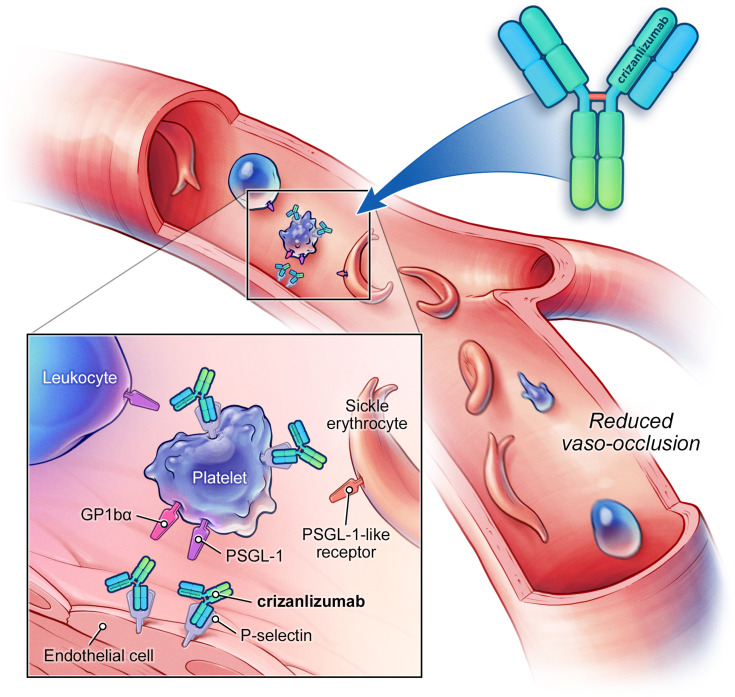
Figure 1
Figure 1
Mechanism of action of crizanlizumab. Crizanlizumab is a monoclonal antibody that binds to P-selectin. Blockade of P-selectin may prevent cell–cell interactions between blood cells and endothelial cells, and thus eliminate or reduce vaso-occlusion. Figure reproduced with permission from© 2020 Novartis AG.
Figure 2
Figure 2
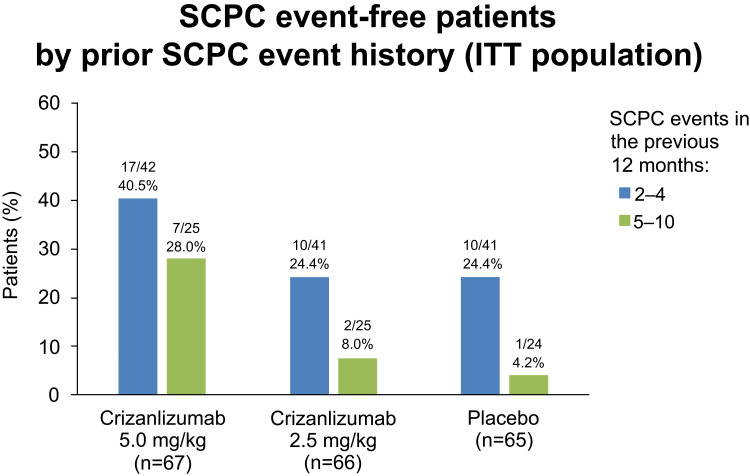
SCPC event-free patients in the high-dose crizanlizumab, low-dose crizanlizumab, and placebo subgroups in an ITT population with respect to the annualized crisis rate in the preceding year. Note: Data from Kutlar et al.

References

    1. Lanzkron S, Carroll CP, Haywood CJ. The burden of emergency department use for sickle-cell disease: an analysis of the national emergency department sample database. Am J Hematol. 2010;85(10):797–799. doi: 10.1002/ajh.21807 - DOI - PMC - PubMed
    1. Ballas SK, Lusardi M. Hospital readmission for adult acute sickle cell painful episodes: frequency, etiology, and prognostic significance. Am J Hematol. 2005;79(1):17–25. doi: 10.1002/ajh.20336 - DOI - PubMed
    1. Ballas SK, Gupta K, Adams-Graves P. Sickle cell pain: a critical reappraisal. Blood. 2012;120(18):3647–3656. doi: 10.1182/blood-2012-04-383430 - DOI - PubMed
    1. van Tuijn CFJ, van Beers EJ, Schnog -J-JB, Biemond BJ. Pain rate and social circumstances rather than cumulative organ damage determine the quality of life in adults with sickle cell disease. Am J Hematol. 2010;85(7):532–535. doi: 10.1002/ajh.21731 - DOI - PMC - PubMed
    1. Manwani D, Frenette PS. Vaso-occlusion in sickle cell disease: pathophysiology and novel targeted therapies. Blood. 2013;122(24):3892–3898. doi: 10.1182/blood-2013-05-498311 - DOI - PMC - PubMed

LinkOut - more resources