


The Impact of Non-Compliance to a Standardized Risk-Adjusted Protocol on Recurrence, Progression, and Mortality in Non-Muscle Invasive Bladder Cancer
- PMID: 33833577
- PMCID: PMC8020126
- DOI: 10.2147/CMAR.S299148
The Impact of Non-Compliance to a Standardized Risk-Adjusted Protocol on Recurrence, Progression, and Mortality in Non-Muscle Invasive Bladder Cancer
Abstract
Purpose: Non-muscle invasive bladder cancer (NMIBC) is a potentially curable or controllable disease if strict adherence to a surveillance protocol is followed. Management and surveillance of NMIBC begins at the time of diagnosis up to a few years thereafter. There is scanty data in the literature evaluating the impact of non-compliance with the surveillance protocols on progression, recurrence, and mortality rate.
Patients and methods: An observational, retrospective cohort study recruited data between 2012 and 2017 at two tertiary hospitals. Data were collected consecutively. NMIBC patients who had at least 3 years of follow-up data were included. Patients were divided into different groups based on their compliance with the cystoscopy follow-up protocol as recommended by the European guidelines. We compared the cystoscopy compliant group with the non-compliant group in view of recurrence, progression, and mortality. In addition, missing variable items during surveillance were calculated using a new scoring model to predict adverse outcomes.
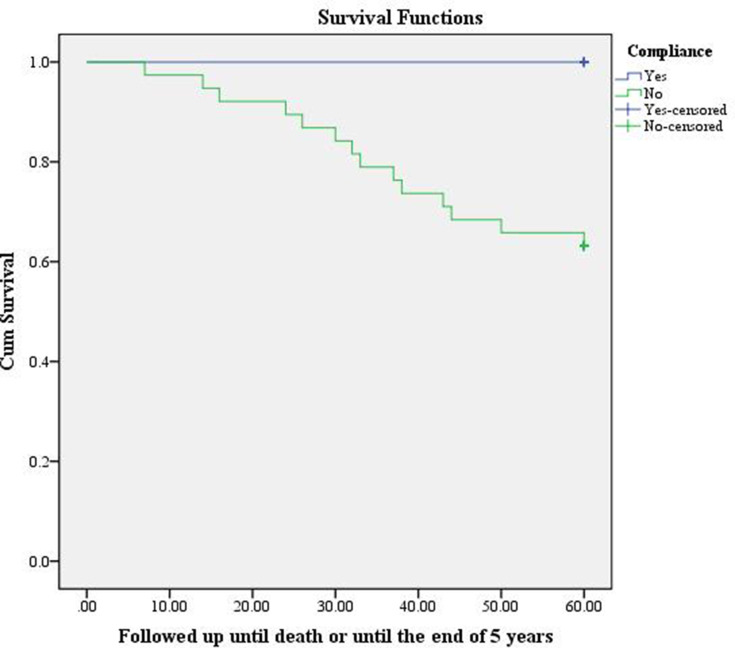
Results: Eighty-eight NMIBC patients met our criteria. Recurrence rate (RR), progression rate (PR), metastasis rate (MsR), and mortality rate (MR) are significantly higher in non-compliant group, RR: (92.6%) (P<0.001), PR: (54.1%) (P<0.001), MsR: (37.7%) (P<0.001), MR: (23.5%) (P= 0.002) respectively. In the subgroup analysis, intermediate and high-risk groups have a PR rate of zero in the compliant group, while it is 100% (P<0.001) and 56.4% (P=0.001) in the non-compliant group, respectively. Use of a Kaplan Meier (KM) graph shows that compliant patients had a better survival in comparison to non-compliant patients. Scoring there or more is statistically and clinically significantly associated with higher recurrence, progression, and mortality. RR: (94%) (P=0.016), PR: 49% (P<0.001) and MR (26%) (P=0.012).
Conclusion: Non-compliance to a standardized surveillance protocol in NMIBC is associated statistically and clinically with adverse outcomes in comparison to a compliant group. This mandates strict adherence to surveillance guidelines particularly in patients with high-risk disease.
Keywords: COVID-19; NMIBC; haematuria; urological malignancies.
© 2021 Abushamma et al.
Conflict of interest statement
The authors report no conflicts of interest for this work.
Figures
References
-
- Sylvester RJ, van der Meijden AP, Oosterlinck W, et al. Predicting recurrence and progression in individual patients with stage Ta T1 bladder cancer using EORTC risk tables: a combined analysis of 2596 patients from seven EORTC trials. Eur Urol. 2006;49(3):466. doi: 10.1016/j.eururo.2005.12.031 - DOI - PubMed
LinkOut - more resources
Full Text Sources
Other Literature Sources
Research Materials
Miscellaneous
