


Associations Between Fear of COVID-19, Affective Symptoms and Risk Perception Among Community-Dwelling Older Adults During a COVID-19 Lockdown
- PMID: 33833722
- PMCID: PMC8021922
- DOI: 10.3389/fpsyg.2021.638831
Associations Between Fear of COVID-19, Affective Symptoms and Risk Perception Among Community-Dwelling Older Adults During a COVID-19 Lockdown
Abstract
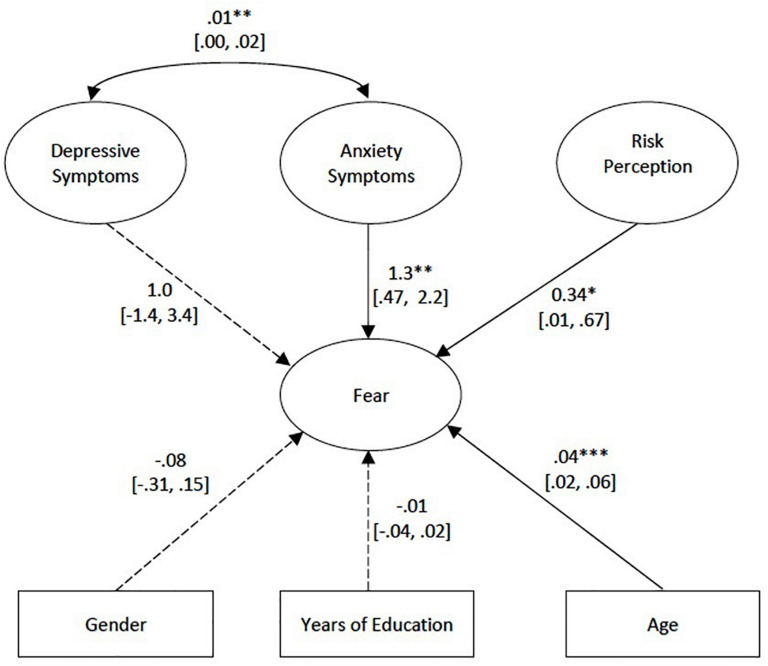
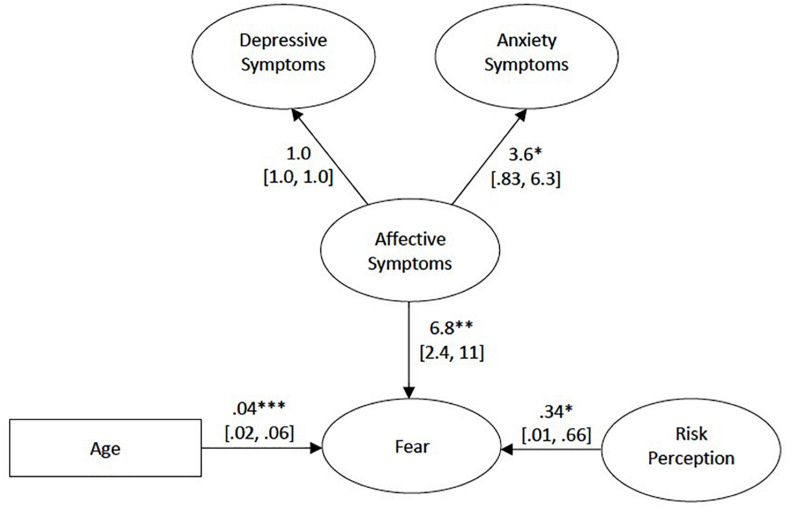
Fear is a common and potentially distressful psychological response to the current COVID-19 pandemic. The factors associated with such fear remains relatively unstudied among older adults. We investigated if fear of COVID-19 could be associated with a combination of psychological factors such as anxiety and depressive symptoms, and risk perception of COVID-19, and demographic factors in a community sample of older adults. Older adults (N = 413, M age = 69.09 years, SD = 5.45) completed measures of fear of COVID-19, anxiety and depressive symptoms, and risk perception of COVID-19, during a COVID-19 lockdown. These variables, together with demographics, were fitted to a structural equation model. Anxiety and depressive symptoms were highly correlated with each other and were combined into the higher order latent variable of affective symptoms for analyses. The final model revealed that fear of COVID-19 was positively associated with psychological factors of affective symptoms and risk perception. Older age was associated with greater fear of COVID-19. Our findings showed that fear of COVID-19 can be a projection of pre-existing affective symptoms and inflated risk perceptions and highlighted the need to address the incorrect risk perceptions of COVID-19 and socio-affective issues among older adults in the community.
Keywords: COVID-19; anxiety; depression; fear; older adults; risk perception.
Copyright © 2021 Han, Mahendran and Yu.
Conflict of interest statement
The authors declare that this study received funding from Research Donations from Kwan Im Thong Hood Cho Temple, Lee Kim Tah Holdings Pte Ltd., and the Hongkong and Shanghai Banking Corporation. The funders were not involved in the study design, collection, analysis, interpretation of data, the writing of this article or the decision to submit it for publication.
Figures
References
-
- American Psychological Association (2021). Anxiety. Washington, DC: American Psychological Association.
-
- Amin J. M., Lovibond P. F. (1997). Dissociations between covariation bias and expectancy bias for fear-relevant stimuli. Cogn. Emot. 11 273–289. 10.1080/026999397379926 - DOI
LinkOut - more resources
Full Text Sources
Other Literature Sources
