


Prediction of Mortality in Patients After Oncologic Gastrointestinal Surgery: Comparison of the ASA, APACHE II, and POSSUM Scoring Systems
- PMID: 33833910
- PMCID: PMC8019072
- DOI: 10.7759/cureus.13684
Prediction of Mortality in Patients After Oncologic Gastrointestinal Surgery: Comparison of the ASA, APACHE II, and POSSUM Scoring Systems
Abstract
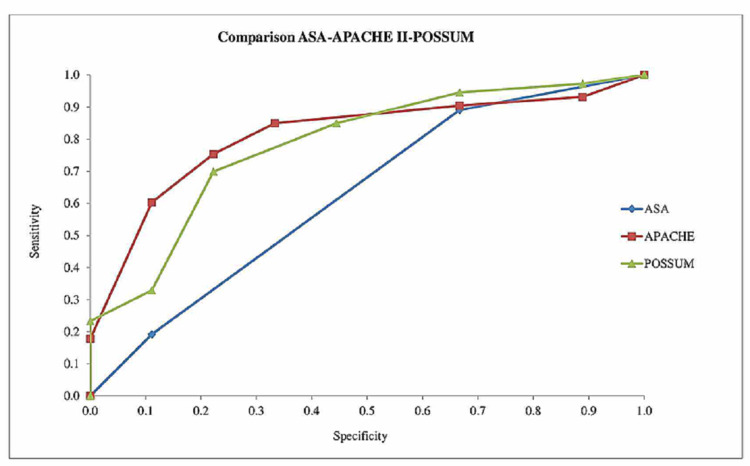
Scoring systems have been developed to predict the expected mortality and morbidity in surgical procedures. In this study, our aim was to compare the ASA (American Society of Anesthesiologists), APACHE (Acute Physiology and Chronic Health Evaluation) II, POSSUM (Physiological and Operative Severity Score for the enUmeration of Mortality and morbidity) scoring systems as predictors of mortality in patients who underwent gastrointestinal oncologic surgery, followed, and were admitted to the intensive care unit during the postoperative period. We examined the files of 82 patients who underwent oncologic gastrointestinal surgery and followed up in the intensive care units (ICUs). The patients' APACHE II scores and predicted mortality rates (PMR) according to the APACHE II, POSSUM, and ASA scores were calculated. The receiver operator characteristic (ROC) curve analysis was used when evaluating the performances of the ASA, APACHE, and POSSUM scoring systems in terms of accurate assessment of mortality. Accordingly, the area under the curve (AUC) = 0.5 no distinction, 0.5 <AUC <0.7 discriminative power of the test is statistically not significant, 0.7 <AUC <0.8 acceptable, 0.8 <AUC <0.9 very good and 0.9 <AUC <1 perfect. The evaluations showed that APACHE II had the best performance with 0.81, followed by POSSUM, which had an acceptable level at 0.78. On the other hand, the ASA score was 0.63 and its discriminative power was identified as statistically insignificant. Our results show that the POSSUM and APACHE II scoring systems were better at predicting mortality than the ASA scoring system for the prediction of mortality in the postoperative period. Both the POSSUM and APACHE II scoring systems can be confidently used for the prediction of mortality in patients undergoing operations due to oncologic gastrointestinal diseases.
Keywords: apache ii; asa; gastrointestinal cancer surgery; icu mortality rate; morbidity and mortality; possum.
Copyright © 2021, KISA et al.
Conflict of interest statement
The authors have declared that no competing interests exist.
Figures
References
-
- Hodgson SV, Foulkes WD, Eng C, Maher ER. A Practical Guide to Human Cancer Genetics. Vol. 4. London: Springer; 2014. A Practical Guide to Human Cancer Genetics; pp. 47–82.
-
- The role of anesthesia in surgical mortality. Dripps RD, Lamont A, Eckenhoff JE. JAMA. 1961;178:261–266. - PubMed
-
- ASA status and age predict adverse events after abdominal surgery. Hall JC, Hall JL. http://pubmed.ncbi.nlm.nih.gov/8794400/ J Qual Clin Pract. 1996;16:103–108. - PubMed
-
- APACHE II: a severity of disease classification system. Knaus WA, Draper EA, Wagner DP, Zimmerman JE. http://pubmed.ncbi.nlm.nih.gov/3928249/ Crit Care Med. 1985;13:818–829. - PubMed
-
- POSSUM: a scoring system for surgical audit. Copeland GP, Jones D, Walters M. Br J Surg. 1991;78:355–360. - PubMed
LinkOut - more resources
Full Text Sources
Other Literature Sources