. 2021 Jul;38(7):1787-1797.
doi: 10.1007/s10815-021-02179-0. Epub 2021 Apr 8.

FSH dose is negatively correlated with number of oocytes retrieved: analysis of a data set with ~650,000 ART cycles that previously identified an inverse relationship between FSH dose and live birth rate

Affiliations

FSH dose is negatively correlated with number of oocytes retrieved: analysis of a data set with ~650,000 ART cycles that previously identified an inverse relationship between FSH dose and live birth rate

Zaramasina L Clark et al. J Assist Reprod Genet. 2021 Jul.

Abstract

Purpose: To evaluate whether total FSH dose was negatively correlated with number of oocytes retrieved in a large data set where previously, a negative correlation between FSH dose and live birth rate was identified.

Methods: Data from 650,637 fresh autologous in vitro fertilization (IVF) cycles reported to the Society for Assisted Reproductive Technology between 2004 and 2012 were included. Logistic regression analysis was performed to determine if the relationship between total FSH dose used during ART with number of oocytes retrieved was impacted by the patient's health prognosis, age, BMI, ovarian stimulation protocol, or infertility diagnosis.

Results: The number of oocytes retrieved was negatively correlated with FSH dose (P < 0.0001). Regardless of patient prognosis, age, BMI, ovarian stimulation protocol, and infertility diagnosis, the highest number of oocytes retrieved was in the 1001-2000 IU FSH group, and was 36-51% lower in the > 5000 IU compared with the optimal, 1001-2000 IU, FSH groups. Overall, ~80% of patients received FSH doses outside of the optimal FSH dose. Moreover, 61% of good prognosis patients (excludes individuals likely prescribed higher FSH doses) received doses exceeding the optimal dose range.

Conclusion: The inverse relationship between FSH dose and the number of oocytes retrieved independent of patient age or health implies that excessive FSH doses during ART may be detrimental to oocyte retrieval.

Keywords: FSH; Oocyte retrieval; Ovarian stimulation.


Conflict of interest statement

The authors declare no competing interests.

Figures

Fig. 1
Fig. 1
Relationship between total FSH dose (IU) and number of oocytes retrieved in patients undergoing fresh autologous IVF cycles for the overall data set (all patients; top panel) and parsed by patient prognosis (good and negative prognosis; bottom panel). Good prognosis patients were selected based on the following criteria: < 35 years, body mass index < 30 kg/m2, no diagnosis of diminished ovarian reserve, or endometriosis. Negative prognosis patients were selected based on the following criteria: either ≥ 35 years and/or body mass index ≥ 30 kg/m2 and/or diagnosis of diminished ovarian reserve, or endometriosis. FSH dose categories included < 1000, 1001–2000, 2001–3000, 3001–4000, 4001–5000, and > 5000 IU. FSH dose category was significantly negatively correlated with the number of oocytes retrieved in all analyses (P < 0.0001). The figure also depicts (red line and text) the decrease in the number of oocytes retrieved in the highest (> 5000 IU) FSH dose category compared to the category with the highest number of oocytes retrieved (1001–2000 IU). The number of patients included in each analysis (N =) is depicted on the appropriate graph
Fig. 2
Fig. 2
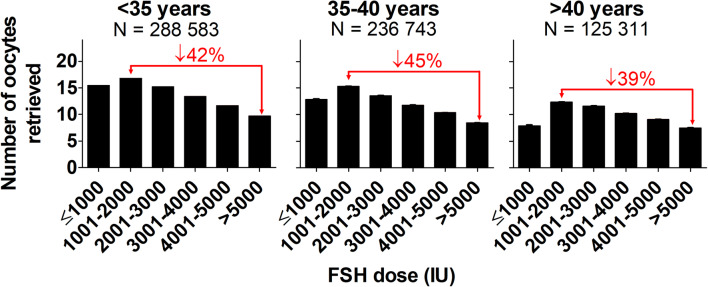
Relationship between total FSH dose (IU) and number of oocytes retrieved in patients undergoing fresh autologous IVF cycles, parsed by patient age (< 35 years, 35–40 years, and > 40 years). FSH dose categories included < 1000, 1001–2000, 2001–3000, 3001–4000, 4001–5000, and > 5000 IU. FSH dose category was significantly negatively correlated with the number of oocytes retrieved in all patient age categories (P < 0.0001). The figure also depicts (red line and text) the decrease in the number of oocytes retrieved in the highest (> 5000 IU) FSH dose category compared to the category with the highest number of oocytes retrieved (1001–2000 IU). The number of patients included in each analysis (N =) is depicted on the appropriate graph
Fig. 3
Fig. 3
Relationship between total FSH dose (IU) and number of oocytes retrieved in patients undergoing fresh autologous IVF cycles, parsed by patient BMI (< 18.5, 18.5–24.9, 25.0–29.9, and ≥ 30). FSH dose categories included < 1000, 1001–2000, 2001–3000, 3001–4000, 4001–5000, and > 5000 IU. FSH dose category was significantly negatively correlated with the number of oocytes retrieved in all patient BMI categories (P < 0.0001). The figure also depicts (red line and text) the decrease in the number of oocytes retrieved in the highest (> 5000 IU) FSH dose category compared to the category with the highest number of oocytes retrieved (1001–2000 IU). The number of patients included in each analysis (N =) is depicted on the appropriate graph
Fig. 4
Fig. 4
Relationship between total FSH dose (IU) and number of oocytes retrieved in patients undergoing fresh autologous IVF cycles, parsed by the three ovarian stimulation protocols (agonist suppression, agonist flare, and antagonist suppression) most common in the data set. FSH dose categories included < 1000, 1001–2000, 2001–3000, 3001–4000, 4001–5000, and > 5000 IU. FSH dose category was significantly negatively correlated with the number of oocytes retrieved in all ovarian stimulation protocol categories (P < 0.0001). The figure also depicts (red line and text) the decrease in the number of oocytes retrieved in the highest (> 5000 IU) FSH dose category compared to the category with the highest number of oocytes retrieved (1001–2000 IU). The number of patients included in each analysis (N =) is depicted on the appropriate graph
Fig. 5
Fig. 5
Relationship between total FSH dose (IU) and number of oocytes retrieved in patients undergoing fresh autologous IVF cycles, parsed by cycles where patients were recorded as having a positive diagnosis for either endometriosis, PCOS, diminished ovarian reserve, tubal disease, unexplained infertility, and those seeking ART for other reasons. FSH dose categories included < 1000, 1001–2000, 2001–3000, 3001–4000, 4001–5000, and > 5000 IU. FSH dose category was significantly correlated with the number of oocytes retrieved in each of the categories (P < 0.0001). The figure also depicts (red line and text) the decrease in the number of oocytes retrieved in the highest (> 5000 IU) FSH dose category compared to the category with the highest number of oocytes retrieved (1001–2000 IU). The number of patients included in each analysis (N =) is depicted on the appropriate graph

References

    1. Pereira N, Friedman C, Hutchinson AP, Lekovich JP, Elias RT, Rosenwaks Z. Increased odds of live birth in fresh in vitro fertilization cycles with shorter ovarian stimulation. Fertil Steril. 2017;107:104–109.e102. doi: 10.1016/j.fertnstert.2016.09.044. - DOI - PubMed
    1. Land JA, Yarmolinskaya MI, Dumoulin JCM, Evers JLH. High-dose human menopausal gonadotropin stimulation in poor responders does not improve in vitro fertilization outcome. Fertil Steril. 1996;65:961–965. doi: 10.1016/S0015-0282(16)58269-7. - DOI - PubMed
    1. Leijdekkers JA, Torrance HL, Schouten NE, van Tilborg TC, Oudshoorn SC, Mol BWJ, et al. Individualized ovarian stimulation in IVF/ICSI treatment: it is time to stop using high FSH doses in predicted low responders. Hum Reprod. 2020;35:1954–63. - PMC - PubMed
    1. Lensen SF, Wilkinson J, Leijdekkers JA, La Marca A, Mol BWJ, Marjoribanks J, Torrance H, Broekmans FJ. Individualised gonadotropin dose selection using markers of ovarian reserve for women undergoing in vitro fertilisation plus intracytoplasmic sperm injection (IVF/ICSI) Cochrane Database Syst Rev. 2018;2:CD012693. - PMC - PubMed
    1. Baker VL, Brown MB, Luke B, Smith GW, Ireland JJ. Gonadotropin dose is negatively correlated with live birth rate: analysis of more than 650,000 assisted reproductive technology cycles. Fertil Steril. 2015;104:1145–1152.e1145. doi: 10.1016/j.fertnstert.2015.07.1151. - DOI - PMC - PubMed

MeSH terms

Substances

LinkOut - more resources