


Return-to-sport quadriceps strength symmetry impacts 5-year cartilage integrity after anterior cruciate ligament reconstruction: A preliminary analysis
- PMID: 33834527
- PMCID: PMC8724934
- DOI: 10.1002/jor.25029
Return-to-sport quadriceps strength symmetry impacts 5-year cartilage integrity after anterior cruciate ligament reconstruction: A preliminary analysis
Abstract
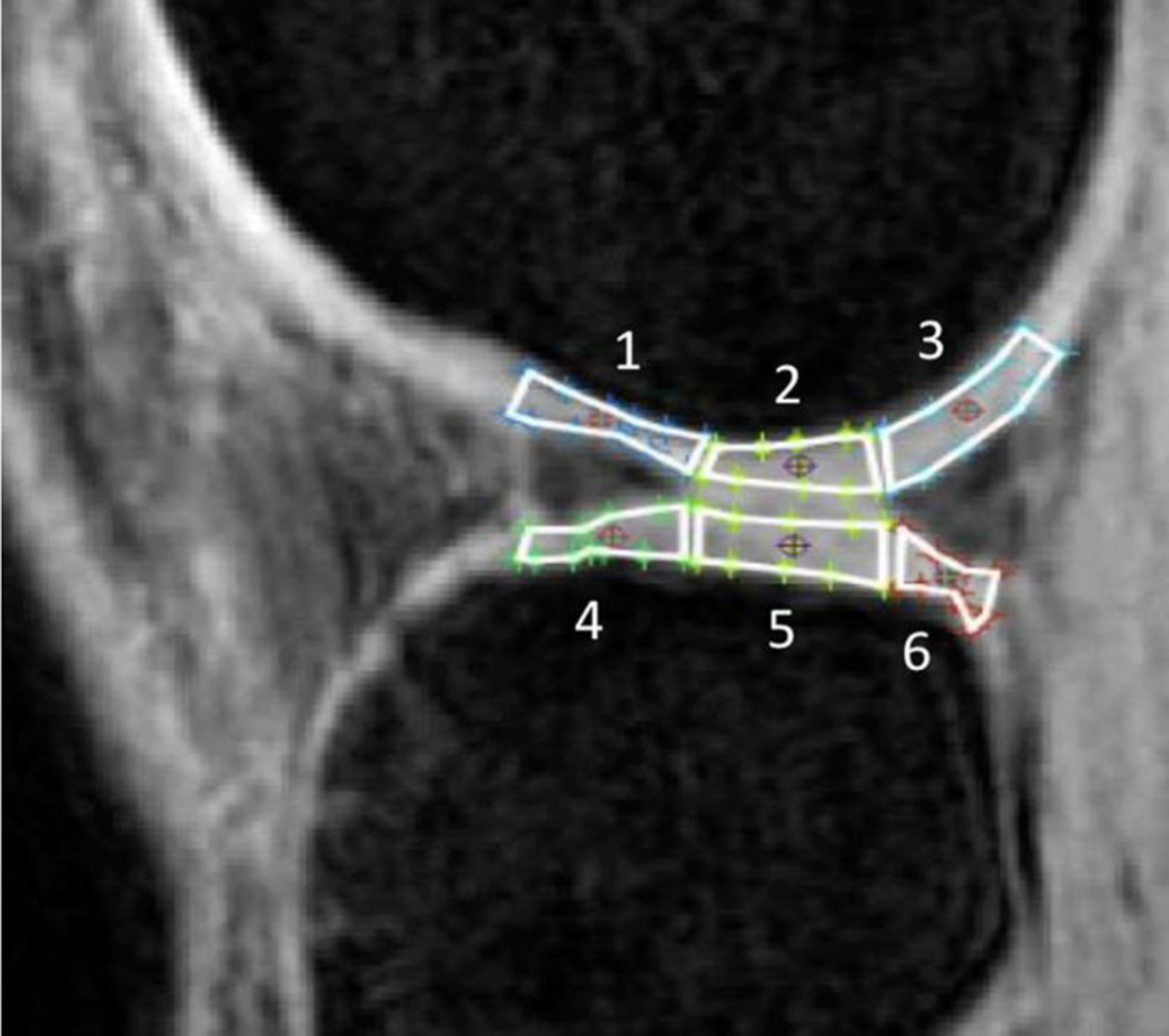
Quadriceps femoris strength asymmetry at the time of return to sports participation after anterior cruciate ligament (ACL) reconstruction contributes to worse function and asymmetric landing patterns, but the impact on longitudinal outcomes is not known. This study determined if young athletes after ACL reconstruction with quadriceps femoris strength asymmetry at a return to sports clearance would demonstrate markers of knee cartilage degeneration 5 years later compared to those with symmetric quadriceps femoris strength at return to sports. Participants (n = 27) were enrolled at the time of medical clearance for sports participation (baseline testing) and followed for 5 years. At baseline, quadriceps femoris strength was measured bilaterally and a limb symmetry index was used to divide the cohort into two groups: return to sport clearance with high quadriceps femoris strength (RTS-HQ; limb symmetry index ≥ 90%) and return to sport clearance with low quadriceps femoris strength (RTS-LQ; limb symmetry index < 85%). At 5 years post-baseline, quantitative magnetic resonance imaging (T2 relaxation times (ms): involved knee medial/lateral femoral condyle and tibial plateau) data were collected. Group differences were evaluated with independent samples t tests. At 5 years post-return to sports, the RTS-LQ strength group (n = 14) demonstrated elevated T2 relaxation times at the anterior region of the lateral femoral condyle compared to the RTS-HQ strength group (n = 13). Clinical Significance: Just over 50% of this cohort was cleared for sports participation with involved limb quadriceps femoris strength deficits that may contribute to early markers of knee cartilage degeneration within the subsequent 5 years.
Keywords: ACL reconstruction; MRI; osteoarthritis; quadriceps femoris.
© 2021 Orthopaedic Research Society. Published by Wiley Periodicals LLC.
Figures
References
-
- Beynnon BD, Johnson RJ, Abate JA, Fleming BC, Nichols CE. Treatment of anterior cruciate ligament injuries, part I. Am J Sports Med. 2005;33(10):1579–1602. - PubMed
-
- Ithurburn MP, Altenburger AR, Thomas S, Hewett TE, Paterno MV, Schmitt LC Young athletes after ACL reconstruction with quadriceps strength asymmetry at the time of return-to-sport demonstrate decreased knee function 1 year later. Knee Surgery, Sport Traumatol Arthrosc. 2018;26(2):426–433. - PubMed
-
- Ithurburn MP, Paterno MV, Ford KR, Hewett TE, Schmitt LC. Young Athletes With Quadriceps Femoris Strength Asymmetry at Return to Sport After Anterior Cruciate Ligament Reconstruction Demonstrate Asymmetric Single-Leg Drop-Landing Mechanics. Am J Sports Med. 2015;43(11):2727–2737. - PubMed
-
- Ithurburn MP, Paterno MV, Ford KR, Hewett TE, Schmitt LC. Young Athletes after Anterior Cruciate Ligament Reconstruction with Single-Leg Landing Asymmetries at the Time of Return to Sport Demonstrate Decreased Knee Function 2 Years Later. Am J Sports Med. 2017;45(11):2604–2613. - PubMed
Publication types
MeSH terms
Grants and funding
LinkOut - more resources
Full Text Sources
Other Literature Sources
Medical
