Neonatal Screening for Congenital Metabolic and Endocrine Disorders—Results From Germany for the Years 2006–2018
- PMID: 33835005
- PMCID: PMC8200684
- DOI: 10.3238/arztebl.m2021.0009
Neonatal Screening for Congenital Metabolic and Endocrine Disorders—Results From Germany for the Years 2006–2018
Abstract
Background: The purpose of neonatal screening is the early detection of congenital metabolic and endocrine disorders that, if untreated, could lead to fatal crises or other long-term adverse sequelae. In Germany, neonatal screening is legally regulated. Quality-assurance reports ("DGNS reports") are created and published annually by the German Society for Neonatal Screening (Deutsche Gesellschaft für Neugeborenen-Screening). Data from the DGNS reports for the years 2006-2018 serve as the basis of the present publication.
Methods: For the years 2006-2018, prevalences were calculated and data on process quality were evaluated.
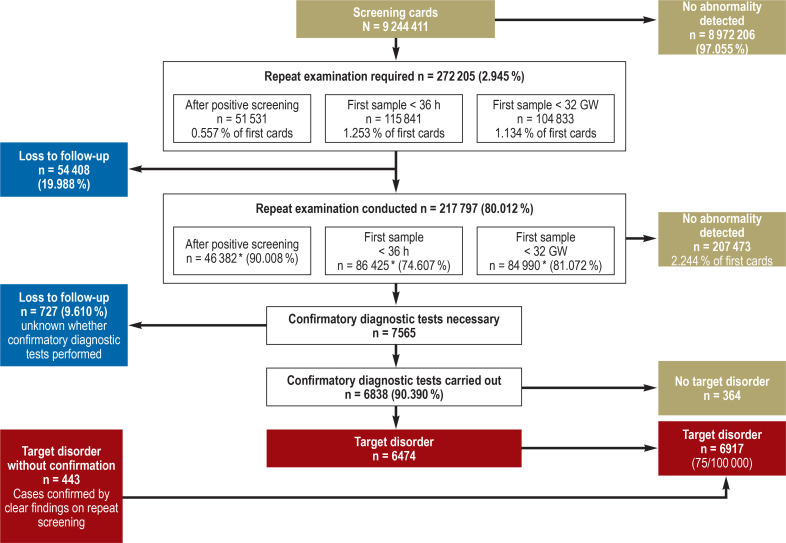
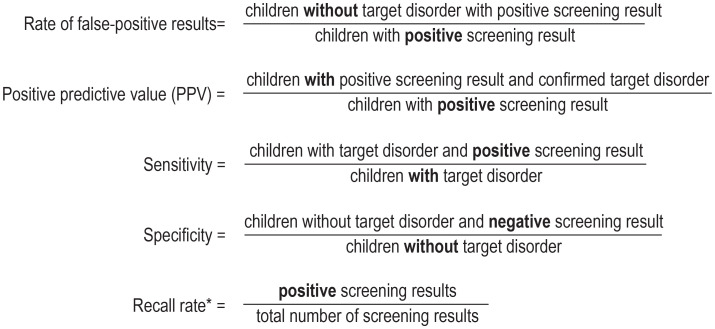
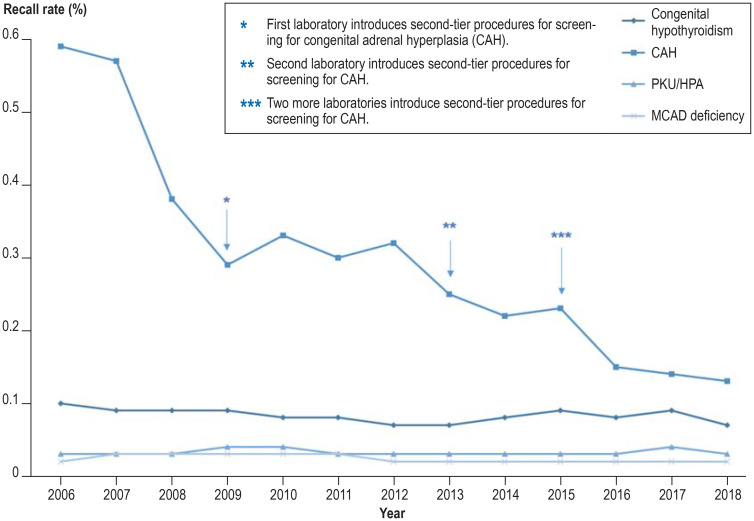
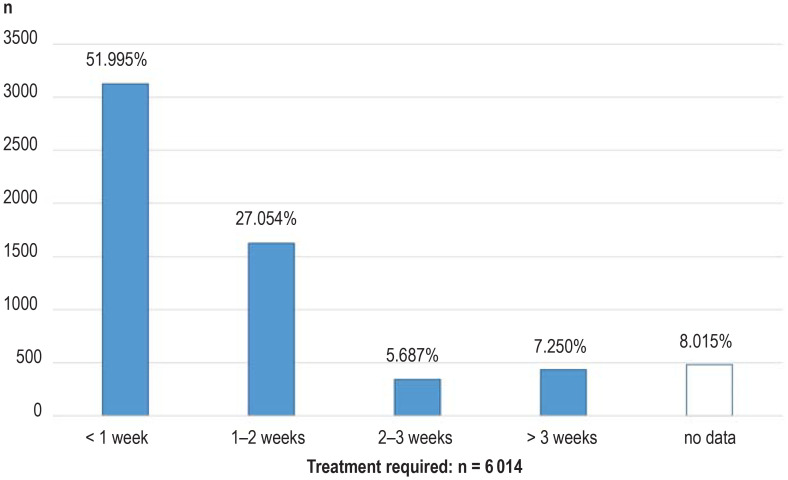
Results: Among 9 218 538 births, 6917 neonates were identified who had one of the target diseases. The overall prevalence was 75 per 100 000 neonates; the disorders most commonly found were congenital hypothyroidism (30 per 100 000) followed by phenylketonuria (PKU) and medium-chain acyl-CoA dehydrogenase deficiency (MCAD) (10 per 100 000 each). Of the 272 205 follow-up screenings requested, 80% were received. The rate of positive screening findings (recall rate) declined over the observation period, from 0.90% in 2006 to 0.37% in 2018. For every five positive screening findings, one case of a target disorder was confirmed. 79% of the children for whom treatment was indicated began to receive treatment within two weeks.
Conclusion: The low recall rate and the early initiation of treatment in 79% of the affected children indicate that neonatal screening for metabolic and endocrine disorders in Germany is effective. The incorporation of tracking structures and the introduction of a registry could further improve the quality of the program.
Figures
Comment in
-
Newborn Screening: Still Room for Improvement.Dtsch Arztebl Int. 2021 Feb 19;118(7):99-100. doi: 10.3238/arztebl.m2021.0008. Dtsch Arztebl Int. 2021. PMID: 33835004 Free PMC article. No abstract available.
-
Support Deficit in Adulthood.Dtsch Arztebl Int. 2021 Jul 12;118(27-28):485. doi: 10.3238/arztebl.m2021.0201. Dtsch Arztebl Int. 2021. PMID: 34491162 Free PMC article. No abstract available.
-
Use Existing Registry.Dtsch Arztebl Int. 2021 Jul 12;118(27-28):485. doi: 10.3238/arztebl.m2021.0202. Dtsch Arztebl Int. 2021. PMID: 34491163 Free PMC article. No abstract available.
References
-
- Richtlinie des Gemeinsamen Bundesausschusses über die Früherkennung von Krankheiten bei Kindern (Kinder-Richtlinie), 2020; §§ 13-28. www.g-ba.de/downloads/62-492-2156/Kinder-RL_2020-05-14_iK-2020-03-25.pdf (last accessed on 15 July 2020)
-
- Richtlinie des Gemeinsamen Bundesausschusses über die Früherkennung von Krankheiten bei Kindern (Kinder-Richtlinie), 2020; §§ 29-42. www.g-ba.de/downloads/62-492-2156/Kinder-RL_2020-05-14_iK-2020-03-25.pdf (last accessed on 15 July 2020)
-
- Nennstiel-Ratzel U, Lüders A, Blankenstein O. Neugeborenenscreening: ein Paradebeispiel für effektive Sekundärprävention. Bundesgesundheitsblatt Gesundheitsforschung Gesundheitsschutz. 2015;58:139–145. - PubMed
-
- Gesetz über genetische Untersuchungen am Menschen (Gendiagnostikgesetz- GenDG), Ausfertigungsdatum 31.07.2009. www.gesetze-im-internet.de/gendg/BJNR252900009.html (last accessed on 15 July 2020)
-
- Nennstiel U, Lüders A, Blankenstein O, et al. DGNS Screening Reports. www.screening-dgns.de/reports.php (last accessed on 15 July 2020)
MeSH terms
Substances
LinkOut - more resources
Full Text Sources
Other Literature Sources
Medical