Effects of an urban sanitation intervention on childhood enteric infection and diarrhea in Maputo, Mozambique: A controlled before-and-after trial
- PMID: 33835026
- PMCID: PMC8121544
- DOI: 10.7554/eLife.62278
Effects of an urban sanitation intervention on childhood enteric infection and diarrhea in Maputo, Mozambique: A controlled before-and-after trial
Abstract
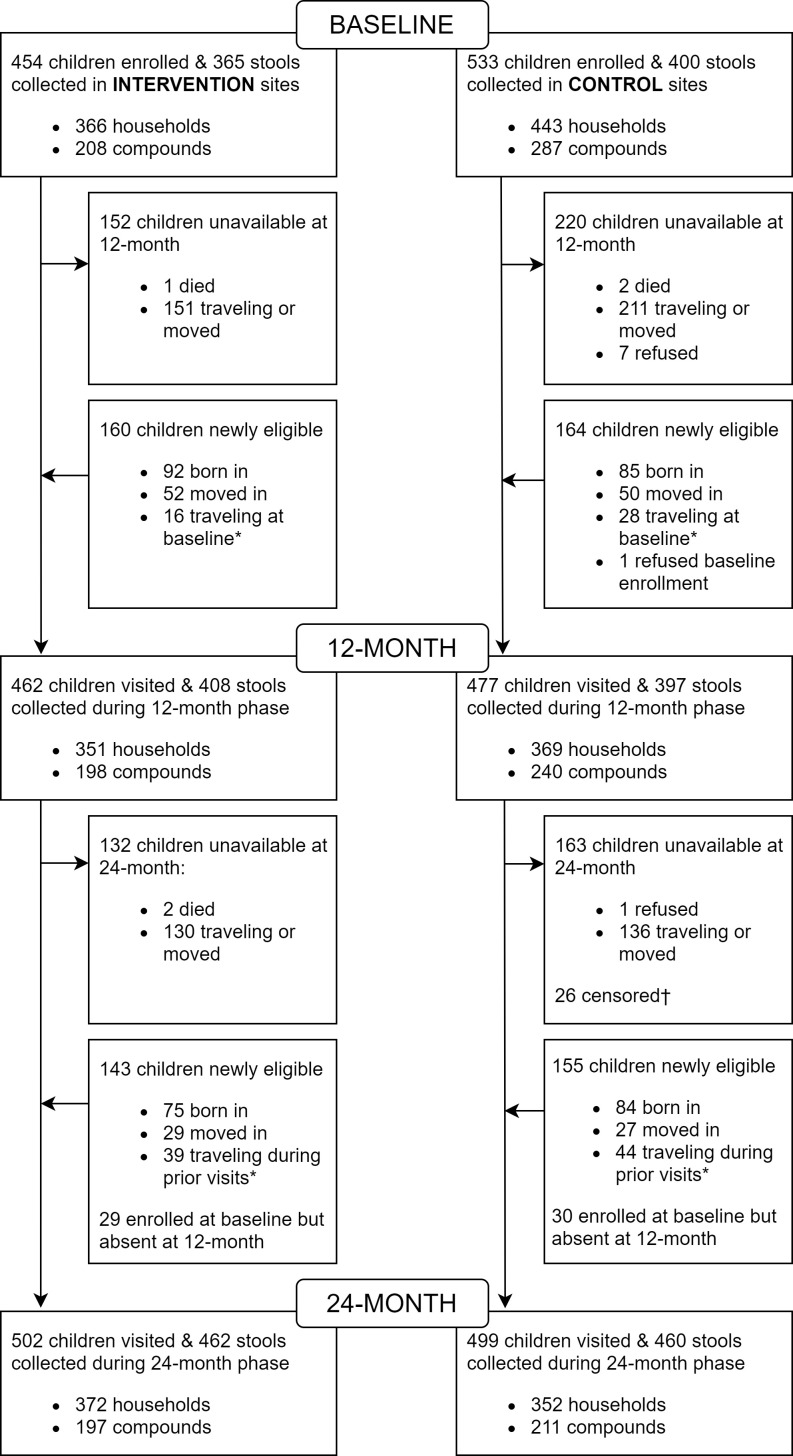
We conducted a controlled before-and-after trial to evaluate the impact of an onsite urban sanitation intervention on the prevalence of enteric infection, soil transmitted helminth re-infection, and diarrhea among children in Maputo, Mozambique. A non-governmental organization replaced existing poor-quality latrines with pour-flush toilets with septic tanks serving household clusters. We enrolled children aged 1-48 months at baseline and measured outcomes before and 12 and 24 months after the intervention, with concurrent measurement among children in a comparable control arm. Despite nearly exclusive use, we found no evidence that intervention affected the prevalence of any measured outcome after 12 or 24 months of exposure. Among children born into study sites after intervention, we observed a reduced prevalence of Trichuris and Shigella infection relative to the same age group at baseline (<2 years old). Protection from birth may be important to reduce exposure to and infection with enteric pathogens in this setting.
Trial registration: ClinicalTrials.gov NCT02362932.
Keywords: diarrhea; enteric infection; environmental health; epidemiology; global health; human; medicine; neglected tropical diseases; sanitation; soil-transmitted helminths.
© 2021, Knee et al.
Conflict of interest statement
JK, TS, ZA, CA, FB, DC, VC, DH, PK, EM, JB, CR, WS, JS, WZ, RN, OC, JB As we have indicated on the ICMJE COI form, attached, this authors's time working on this study was funded in part by the study's funders, the United States Agency for International Development and the Bill and Melinda Gates Foundation. AM, VZ No competing interests declared
Figures


References
-
- Barreto ML, Genser B, Strina A, Teixeira MG, Assis AM, Rego RF, Teles CA, Prado MS, Matos SM, Santos DN, dos Santos LA, Cairncross S. Effect of city-wide sanitation programme on reduction in rate of childhood diarrhoea in northeast brazil: assessment by two cohort studies. The Lancet. 2007;370:1622–1628. doi: 10.1016/S0140-6736(07)61638-9. - DOI - PMC - PubMed
-
- Barreto ML, Genser B, Strina A, Teixeira MG, Assis AM, Rego RF, Teles CA, Prado MS, Matos S, Alcântara-Neves NM, Cairncross S. Impact of a citywide sanitation program in northeast brazil on intestinal parasites infection in young children. Environmental Health Perspectives. 2010;118:1637–1642. doi: 10.1289/ehp.1002058. - DOI - PMC - PubMed
-
- Benjamin-Chung J, Pilotte N, Ercumen A, Grant JR, Maasch J, Gonzalez AM, Ester AC, Arnold BF, Rahman M, Haque R, Hubbard AE, Luby SP, Williams SA, Colford JM. Comparison of multi-parallel qPCR and double-slide Kato-Katz for detection of soil-transmitted helminth infection among children in rural bangladesh. PLOS Neglected Tropical Diseases. 2020;14:e0008087. doi: 10.1371/journal.pntd.0008087. - DOI - PMC - PubMed
Publication types
MeSH terms
Substances
Associated data
LinkOut - more resources
Full Text Sources
Other Literature Sources
Medical