


Research Funding, Income, and Career Satisfaction Among Clinician-Scientists in Ophthalmology in the United States
- PMID: 33836182
- PMCID: PMC8184629
- DOI: 10.1016/j.ajo.2021.03.034
Research Funding, Income, and Career Satisfaction Among Clinician-Scientists in Ophthalmology in the United States
Abstract
Purpose: The purpose of this study was to characterize clinician-scientists in ophthalmology and identify factors associated with successful research funding, income, and career satisfaction.
Design: Cross-sectional study.
Methods: A survey was conducted of clinician-scientists in ophthalmology at US academic institutions between April 17, 2019, and May 19, 2019. Collected information including 1) demographic data; 2) amount, type, and source of startup funding; first extramural grant; and first R01-equivalent independent grant; 3) starting and current salaries; and 4) Likert-scale measurements of career satisfaction were analyzed using multivariate regression.
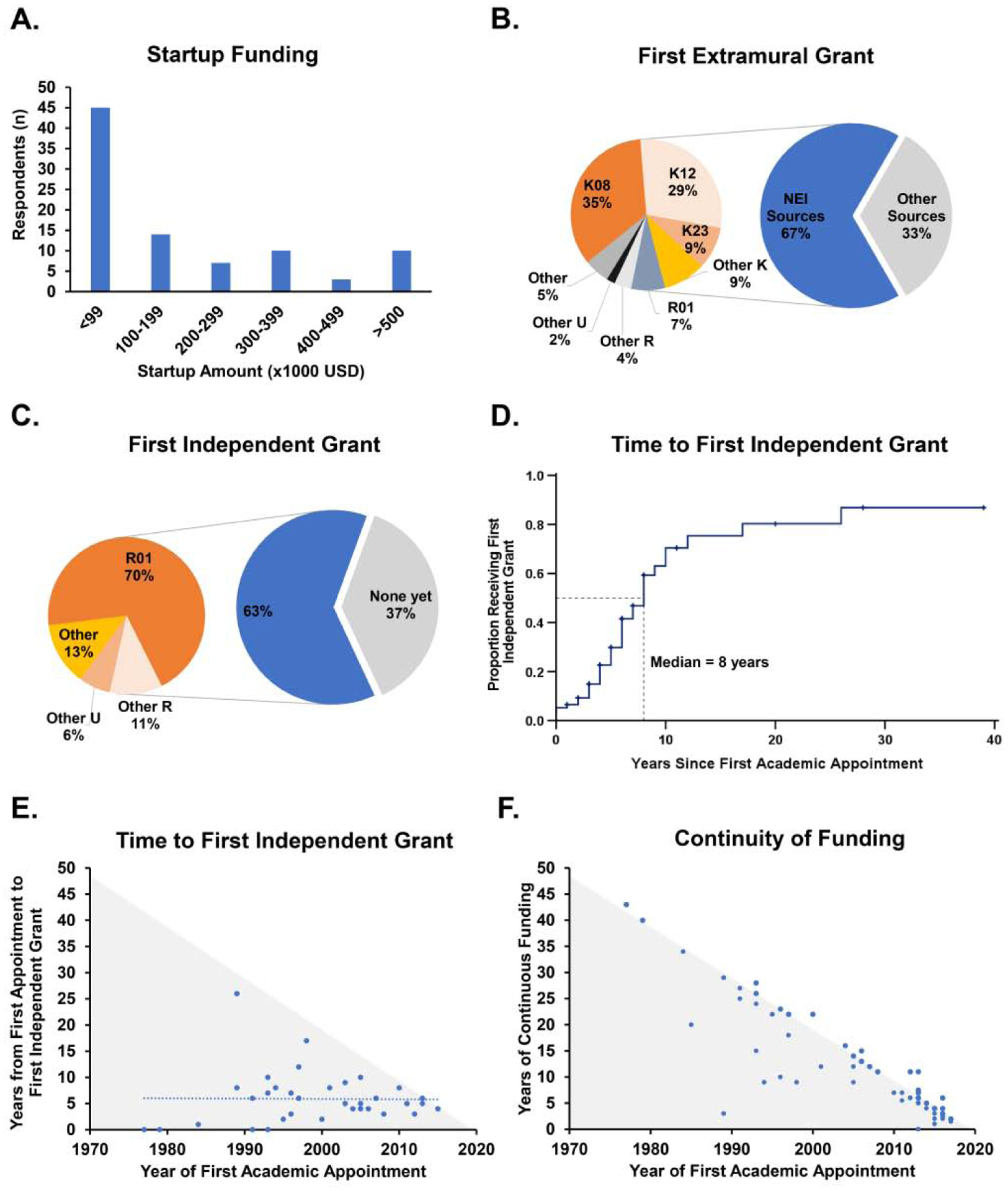
Results: Ninety-eight clinician-scientists in ophthalmology were surveyed across different ages (mean: 48 ± 11 years), research categories, institutional types, geographic regions, and academic ranks. Median startup funding ranged from $50-99k, and median starting salaries ranged from $150-199k. A majority of investigators (67%) received their first extramural award from the National Eye Institute, mainly through K-award mechanisms (82%). The median time to receiving their first independent grant was 8 years, mainly through an R01 award (70%). Greater institutional startup support (P = .027) and earlier extramural grant success (P = .022) were associated with earlier independent funding. Male investigators (P = .001) and MD degreed participants (P = .008) were associated with higher current salaries but not starting salaries. Overall career satisfaction increased with career duration (P = .011) but not with earlier independent funding (P = .746) or higher income (P = .300).
Conclusions: Success in research funding by clinician-scientists in ophthalmology may be linked to institutional support and earlier acquisition of extramural grants but does not impact academic salaries. Nevertheless, career satisfaction among clinician-scientists improves with time, which is not necessarily influenced by research or financial success.
Copyright © 2021 Elsevier Inc. All rights reserved.
Figures



References
-
- Franko M, Ionescu-Pioggia M. Making the right moves: a practical guide to scientific management for postdocs and new faculty. Burroughs Wellcome Fund; 2006.
-
- Wyngaarden JB. The clinical investigator as an endangered species. N Engl J Med. 1979;23:1254–9. - PubMed
-
- Schafer AI, editor. The vanishing physician-scientist? Ithaca, New York: Cornell University Press; 2009.
-
- Ley TJ, Rosenberg LE. The physician scientist career pipeline in 2005. JAMA. 2005;294:1343–51. - PubMed
-
- Ambati BK, Cahoon J. Rejuvenating clinician-scientist training. Invest Ophthalmol Vis Sci. 2014;55(3):1853–1855. - PubMed
MeSH terms
Grants and funding
LinkOut - more resources
Full Text Sources
Other Literature Sources
Miscellaneous
