


Promoting vegetable intake in preschool children: Independent and combined effects of portion size and flavor enhancement
- PMID: 33836215
- PMCID: PMC8206024
- DOI: 10.1016/j.appet.2021.105250
Promoting vegetable intake in preschool children: Independent and combined effects of portion size and flavor enhancement
Abstract
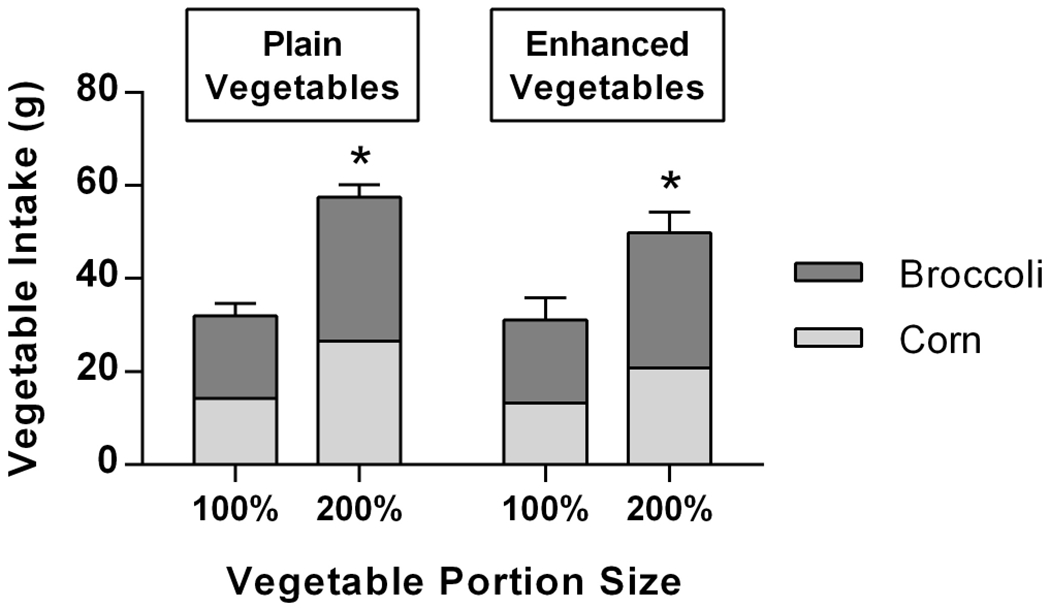
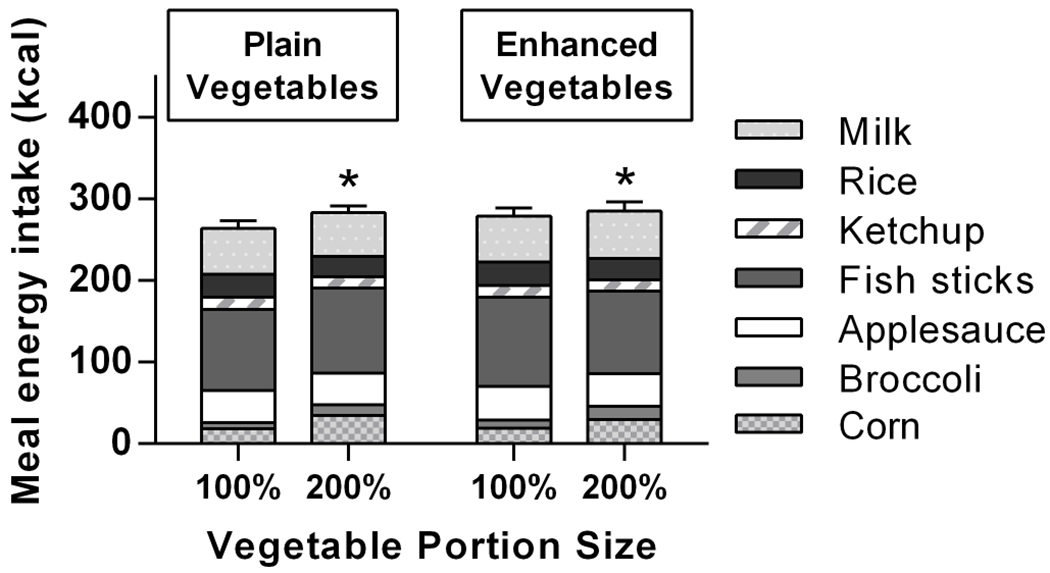
This study investigated the independent and combined effects on preschool children's vegetable intake of serving a larger portion of vegetables and enhancing their flavor. In a crossover design, lunch was served in childcare centers once a week for four weeks to 67 children aged 3-5 y (26 boys, 41 girls). The meal consisted of two familiar vegetables (broccoli and corn) served with fish sticks, rice, ketchup, applesauce, and milk. Across the four meals, we varied the portion of vegetables (60 or 120 g total weight, served as equal weights of broccoli and corn) and served them either plain or enhanced (6.6% light butter and 0.5% salt by weight). All meals were consumed ad libitum and were weighed to determine intake. Doubling the portion of vegetables led to greater consumption of both broccoli and corn (both p < 0.0001) and increased meal vegetable intake by 68% (mean ± SEM 21 ± 3 g). Enhancing vegetables with butter and salt, however, did not influence their intake (p = 0.13), nor did flavor enhancement modify the effect of portion size on intake (p = 0.10). Intake of other meal components did not change when the vegetable portion was doubled (p = 0.57); thus, for the entire meal, the increase in vegetable consumption led to a 5% increase in energy intake (13 ± 5 kcal; p = 0.02). Ratings indicated that children had similar liking for the plain and enhanced versions of each vegetable (both p > 0.31). All versions of vegetables were well-liked, as indicated by ≥ 76% of the children rating them as "yummy" or "just okay". Serving a larger portion of vegetables at a meal was an effective strategy to promote vegetable intake in children, but when well-liked vegetables were served, adding butter and salt was not necessary to increase consumption.
Trial registration: ClinicalTrials.gov NCT03926065.
Keywords: Eating behavior; Energy intake; Liking; Portion size; Preschool children; Vegetable intake.
Copyright © 2021 Elsevier Ltd. All rights reserved.
Conflict of interest statement
Declaration of competing interest
The authors have no competing interests to declare.
Figures
Similar articles
-
Eating vegetables first: the use of portion size to increase vegetable intake in preschool children.Am J Clin Nutr. 2010 May;91(5):1237-43. doi: 10.3945/ajcn.2009.29139. Epub 2010 Mar 10. Am J Clin Nutr. 2010. PMID: 20219955 Free PMC article.
-
Double trouble: Portion size and energy density combine to increase preschool children's lunch intake.Physiol Behav. 2016 Aug 1;162:18-26. doi: 10.1016/j.physbeh.2016.02.019. Epub 2016 Feb 12. Physiol Behav. 2016. PMID: 26879105 Free PMC article.
-
Does milk matter: Is children's intake affected by the type or amount of milk served at a meal?Appetite. 2016 Oct 1;105:509-18. doi: 10.1016/j.appet.2016.06.022. Epub 2016 Jun 21. Appetite. 2016. PMID: 27338218 Free PMC article. Clinical Trial.
-
Systematic review and meta-analysis of strategies to increase vegetable consumption in preschool children aged 2-5 years.Appetite. 2018 Aug 1;127:138-154. doi: 10.1016/j.appet.2018.04.019. Epub 2018 Apr 25. Appetite. 2018. PMID: 29702128
-
The influence of plate size on meal composition. Literature review and experiment.Appetite. 2014 Nov;82:91-6. doi: 10.1016/j.appet.2014.07.010. Epub 2014 Jul 15. Appetite. 2014. PMID: 25049139 Review.
Cited by
-
Portion size can be used strategically to increase intake of vegetables and fruits in young children over multiple days: a cluster-randomized crossover trial.Am J Clin Nutr. 2022 Jan 11;115(1):272-283. doi: 10.1093/ajcn/nqab321. Am J Clin Nutr. 2022. PMID: 34550306 Free PMC article. Clinical Trial.
-
Food Properties and Individual Characteristics Influence Children's Intake Across Multiple Days of Weighed Assessments in Childcare Programs.J Nutr. 2023 May;153(5):1646-1655. doi: 10.1016/j.tjnut.2023.03.025. Epub 2023 Mar 24. J Nutr. 2023. PMID: 36965692 Free PMC article. Clinical Trial.
-
The Effects of Potato Presentation on Vegetable Intake in School-Aged Children: A Cross-Over Study.Nutrients. 2023 Oct 24;15(21):4496. doi: 10.3390/nu15214496. Nutrients. 2023. PMID: 37960149 Free PMC article.
-
Healthy eating interventions delivered in early childhood education and care settings for improving the diet of children aged six months to six years.Cochrane Database Syst Rev. 2023 Jun 12;6(6):CD013862. doi: 10.1002/14651858.CD013862.pub2. Cochrane Database Syst Rev. 2023. Update in: Cochrane Database Syst Rev. 2023 Aug 22;8:CD013862. doi: 10.1002/14651858.CD013862.pub3. PMID: 37306513 Free PMC article. Updated. Review.
-
Interventions for increasing fruit and vegetable consumption in children aged five years and under.Cochrane Database Syst Rev. 2024 Sep 23;9(9):CD008552. doi: 10.1002/14651858.CD008552.pub8. Cochrane Database Syst Rev. 2024. PMID: 39312396
References
-
- Baranowski T, Domel S, Gould R, Baranowski J, Leonard S, Treiber F, & Mullis R (1993). Increasing fruit and vegetable consumption among 4th and 5th grade students: results from focus groups using reciprocal determinism. Journal of Nutrition Education, 25(3), 114–120. 10.1016/S0022-3182(12)80567-X - DOI
-
- Birch LL (1979). Dimensions of preschool children’s food preferences. Journal of Nutrition Education, 11(2), 77–80. 10.1016/S0022-3182(79)80089-8 - DOI
-
- Birch LL, Fisher JO, Grimm-Thomas K, Markey CN, Sawyer R, & Johnson SL (2001). Confirmatory factor analysis of the Child Feeding Questionnaire: a measure of parental attitudes, beliefs and practices about child feeding and obesity proneness. Appetite, 36(3), 201–210. 10.1006/appe.2001.0398 - DOI - PubMed
Publication types
MeSH terms
Associated data
Grants and funding
LinkOut - more resources
Full Text Sources
Other Literature Sources
Medical
