


Developments in solution-state NMR yield broader and deeper views of the dynamic ensembles of nucleic acids
- PMID: 33836446
- PMCID: PMC8714323
- DOI: 10.1016/j.sbi.2021.02.007
Developments in solution-state NMR yield broader and deeper views of the dynamic ensembles of nucleic acids
Abstract
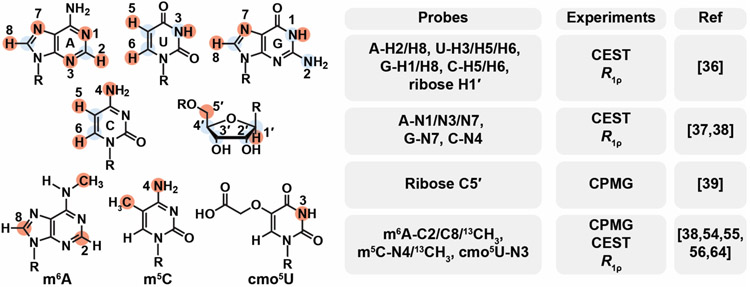
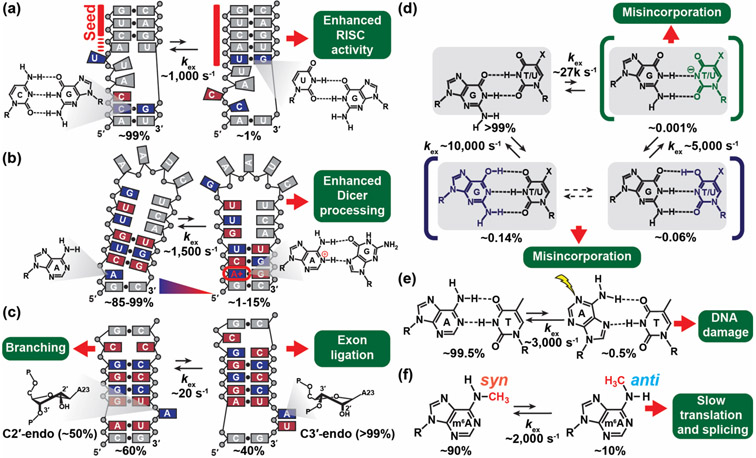
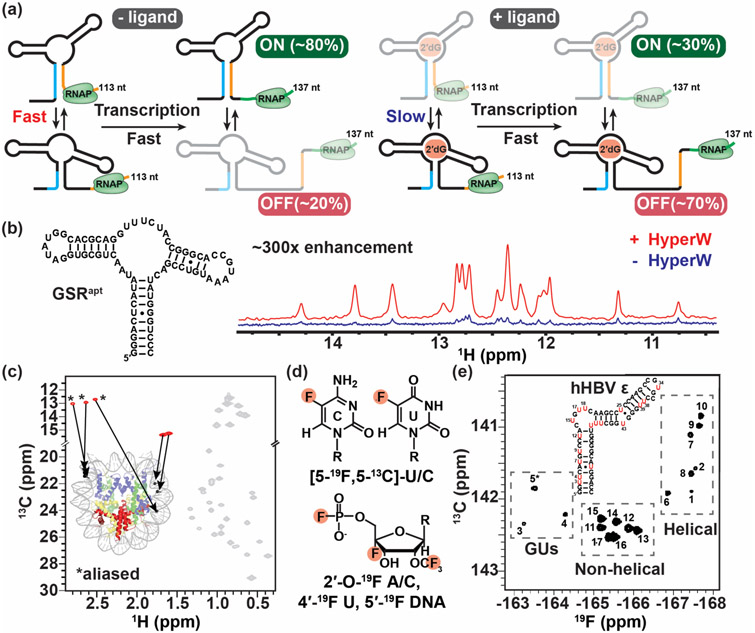
Nucleic acids do not fold into a single conformation, and dynamic ensembles are needed to describe their propensities to cycle between different conformations when performing cellular functions. We review recent advances in solution-state nuclear magnetic resonance (NMR) methods and their integration with computational techniques that are improving the ability to probe the dynamic ensembles of DNA and RNA. These include computational approaches for predicting chemical shifts from structure and generating conformational libraries from sequence, measurements of exact nuclear Overhauser effects, development of new probes to study chemical exchange using relaxation dispersion, faster and more sensitive real-time NMR techniques, and new NMR approaches to tackle large nucleic acid assemblies. We discuss how these advances are leading to new mechanistic insights into gene expression and regulation.
Keywords: Dynamic ensembles; Excited conformational states; Nucleic acids; Solution state NMR.
Copyright © 2021 Elsevier Ltd. All rights reserved.
Conflict of interest statement
Conflict of interest statement HMA is an adviser to and holds an ownership interest in Nymirum Inc., an RNA-based drug discovery company. The other authors declare no competing interests.
Figures

References
-
- Alderson TR, Kay LE: NMR spectroscopy captures the essential role of dynamics in regulating biomolecular function. Cell 2021, 184:577–595. - PubMed
-
- Frauenfelder H, Sligar SG, Wolynes PG: The energy landscapes and motions of proteins. Science 1991, 254:1598–1603. - PubMed
-
- Zhang Q, Stelzer AC, Fisher CK, Al-Hashimi HM: Visualizing spatially correlated dynamics that directs RNA conformational transitions. Nature 2007, 450:1263–1267. - PubMed
Publication types
MeSH terms
Substances
Grants and funding
LinkOut - more resources
Full Text Sources
Other Literature Sources
