


The intracellular environment affects protein-protein interactions
- PMID: 33836588
- PMCID: PMC7980425
- DOI: 10.1073/pnas.2019918118
The intracellular environment affects protein-protein interactions
Abstract
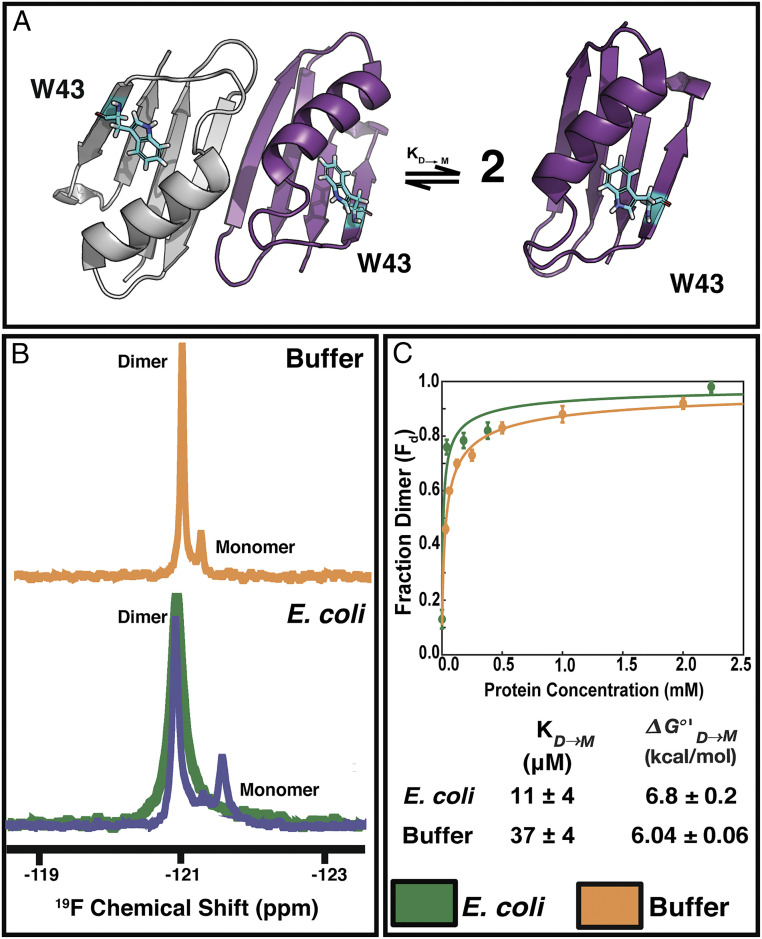
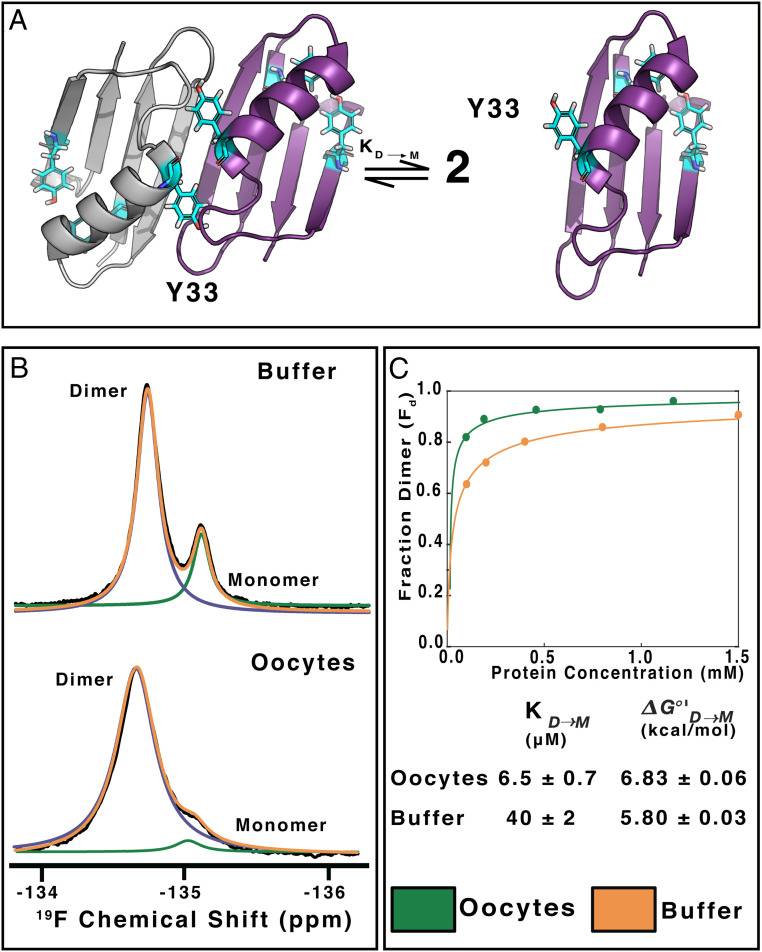
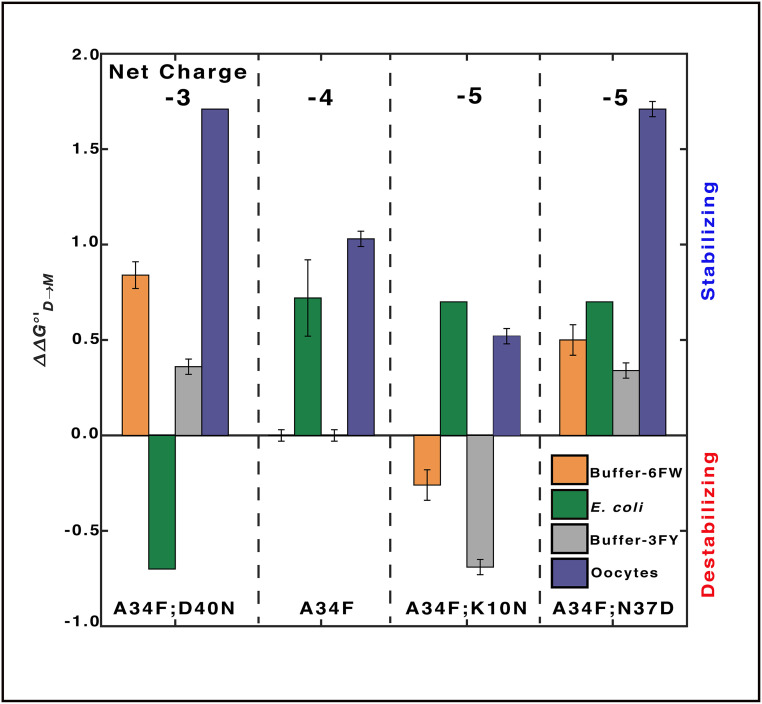
Protein-protein interactions are essential for life but rarely thermodynamically quantified in living cells. In vitro efforts show that protein complex stability is modulated by high concentrations of cosolutes, including synthetic polymers, proteins, and cell lysates via a combination of hard-core repulsions and chemical interactions. We quantified the stability of a model protein complex, the A34F GB1 homodimer, in buffer, Escherichia coli cells and Xenopus laevis oocytes. The complex is more stable in cells than in buffer and more stable in oocytes than E. coli Studies of several variants show that increasing the negative charge on the homodimer surface increases stability in cells. These data, taken together with the fact that oocytes are less crowded than E. coli cells, lead to the conclusion that chemical interactions are more important than hard-core repulsions under physiological conditions, a conclusion also gleaned from studies of protein stability in cells. Our studies have implications for understanding how promiscuous-and specific-interactions coherently evolve for a protein to properly function in the crowded cellular environment.
Keywords: macromolecular crowding; protein; protein–protein interactions; thermodynamics.
Conflict of interest statement
The authors declare no competing interest.
Figures
References
-
- van Holde K. E., Physical Biochemistry (Prentice Hall, 1985).
-
- Guseman A. J., Pielak G. J., “Protein stability and weak intracellular interactions” in In-Cell NMR Spectroscopy: From Molecular Sciences to Cell Biology, Ito Y., Dötsch V., Shirakawa M., Eds. (The Royal Society of Chemistry, 2019), pp. 188–206.
-
- Zimmerman S. B., Trach S. O., Estimation of macromolecule concentrations and excluded volume effects for the cytoplasm of Escherichia coli. J. Mol. Biol. 222, 599–620 (1991). - PubMed
Publication types
MeSH terms
Substances
Grants and funding
LinkOut - more resources
Full Text Sources
Other Literature Sources
