


Selenium source and level on performance, selenium retention and biochemical responses of young broiler chicks
- PMID: 33836766
- PMCID: PMC8033718
- DOI: 10.1186/s12917-021-02855-4
Selenium source and level on performance, selenium retention and biochemical responses of young broiler chicks
Abstract
Background: Selenium (Se) has been recognized as an essential micronutrient for nearly all forms of life. In recent decades, broiler responses to dietary Se supplemental levels and sources have received considerable attention. On environmental grounds, organic trace mineral utilization in practical broiler feeds has been defended due to its higher bioavailability. In such feeds, trace minerals are provided simultaneously in the same supplement as inorganic salts or organic chelates, a fact commonly ignored in assays conducted to validate organic trace mineral sources. The current assay aimed to investigate growth and biochemical responses, as well as Se retention of growing chicks fed diets supplemented with organic and inorganic Se levels and where the trace minerals (zinc, copper, manganese, and iron) were provided as organic chelates or inorganic salts according to Se source assessed. In so doing, a 2 × 5 factorial arrangement was used to investigate the effects of sodium selenite (SS) and selenium-yeast (SY) supplemented in feeds to provide the levels of 0, 0.08, 0.16, 0.24, and 0.32 mg Se/kg.
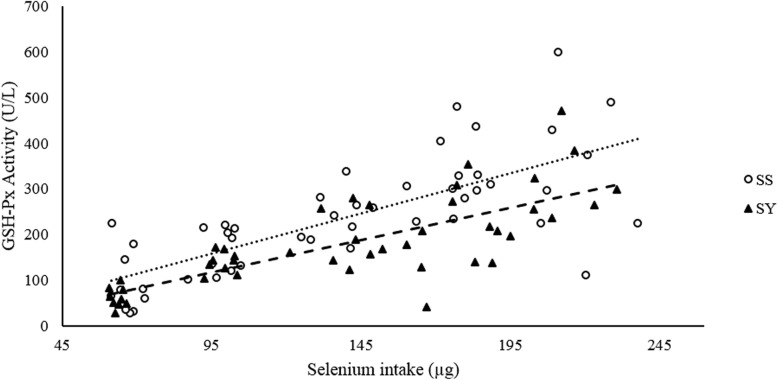
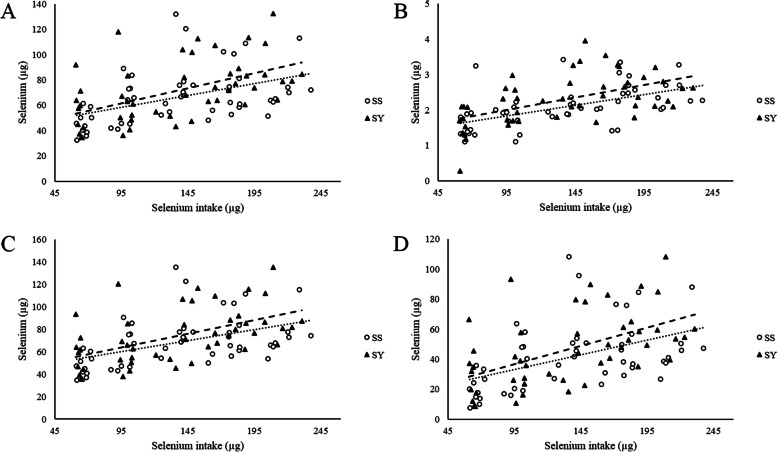
Results: Chicks fed selenium-yeast diets had body weight (BW), and average daily gain (ADG) maximized at 0.133 and 0.130 mg Se/kg, respectively. Both Se sources linearly increased (P < 0.05) the glutathione peroxidase (GSH-Px) activity in chick blood but higher values were observed in sodium selenite fed chicks (P < 0.05). Both Se sources influenced thyroid hormone serum concentrations (P < 0.05). Chicks fed SY exhibited greater retention of Se in the feathers (P < 0.05). Relative bioavailability of selenium yeast compared with SS for the Se content in carcass, feathers, total and Se retention were, 126, 116, 125 and 125%, respectively. SY supplementation resulted in lower liver Se concentration as Se supplementation increased (P < 0.05).
Conclusions: Based on performance traits, the supplemental level of organic Se as SY in organic trace minerals supplement to support the maximal growth of broiler chicks is 0.133 mg Se/kg.
Keywords: Glutathione peroxidase; Organic trace minerals; Selenium balance; Selenium yeast; Tissue mineralization.
Conflict of interest statement
JEP contracts with Alltech, the supplier of the selenium yeast used in this experiment, to supervise this research. The other authors declare that they have no competing interests.
Figures
References
-
- Rao SVR, Prakash B, Raju MVLN, Panda AK, Poonam S, Murthy OK. Effect of supplementing organic selenium on performance, carcass traits, oxidative parameters and immune responses in commercial broiler chickens. Asian Austral J Anim. 2013;26(2):247–252. doi: 10.5713/ajas.2012.12299. - DOI - PMC - PubMed
-
- Surai PF, Fisinin VI. Selenium in poultry breeder nutrition: an update. Anim Feed Sci Tech. 2014;191:1–15. doi: 10.1016/j.anifeedsci.2014.02.005. - DOI
-
- Wang YX, Xiao X, Zhan XA. Antagonistic effects of different selenium sources on growth inhibition, oxidative damage, and apoptosis induced by fluorine in broilers. Poult Sci. 2018. 10.3382/ps/pey192. - PubMed
MeSH terms
Substances
LinkOut - more resources
Full Text Sources
Other Literature Sources
