


Immune cells lacking Y chromosome show dysregulation of autosomal gene expression
- PMID: 33837451
- PMCID: PMC8106578
- DOI: 10.1007/s00018-021-03822-w
Immune cells lacking Y chromosome show dysregulation of autosomal gene expression
Abstract
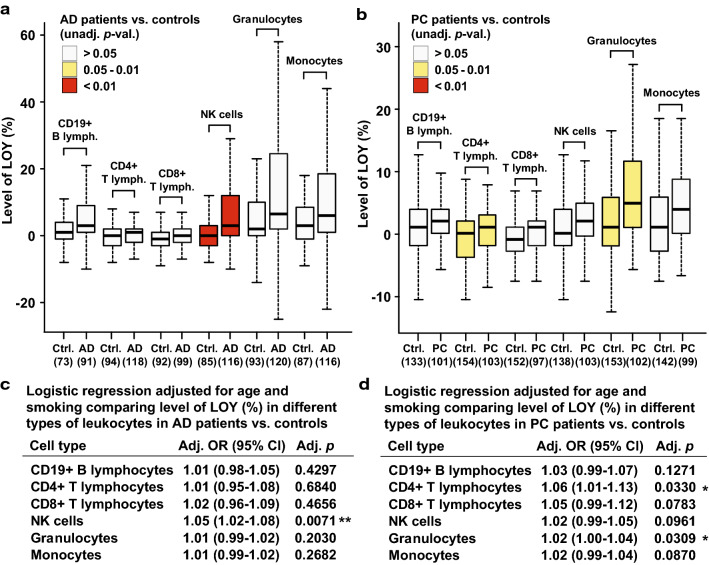
Epidemiological investigations show that mosaic loss of chromosome Y (LOY) in leukocytes is associated with earlier mortality and morbidity from many diseases in men. LOY is the most common acquired mutation and is associated with aberrant clonal expansion of cells, yet it remains unclear whether this mosaicism exerts a direct physiological effect. We studied DNA and RNA from leukocytes in sorted- and single-cells in vivo and in vitro. DNA analyses of sorted cells showed that men diagnosed with Alzheimer's disease was primarily affected with LOY in NK cells whereas prostate cancer patients more frequently displayed LOY in CD4 + T cells and granulocytes. Moreover, bulk and single-cell RNA sequencing in leukocytes allowed scoring of LOY from mRNA data and confirmed considerable variation in the rate of LOY across individuals and cell types. LOY-associated transcriptional effect (LATE) was observed in ~ 500 autosomal genes showing dysregulation in leukocytes with LOY. The fraction of LATE genes within specific cell types was substantially larger than the fraction of LATE genes shared between different subsets of leukocytes, suggesting that LOY might have pleiotropic effects. LATE genes are involved in immune functions but also encode proteins with roles in other diverse biological processes. Our findings highlight a surprisingly broad role for chromosome Y, challenging the view of it as a "genetic wasteland", and support the hypothesis that altered immune function in leukocytes could be a mechanism linking LOY to increased risk for disease.
Keywords: Differential gene expression; LATE; LOY; LOY-associated transcriptional effects; Mosaic loss of chromosome Y.
Conflict of interest statement
J.P.D. and L.A.F. are cofounders and shareholders in Cray Innovation AB.
Figures
References
-
- Wright DJ, Day FR, Kerrison ND, Zink F, Cardona A, Sulem P, Thompson DJ, Sigurjonsdottir S, Gudbjartsson DF, Helgason A, Chapman JR, Jackson SP, Langenberg C, Wareham NJ, Scott RA, Thorsteindottir U, Ong KK, Stefansson K, Perry JRB. Genetic variants associated with mosaic Y chromosome loss highlight cell cycle genes and overlap with cancer susceptibility. Nat Genet. 2017;49(5):674–679. doi: 10.1038/ng.3821. - DOI - PMC - PubMed
-
- Thompson DJ, Genovese G, Halvardson J, Ulirsch JC, Wright DJ, Terao C, Davidsson OB, Day FR, Sulem P, Jiang Y, Danielsson M, Davies H, Dennis J, Dunlop MG, Easton DF, Fisher VA, Zink F, Houlston RS, Ingelsson M, Kar S, Kerrison ND, Kinnersley B, Kristjansson RP, Law PJ, Li R, Loveday C, Mattisson J, McCarroll SA, Murakami Y, Murray A, Olszewski P, Rychlicka-Buniowska E, Scott RA, Thorsteinsdottir U, Tomlinson I, Moghadam BT, Turnbull C, Wareham NJ, Gudbjartsson DF, International Lung Cancer C. Breast Cancer Association C. Consortium of Investigators of Modifiers of B. Endometrial Cancer Association C. Ovarian Cancer Association C. Prostate Cancer Association Group to Investigate Cancer Associated Alterations in the Genome C. Kidney Cancer GM-AP. e QC. Biobank-based Integrative Omics Study C. Me Research T. Kamatani Y, Hoffmann ER, Jackson SP, Stefansson K, Auton A, Ong KK, Machiela MJ, Loh PR, Dumanski JP, Chanock SJ, Forsberg LA, Perry JRB. Genetic predisposition to mosaic Y chromosome loss in blood. Nature. 2019;575(7784):652–657. doi: 10.1038/s41586-019-1765-3. - DOI - PMC - PubMed
-
- Forsberg L, Halvardson J, Rychlicka E, Danielsson M, Torabi Moghadam B, Mattisson J, Rasi C, Davies H, Lind L, Giedraitis V, Lannfelt L, Kilander L, Ingelsson M, Dumanski J. Mosaic loss of chromosome Y (LOY) in leukocytes matters. Nat Genet. 2019;51(1):4–7. doi: 10.1038/s41588-018-0267-9. - DOI - PubMed
MeSH terms
Grants and funding
LinkOut - more resources
Full Text Sources
Other Literature Sources
Medical
Research Materials
