


The impact of mild-to-severe hearing loss on the neural dynamics serving verbal working memory processing in children
- PMID: 33838545
- PMCID: PMC8056458
- DOI: 10.1016/j.nicl.2021.102647
The impact of mild-to-severe hearing loss on the neural dynamics serving verbal working memory processing in children
Abstract
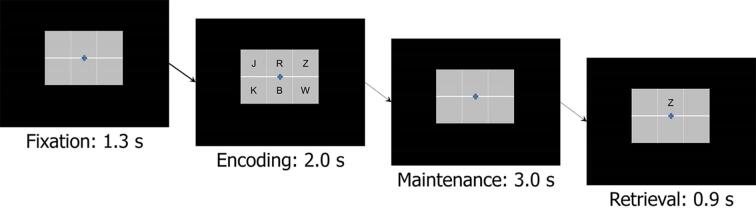
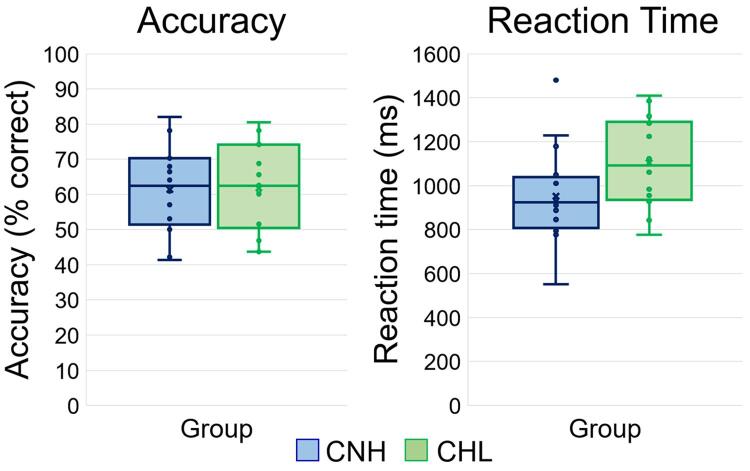
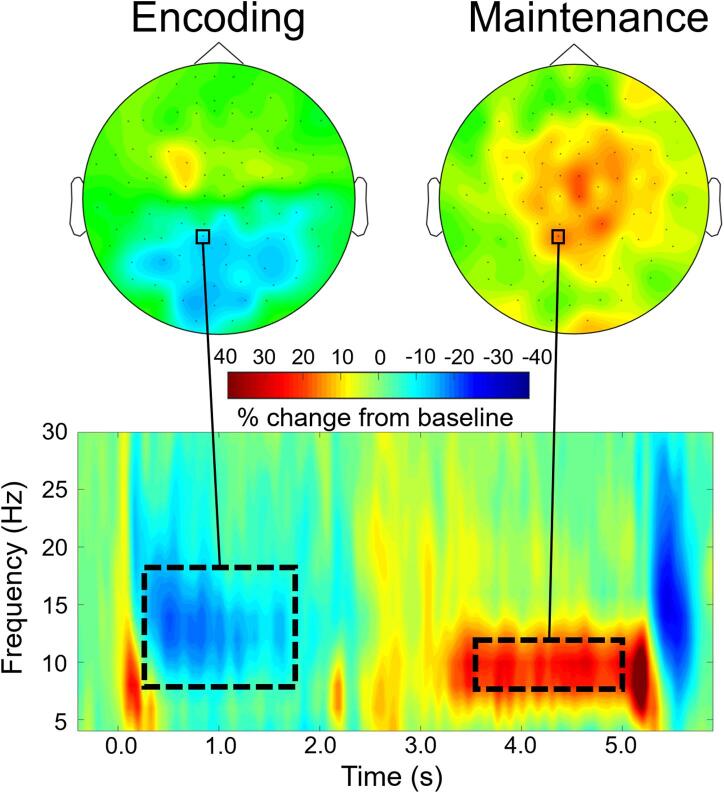
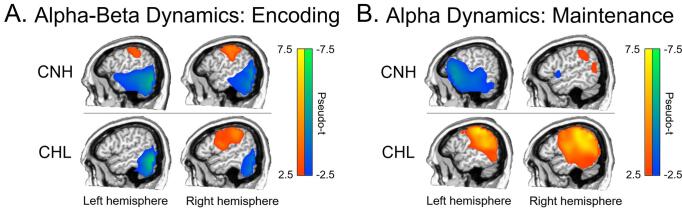
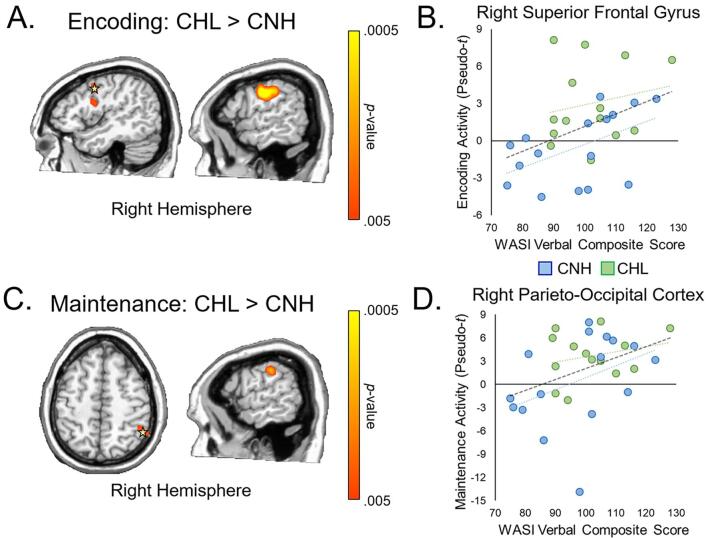
Children with hearing loss (CHL) exhibit delays in language function relative to children with normal hearing (CNH). However, evidence on whether these delays extend into other cognitive domains such as working memory is mixed, with some studies showing decrements in CHL and others showing CHL performing at the level of CNH. Despite the growing literature investigating the impact of hearing loss on cognitive and language development, studies of the neural dynamics that underlie these cognitive processes are notably absent. This study sought to identify the oscillatory neural responses serving verbal working memory processing in CHL compared to CNH. To this end, participants with and without hearing loss performed a verbal working memory task during magnetoencephalography. Neural oscillatory responses associated with working memory encoding and maintenance were imaged separately, and these responses were statistically evaluated between CHL and CNH. While CHL performed as well on the task as CNH, CHL exhibited significantly elevated alpha-beta activity in the right frontal and precentral cortices during encoding relative to CNH. In contrast, CHL showed elevated alpha maintenance-related activity in the right precentral and parieto-occipital cortices. Crucially, right superior frontal encoding activity and right parieto-occipital maintenance activity correlated with language ability across groups. These data suggest that CHL may utilize compensatory right-hemispheric activity to achieve verbal working memory function at the level of CNH. Neural behavior in these regions may impact language function during crucial developmental ages.
Keywords: Audiology; Cognition; Hearing aids; Neurophysiology; Oscillations.
Copyright © 2021 The Authors. Published by Elsevier Inc. All rights reserved.
Conflict of interest statement
The authors report no conflicts of interest. This work was supported by the National Institutes of Health (R01-DC013591 to RWM). The funders had no role in study design, data collection and analysis, decision to publish, or preparation of the manuscript.
Figures
References
-
- Akeroyd M.A. Are individual differences in speech reception related to individual differences in cognitive ability? A survey of twenty experimental studies with normal and hearing-impaired adults. Int. J. Audiol. 2008;47(Suppl 2):S53–S71. - PubMed
-
- Baddeley A. Working memory. Science. 1992;255(5044):556–559. - PubMed
-
- Baddeley A. The episodic buffer: a new component of working memory? Trends Cogn. Sci. 2000;4(11):417–423. - PubMed
-
- Baddeley A. Working memory and language: an overview. J. Commun. Disord. 2003;36(3):189–208. - PubMed
-
- Baddeley A. Working memory: looking back and looking forward. Nat. Rev. Neurosci. 2003;4(10):829–839. - PubMed
Publication types
MeSH terms
Grants and funding
LinkOut - more resources
Full Text Sources
Other Literature Sources
Medical
