


Trends and Patterns of Tobacco and Nicotine Product Use Among Youth in Canada, England, and the United States From 2017 to 2019
- PMID: 33839006
- PMCID: PMC8403620
- DOI: 10.1016/j.jadohealth.2021.02.011
Trends and Patterns of Tobacco and Nicotine Product Use Among Youth in Canada, England, and the United States From 2017 to 2019
Abstract
Purpose: The tobacco and nicotine market is diversifying. Implications for public health will depend on trends in use, including overall use, and who is using these products. This study examined differences over time (2017-2019), across countries (Canada, England, the United States (US)), and by smoking and vaping, in use of other tobacco/nicotine products and overall use.
Methods: The study includes online repeat cross-sectional surveys of youth aged 16-19 years in Canada (N = 11,714), England (N = 11,170), US (N = 11,838) in 2017, 2018, and 2019. Past 30-day use of tobacco/nicotine products (any, cigarette, e-cigarette, other combusted [cigars/cigarillos/waterpipe], other non-combusted [smokeless tobacco/nicotine replacement therapies) were examined by country, year, and, for other combusted and non-combusted products, past 30-day cigarette smoking and vaping. Use of emerging products (IQOS, nicotine pouches) was explored in 2018-2019.
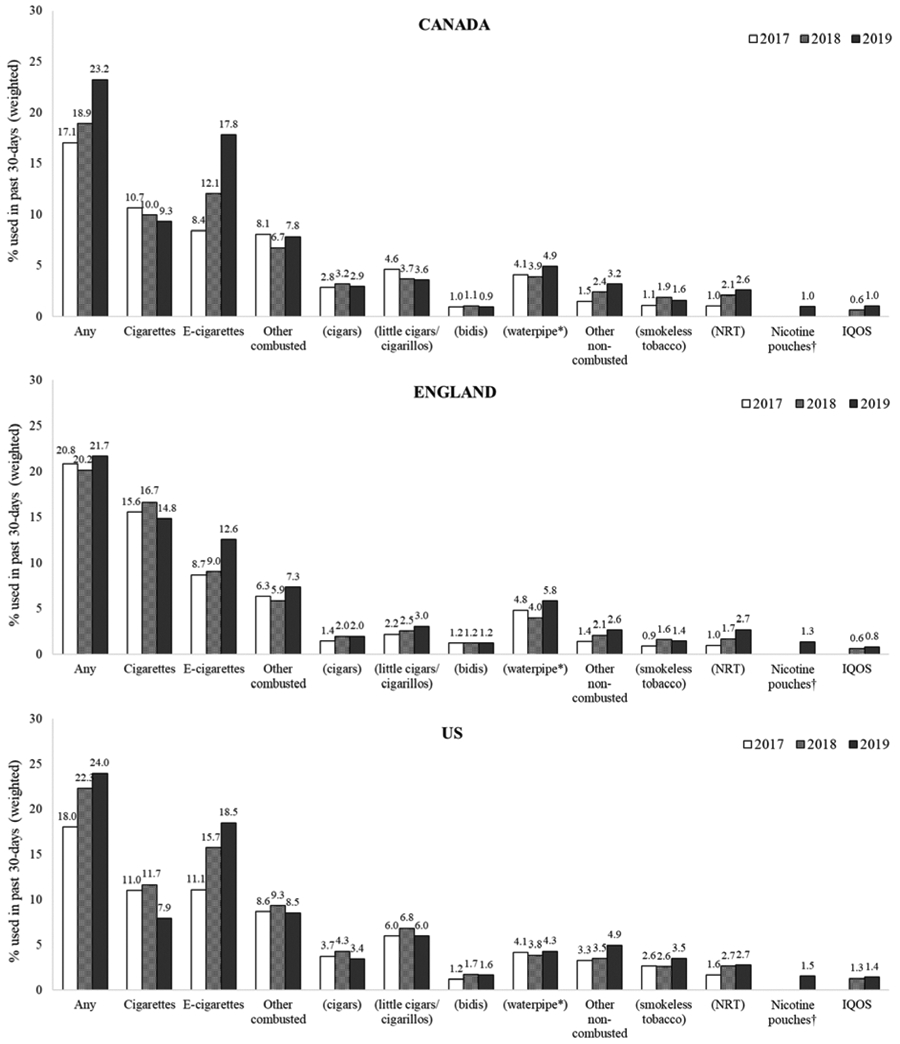
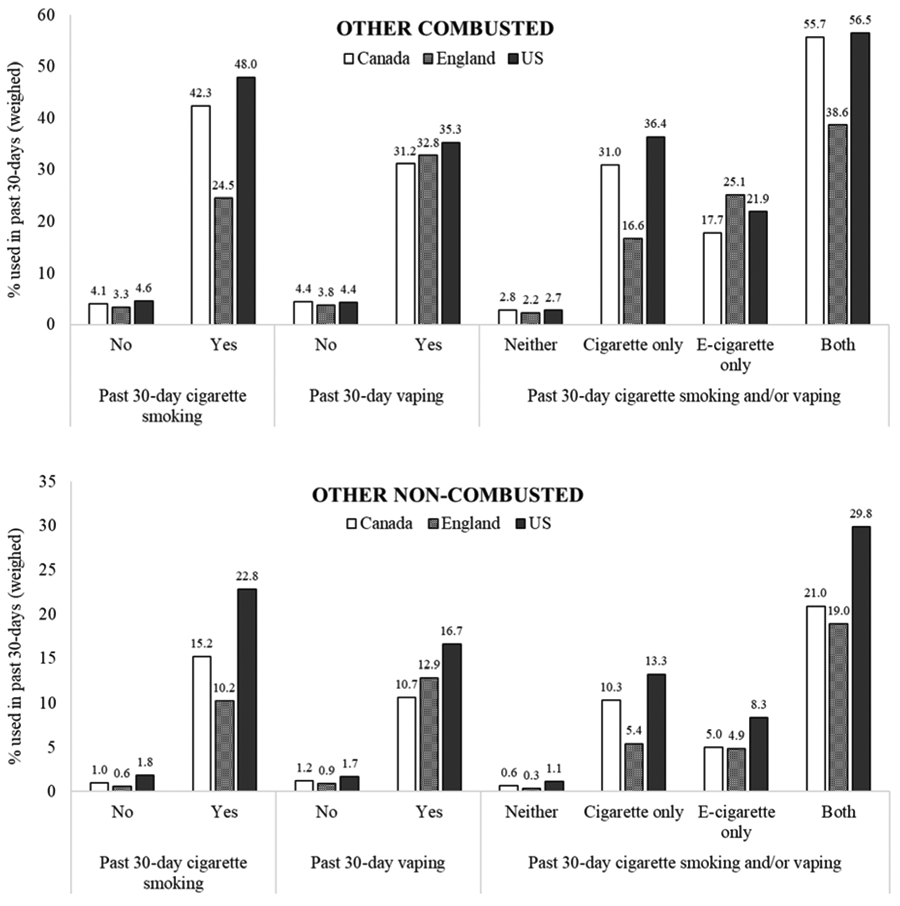
Results: From 2017 to 2019, use of any product increased in Canada (17.1%-23.2%, AOR = 1.07 [95% CI = 1.04-1.09]) and the US (18.0%-24.0%, AOR = 1.06 [1.04-1.09]) but not England (20.8%-21.7%, AOR = 1.01 [.99-1.03]). Use of other combusted products (cigars/cigarillos/waterpipe) showed little change (Canada: 8.1%-7.8%; England: 6.3%-7.3%; US: 8.6%-8.5%; p ≥ .151). Use of other non-combusted products (smokeless/nicotine replacement therapies) increased in all countries (Canada: 1.5%-3.2%, AOR = 1.02 [1.01-1.02]; England: 1.4%-2.6%, AOR = 1.02 [1.01-1.03]; US: 3.3%-4.9%, AOR = 1.02 [1.01-1.02]). Vaping increased in all countries (Canada: 8.4%-17.8%; England: 8.7%-12.6%; United States: 11.1%-18.5%; all p < .001). Smokers and vapers reported greater use of other combusted and non-combusted products than those who neither smoked/vaped (p < .001). Emerging product use was rare (≤1.5%).
Conclusions: Youth past 30-day tobacco and nicotine product use increased from 2017 to 2019 in Canada and the United States, largely due to increases in vaping and other non-combusted products. "Other" tobacco/nicotine products were used predominantly by youth who smoked cigarettes and/or vaped.
Keywords: Adolescent; Electronic nicotine delivery systems; Nicotine; Prevalence; Smoking; Surveys and questionnaires; Tobacco products.
Copyright © 2021 Society for Adolescent Health and Medicine. Published by Elsevier Inc. All rights reserved.
Conflict of interest statement
Figures
References
-
- Levy DT, Mumford EA, Cummings KM, Gilpin EA, Giovino G, Hyland A, Sweanor D, Warner KE. The Relative Risks of a Low-Nitrosamine Smokeless Tobacco Product Compared with Smoking Cigarettes: Estimates of a Panel of Experts. Cancer Epidemiol Biomarkers Prev. 2004. doi. - PubMed
-
- McNeill A, Brose LS, Calder R, Bauld L, Robson D. Vaping in England: an evidence update including mental health and pregnancy, March 2020: A report commissioned by Public Health England. 2020. https://www.gov.uk/government/publications/vaping-in-england-evidence-up....
Publication types
MeSH terms
Substances
Grants and funding
LinkOut - more resources
Full Text Sources
Other Literature Sources
Medical
Miscellaneous
