


Gene therapy for ALS: A review
- PMID: 33839324
- PMCID: PMC8636154
- DOI: 10.1016/j.ymthe.2021.04.008
Gene therapy for ALS: A review
Abstract
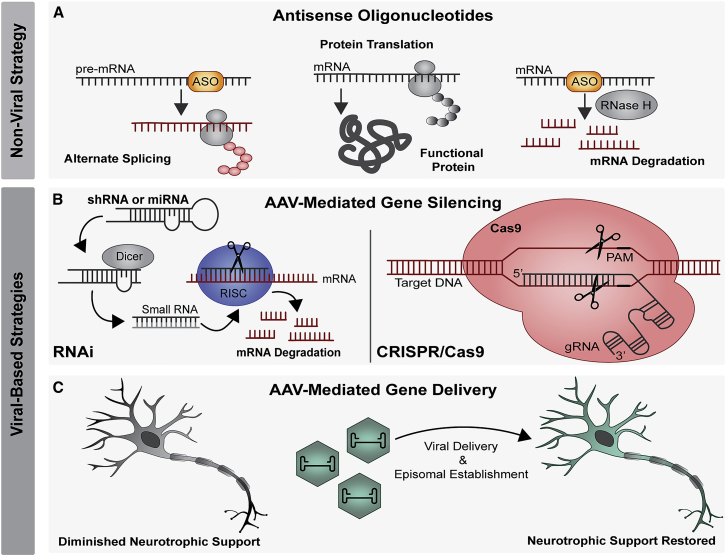
Amyotrophic lateral sclerosis (ALS) has historically posed unique challenges for gene-therapy-based approaches, due to a paucity of therapeutic targets as well as the difficulty of accessing both the brain and spinal cord. Recent advances in our understanding of disease mechanism and ALS genetics, however, have combined with tremendous strides in CNS targeting, gene delivery, and gene editing and knockdown techniques to open new horizons of therapeutic possibility. Gene therapy clinical trials are currently underway for ALS patients with SOD1 mutations, C9orf72 hexanucleotide repeat expansions, ATXN2 trinucleotide expansions, and FUS mutations, as well as sporadic disease without known genetic cause. In this review, we provide an in-depth exploration of the state of ALS-directed gene therapy, including antisense oligonucleotides, RNA interference, CRISPR, adeno-associated virus (AAV)-mediated trophic support, and antibody-based methods. We discuss how each of these approaches has been implemented across known genetic causes as well as sporadic ALS, reviewing preclinical studies as well as completed and ongoing human clinical trials. We highlight the transformative potential of these evolving technologies as the gene therapy field advances toward a true disease-modifying treatment for this devastating illness.
Keywords: AAV; ALS; ASO; CRISPR; RNAi; amyotrophic lateral sclerosis; clinical trial; gene delivery; gene therapy.
Copyright © 2021 The Authors. Published by Elsevier Inc. All rights reserved.
Conflict of interest statement
Declaration of interests B.L.D. is a founder of Spark Therapeutics and Spirovant Sciences and is on the SAB of Patch Bio, Resilience, Saliogen Therapeutics, Panorama Medicines, Homology Medicines, and Spirovant Sciences.
Figures
References
-
- Oskarsson B., Gendron T.F., Staff N.P. Amyotrophic Lateral Sclerosis: An Update for 2018. Mayo Clin. Proc. 2018;93:1617–1628. - PubMed
-
- Chen J.J. Overview of current and emerging therapies for amytrophic lateral sclerosis. Am. J. Manag. Care. 2020;26(9, Suppl):S191–S197. - PubMed
-
- Bensimon G., Lacomblez L., Meininger V., ALS/Riluzole Study Group A controlled trial of riluzole in amyotrophic lateral sclerosis. N. Engl. J. Med. 1994;330:585–591. - PubMed
Publication types
MeSH terms
Substances
Grants and funding
LinkOut - more resources
Full Text Sources
Other Literature Sources
Medical
Miscellaneous
