


Examining brief and ultra-brief anxiety and depression screening methods in a real-world epilepsy clinic sample
- PMID: 33839449
- PMCID: PMC8477167
- DOI: 10.1016/j.yebeh.2021.107943
Examining brief and ultra-brief anxiety and depression screening methods in a real-world epilepsy clinic sample
Abstract
Objective: Recent epilepsy quality measure recommendations for depression and anxiety screening endorse ultra-brief screeners, the Patient Health Questionnaire-2 (PHQ-2) and Generalized Anxiety Disorder-2 (GAD-2). Thus, it is important to assess how symptom detection may be affected using ultra-brief screeners compared with slightly longer, well-validated instruments: Neurological Disorders Depression Inventory-Epilepsy (NDDI-E) and Generalized Anxiety Disorder-7 (GAD-7). The objective was to compare symptom detection by brief versus ultra-brief depression and anxiety screeners in a large real-world epilepsy clinic sample.
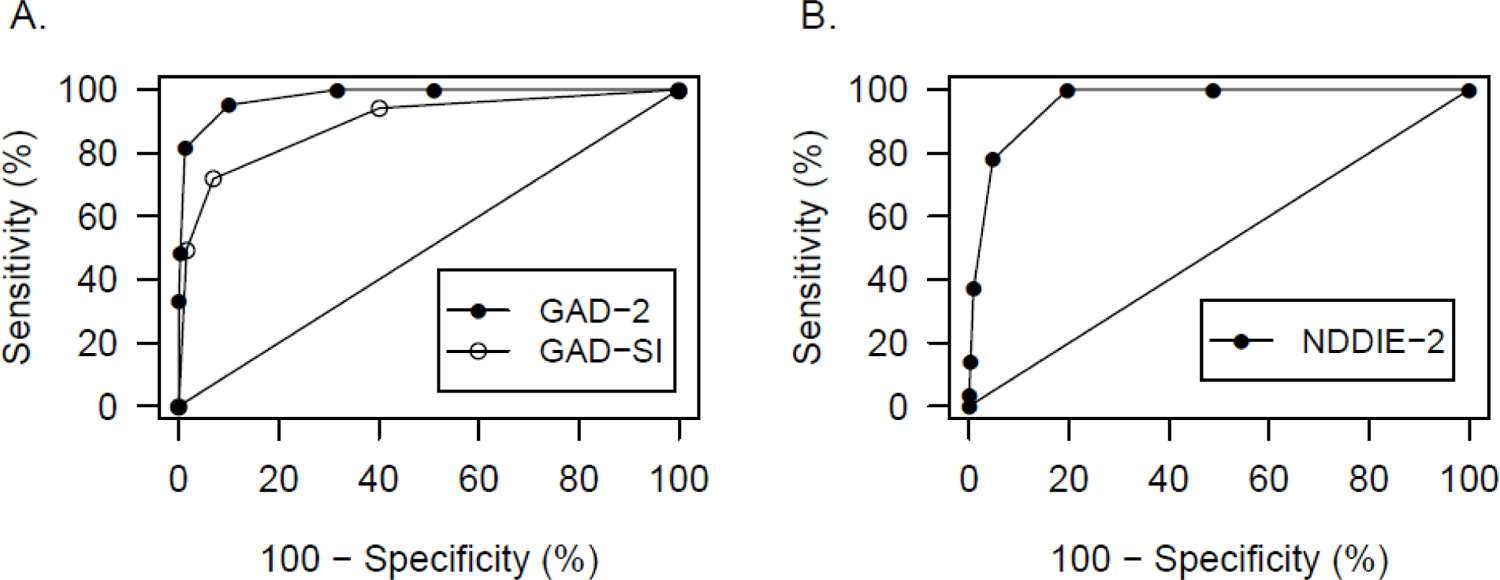
Methods: This was a prospective, cross-sectional assessment of consecutive patients in an adult tertiary epilepsy practice who completed the GAD-7 and NDDI-E with embedded ultra-brief scales (GAD-2; GAD-Single Item: GAD-SI; NDDI-E 2 item: NDDIE-2) on a tablet and had clinic staff administered ultra-brief PHQ-2 (yes/no version) documented in the medical record at the same visit. Prevalences of positive anxiety and depression screens were calculated for each instrument overall, and by epilepsy status. Concordance correlation coefficients (CCC) were calculated comparing the ultra-brief with brief anxiety and depression instruments, and receiver operating curves (ROC) were calculated using the longer instruments as alternative standards.
Results: Among N = 422 individuals the prevalence of positive anxiety screen by GAD-7 was 24% and positive depression screen by NDDI-E was 20%. Positive anxiety and depression screens were significantly less prevalent among seizure-free individuals than those with continued seizures. The verbally administered yes/no PHQ-2 had only 1 positive screen (0.2%). Other than poor concordance between the PHQ-2 and NDDI-E, the screener pairs had acceptable concordance (CCC 0.79 to 0.92). Areas under the ROC curves were acceptable for the NDDIE-2, GAD-2 and GAD-SI (0.96, 0.98, and 0.89, respectively).
Significance: In this sample, clinic staff interview-administered yes/no PHQ-2 had exceedingly low sensitivity compared with the NDDI-E self-reported on a tablet. Further investigation is warranted to assess if poor detection is due to characteristics of this PHQ-2 in epilepsy samples, or method of administration in this clinic. The other ultra-brief anxiety and depression instruments demonstrated good concordance with the longer, well-validated instruments and may be useful in clinical practice.
Keywords: Anxiety; Depression; Epilepsy clinic; Learning health system; Psychiatric comorbidity; Screening instruments.
Copyright © 2021 Elsevier Inc. All rights reserved.
Conflict of interest statement
Declaration of Competing Interest Dr. Conner has served as a paid consultant as member of Epilepsy Council and Advisory Board for SK Life Sciences, Inc. She is also a paid consultant serving on an Advanced Practice Provider (APP) advisory board for Neurelis, Inc. She serves in a volunteer role for the American Epilepsy Society as Vice Chair of the APP Committee. Dr. Duncan reports grants from Agency for Healthcare Research and Quality, Patient Centered Outcomes Research Institute, National Institute of Aging, National Institute Nursing Research, during the conduct of the study; Founding Partner of Care Directions, LLC., outside the submitted work. The remaining authors have no declarations of interest.
Figures
References
-
- Patel AD, Baca C, Franklin G, Herman ST, Hughes I, Meunier L, Moura L, Munger Clary H, Parker-McFadden B, Pugh MJ, Schultz RJ, Spanaki MV, Bennett A, Josephson SA. Quality improvement in neurology: Epilepsy Quality Measurement Set 2017 update. Neurology 2018;91: 829–836. - PubMed
-
- Siu AL, Force USPST, Bibbins-Domingo K, Grossman DC, Baumann LC, Davidson KW, Ebell M, Garcia FA, Gillman M, Herzstein J, Kemper AR, Krist AH, Kurth AE, Owens DK, Phillips WR, Phipps MG, Pignone MP. Screening for Depression in Adults: US Preventive Services Task Force Recommendation Statement. JAMA 2016;315: 380–7. - PubMed
-
- Gill SJ, Lukmanji S, Fiest KM, Patten SB, Wiebe S, Jette N. Depression screening tools in persons with epilepsy: A systematic review of validated tools. Epilepsia 2017;58: 695–705. - PubMed
-
- Micoulaud-Franchi JA, Lagarde S, Barkate G, Dufournet B, Besancon C, Trebuchon-Da Fonseca A, Gavaret M, Bartolomei F, Bonini F, McGonigal A. Rapid detection of generalized anxiety disorder and major depression in epilepsy: Validation of the GAD-7 as a complementary tool to the NDDI-E in a French sample. Epilepsy Behav 2016;57: 211–216. - PubMed
Publication types
MeSH terms
Grants and funding
LinkOut - more resources
Full Text Sources
Other Literature Sources
Medical
